
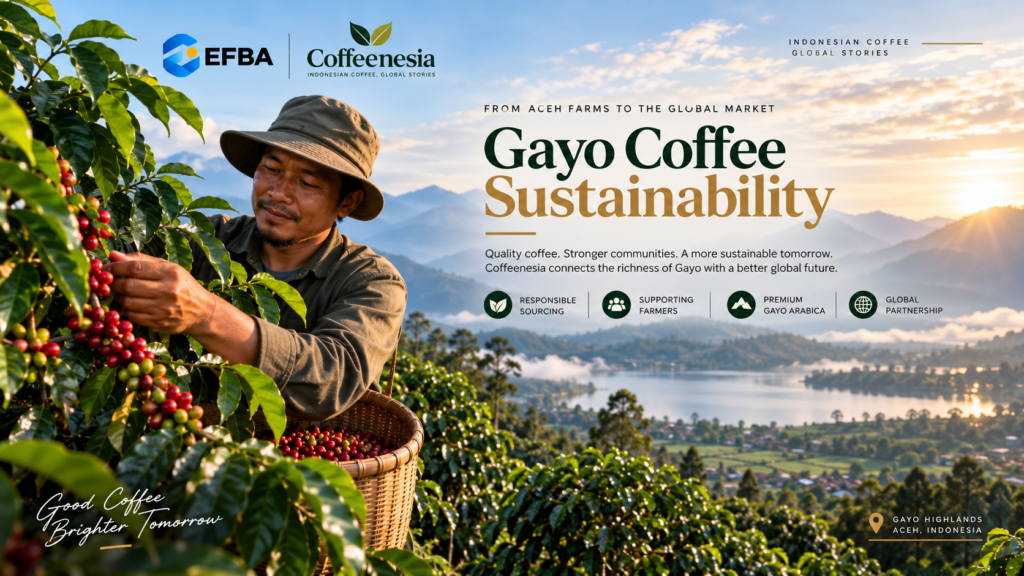
Gayo coffee sustainability is becoming increasingly important for coffee importers, specialty roasters, distributors, cafés, beverage companies, and brands sourcing Indonesian coffee. Buyers are no longer evaluating coffee only through flavor, price, origin, and processing method because long-term supply also depends on farm productivity, farmer resilience, soil health, climate adaptation, post-harvest management, traceability, quality consistency, and access to international markets. For Gayo coffee from Aceh, these factors are closely connected because changes at farm level can eventually influence quality, availability, sourcing risk, and commercial continuity.
Gayo coffee originates from the highlands of Aceh, one of Indonesia’s important Arabica-producing landscapes. However, maintaining the value of this origin requires more than producing excellent coffee during a single harvest. Coffee farms need to remain productive, farming communities need economically viable livelihoods, agricultural landscapes need to support future production, and post-harvest systems need to preserve quality efficiently. Therefore, sustainability is best understood as a connected journey from Farm → Harvest → Processing → Quality Control → Traceability → Buyer → Global Market.
For Coffeenesia, this perspective is particularly relevant because its published company information focuses on coffee and cascara connected with Gayo, Aceh, Indonesia. Coffeenesia’s role in the topic is not simply to describe sustainability as a marketing term, but to help buyers understand how origin, coffee quality, processing, cascara utilization, traceability, and commercial sourcing can connect within the broader Gayo coffee value chain. This guide therefore combines Coffeenesia’s published sourcing perspective with independent information from institutions including WRI Indonesia, Bank Indonesia, and the European Commission.
What Is Gayo Coffee Sustainability?
Gayo coffee sustainability refers to the long-term ability of the Gayo coffee ecosystem to produce quality coffee while supporting environmental, economic, agricultural, and social resilience. Sustainability is therefore broader than one farming technique, certification, environmental claim, or processing method. It can include soil and land management, agroforestry, climate adaptation, farm productivity, farmer livelihoods, selective harvesting, post-harvest efficiency, coffee by-product utilization, traceability, quality control, and access to viable markets.
These factors are interconnected rather than independent. Declining soil condition can affect plant health and productivity, while lower productivity can reduce farm income and make investment in rehabilitation more difficult. At the same time, better farm management combined with careful harvesting, stronger post-harvest practices, quality control, and market access can create greater value from an existing coffee-growing landscape. Sustainable coffee should consequently be evaluated as a system rather than as a single environmental action.
This broader interpretation is also reflected in WRI Indonesia’s Sustainable Gayo Coffee Project in Bener Meriah, Aceh. The initiative focuses on improving Gayo coffee productivity and quality while aligning production with sustainability principles and strengthening farmers’ capacity to implement more sustainable practices. For buyers researching sustainable Gayo coffee, this provides independent evidence that sustainability is being addressed at landscape and farming-community level, rather than functioning only as a marketing concept.
Why Sustainability Matters for Gayo Coffee
The Gayo Highlands represent a major Indonesian coffee-growing landscape, but land area alone does not guarantee long-term productivity. In August 2026, Bank Indonesia reported that approximately 120,000 hectares of coffee plantations extend across the Gayo Highlands. The same publication reported average farmer productivity of approximately 750 kilograms per hectare per year, compared with estimated potential productivity of approximately 1.5–2 tonnes per hectare annually.
This productivity gap helps explain why sustainability cannot simply mean expanding coffee-growing land. Improving plant health, farming knowledge, soil management, farm rehabilitation, harvesting, post-harvest quality, and access to markets can be equally important for increasing value from existing farms. Sustainable development therefore needs to balance productivity with the ability of farms and surrounding landscapes to continue supporting coffee production over future harvest cycles.
Climate pressure adds another dimension. WRI Indonesia reported in June 2026 that rising temperatures, shifting weather patterns, and increasingly unpredictable seasons are affecting coffee production and quality in Bener Meriah. Average green-bean productivity among farmers discussed by WRI was approximately 600–750 kg per hectare annually, while the organization linked climate pressure and unsustainable cultivation practices with greater vulnerability for coffee landscapes and farming communities.
For global coffee buyers, these are not only environmental concerns because they can eventually become sourcing concerns. Farm productivity, climate resilience, farmer continuity, processing capacity, and landscape health can influence future availability, quality consistency, price pressure, and supply reliability. Therefore, Gayo coffee sustainability is directly connected with long-term supply-chain resilience.
7 Core Pillars of Sustainable Gayo Coffee
A practical way to understand sustainable Gayo coffee is to examine the major stages connecting farms in Aceh with commercial buyers. Sustainability begins before the coffee cherry is harvested and continues through processing, quality control, traceability, packaging, sourcing, and market relationships. The following seven pillars combine the environmental, agricultural, economic, and commercial dimensions that can influence whether the Gayo coffee ecosystem remains viable over time.
1. Sustainable Coffee Begins at Farm Level
Every cup of Gayo coffee begins with agricultural decisions. Soil conditions, plant health, shade, pruning, nutrition, pest management, coffee-tree age, harvesting practices, and local environmental conditions can all influence both productivity and potential quality. Sustainable farming therefore aims to maintain the agricultural foundation of coffee production across multiple harvest cycles instead of maximizing one season at the expense of future farm performance.
Depending on farm conditions, this can involve improved soil management, responsible agricultural inputs, plant rehabilitation, replanting, erosion management, appropriate shade, integrated pest management, and stronger farmer knowledge. WRI Indonesia’s work in Bener Meriah includes field-school activities related to Good Agricultural Practices and sustainable coffee production, demonstrating how broad sustainability objectives can be translated into practical farm-management decisions. For international buyers, these origin-level practices provide important context about the agricultural system behind the coffee they purchase.
2. Agroforestry and Climate Resilience
Agroforestry can form part of a more resilient coffee-growing system when it is appropriately designed for local conditions. Coffee can grow alongside shade trees and other vegetation, potentially supporting vegetation diversity, microclimate management, soil protection, and additional farm resources. However, agroforestry is not a single universal formula because tree species, shade density, coffee variety, elevation, soil, water, and farm-management capacity all influence how a particular system performs.
This becomes increasingly relevant as coffee-growing areas respond to climate pressure. Arabica coffee is sensitive to environmental conditions, while changing rainfall, temperature, flowering cycles, pests, disease, and extreme weather can affect both yield and quality. WRI Indonesia specifically includes agroforestry, land conservation, and climate-adaptive farming within its Sustainable Gayo Coffee work, providing a useful independent example of how resilience is being addressed in the Gayo landscape.
For buyers, climate resilience adds a long-term dimension to supplier and origin evaluation. A coffee may perform well today, but commercial relationships often continue across several harvest cycles. Understanding how an origin is responding to environmental risk can therefore complement traditional purchasing criteria such as flavor, processing, specification, price, volume, and logistics.
3. Farmer Productivity and Economic Resilience
Environmental sustainability cannot be separated from farmer economics because coffee farms need sufficient value to remain productive. When farming generates inadequate returns, producers can find it more difficult to invest in plant maintenance, rehabilitation, equipment, harvesting, post-harvest infrastructure, or quality improvement. Over time, weak economic incentives can also influence whether younger generations see coffee farming as a viable livelihood.
Improving productivity should consequently mean more than maximizing volume. Better farm management, healthier plants, efficient harvesting, quality-focused processing, stronger market access, and reduced avoidable losses can help farms create more value from existing land. This connection explains why sustainable coffee initiatives increasingly combine environmental interventions with farmer capacity and economic resilience rather than treating these subjects separately.
For Coffeenesia and other businesses connecting Gayo coffee with buyers, this origin-level context matters because long-term commercial supply ultimately depends on the people managing the coffee landscape. Buyers evaluating Indonesian specialty coffee can therefore consider farmer resilience alongside cup quality and price when thinking about long-term sourcing relationships.
4. Selective Harvesting and Quality
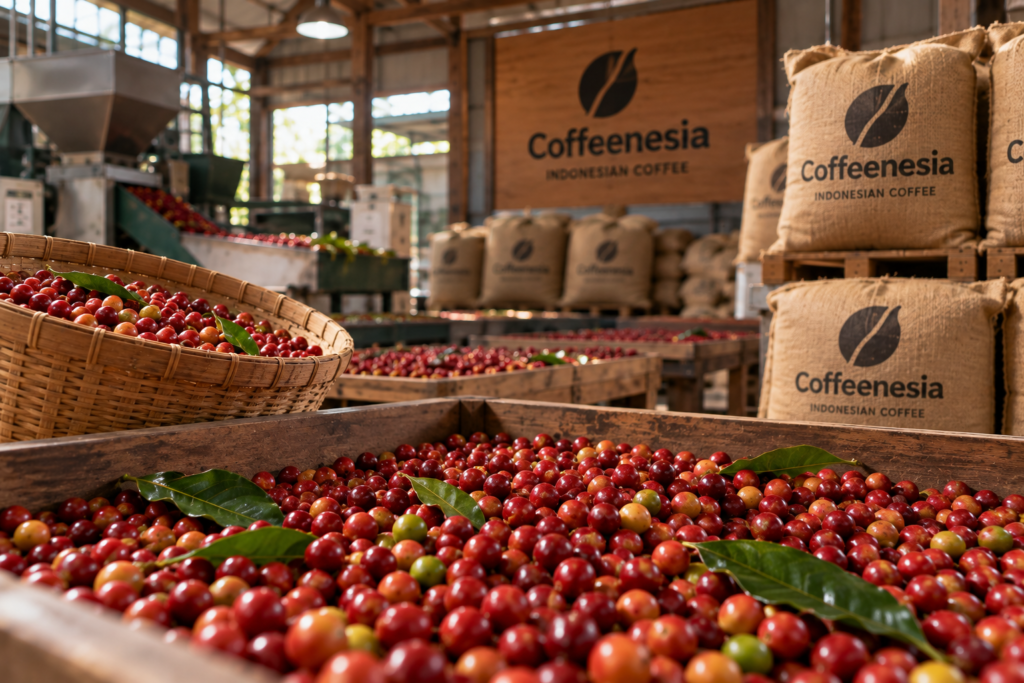
Sustainability continues into harvesting because the way coffee cherries are selected can influence both quality and resource efficiency. Coffee cherries do not necessarily mature at the same time, and excessive inclusion of immature, overripe, or defective cherries can increase sorting requirements and affect final quality. Selective harvesting therefore aims to prioritize appropriately mature cherries so that more of the harvested material has the potential to meet the intended product specification.
Coffeenesia describes ripe-red-cherry selection within its published sourcing and production process for Gayo-origin products. This illustrates an important principle: sustainable coffee production is not only about producing more agricultural output, but also about creating greater usable value from what is already harvested. Better raw-material selection can support subsequent processing and quality-control stages while reducing the commercial impact of unsuitable material.
Buyers researching the product itself can continue to Coffeenesia’s Gayo Coffee Beans guide, which explains Gayo origin, processing, flavor variation, quality evaluation, and sourcing considerations. Connecting sustainability content with product-level information also helps buyers understand how farm and processing decisions can eventually influence commercial coffee characteristics.
5. Sustainable Post-Harvest Processing
Once coffee cherries leave the farm, post-harvest processing becomes another important sustainability and quality stage. Depending on the method, processing can involve sorting, depulping, fermentation, washing, drying, hulling, grading, and storage. These activities require labor, infrastructure, water, energy, time, and careful quality management, which means the way coffee is processed can affect both its commercial value and its resource footprint.
Drying is especially important because poor moisture management can affect coffee condition during storage and transportation. Coffeenesia’s published information describes gradual drying on raised beds as part of its approach to coffee and cascara preparation, while its product information includes Washed, Honey, and Natural processing depending on product requirements. Buyers should nevertheless evaluate the actual lot and current specification because processing terminology alone does not guarantee a specific flavor or quality result.
For B2B sourcing, post-harvest questions can therefore include processing method, drying approach, moisture specification, storage, lot separation, physical defects, sample consistency, and packaging. This connects sustainability with practical quality control rather than treating environmental management and commercial performance as unrelated subjects. Learn more through Coffeenesia’s Gayo Coffee Processing Guide.
6. Cascara and Coffee By-Product Utilization
Coffee production creates material beyond the seed that ultimately becomes a roasted coffee bean. The fruit surrounding the seed can become a significant post-harvest by-product, which creates an opportunity to explore better resource utilization. When coffee cherry material is appropriately selected, processed, dried, stored, and handled for the intended application, part of this material can be developed into cascara rather than being viewed only as residual agricultural material.
Coffeenesia includes Gayo cascara alongside its coffee-focused product portfolio, making cascara relevant to its sustainability narrative. Coffeenesia’s published material also describes an intention to utilize remaining coffee pulp as organic material for the soil. These practices illustrate a circular-resource direction in which businesses examine whether more value can be generated from existing agricultural output, although any zero-waste or environmental-performance claim should always be supported by current operational evidence.
A simplified circular model can be expressed as Coffee Farm → Coffee Cherry → Coffee Bean + Cascara → Remaining Organic Material → Potential Soil or Resource Use. This model does not imply that coffee production has no environmental impact, but it demonstrates how product innovation and by-product management can become part of sustainability planning. For beverage companies, cascara also provides another way to explore the Gayo origin beyond conventional roasted coffee.
7. Traceability and Global Market Readiness
Gayo coffee traceability helps connect the physical coffee purchased by a buyer with information about its origin and preparation. Depending on the supply structure, useful traceability data can include Indonesia as the country of origin, Aceh as the province, the Gayo region, producing area, farmer group or producer where available, coffee variety, processing method, harvest, and lot identification. Not every commercial coffee provides the same traceability depth, so buyers should ask what information can genuinely be verified for the product being offered.
For specialty roasters, traceability can support accurate origin communication and product storytelling, while importers and distributors may also use traceability for supplier management and documentation. Coffeenesia states in its published product information that it provides information related to origin, coffee variety, and processing methods. Buyers should still confirm the exact information available for each current commercial lot rather than assuming that every product carries identical documentation.
A useful sourcing framework is Indonesia → Aceh → Gayo → Producer or Group → Process → Harvest → Lot, with each level included only when it can be supported. This evidence-based approach is more trustworthy than simply labeling a product “Indonesian Arabica” or “sustainable coffee” without explaining what those descriptions mean for the specific coffee.
What Sustainable Gayo Coffee Means for Global Buyers
For commercial buyers, sustainability should complement rather than replace traditional coffee procurement criteria. Importers, roasters, distributors, and beverage companies still need coffee that meets agreed physical, sensory, commercial, and logistical requirements. A sustainability narrative has limited purchasing value if the coffee cannot meet required quality, volume, packaging, documentation, lead time, or shipment conditions.
A more complete sourcing decision therefore combines Origin + Sustainability Context + Product Specification + Quality + Traceability + Commercial Capability. This allows buyers to distinguish broad environmental claims from operational information that can influence the purchasing relationship. It also reduces the risk of treating sustainability as a badge rather than an ongoing process that needs evidence, monitoring, and continuous improvement.
| Buyer Question | Why It Matters |
|---|---|
| Where is the coffee produced? | Supports origin verification and traceability. |
| What processing method is used? | Provides quality, resource-use, and sensory context. |
| Can the supplier provide representative samples? | Allows buyers to evaluate the actual coffee before larger orders. |
| What physical specifications are available? | Helps compare coffee against purchasing requirements. |
| What traceability information is available? | Supports transparency and market requirements. |
| How are coffee by-products handled? | Provides insight into resource and waste-management practices. |
| What volume and repeat supply are available? | Connects sustainability with commercial continuity. |
| How is quality controlled? | Reduces the risk of unsuitable or inconsistent commercial lots. |
Gayo Coffee Traceability and EUDR
Traceability is becoming more important in international coffee trade because major markets are placing greater attention on supply-chain transparency. The European Union Deforestation Regulation, commonly known as EUDR, covers coffee among seven core commodities associated with deforestation risk. According to the European Commission’s current implementation information, the regulation is scheduled to apply from 30 December 2026 for large and medium-sized operators and from 30 June 2027 for most micro and small operators.
The regulation aims to ensure that covered products placed on the EU market or exported from it meet relevant deforestation-free and legal-production requirements. However, specific responsibilities depend on the operator, product, business size, supply-chain role, and applicable implementation rules. Coffee suppliers and buyers should therefore review current official guidance rather than relying on simplified interpretations of EUDR requirements.
For Gayo coffee, the broader lesson is that stronger origin and supply-chain information can support future market readiness even beyond one regulation. Buyers increasingly want to know where coffee comes from and whether information about its journey can be documented. The latest official EUDR information is available through the European Commission.
How Buyers Can Evaluate Sustainable Coffee Suppliers
Buyers should be cautious with broad claims such as “100% sustainable,” “zero impact,” “fully traceable,” or “eco-friendly” when those claims are not accompanied by clear evidence. Sustainability is multidimensional, and no single statement can describe every environmental, social, economic, and commercial aspect of a coffee supply chain. A stronger supplier evaluation begins by identifying what the supplier actually does, which information is documented, which practices apply to the specific coffee, and which claims have independent verification.
For example, a buyer can request information about origin, farm or producer-group identification where available, processing, harvest, lot, moisture, defects, sample quality, storage, packaging, water management, by-product handling, and repeat supply. Buyers can also ask whether environmental or sustainability claims refer to a specific farm, producer group, project, supplier operation, certification, or the broader Gayo region. This distinction reduces ambiguity and makes supplier comparisons more meaningful.
Quality control should remain part of this evaluation because rejected coffee, unsuitable lots, excessive sorting, inconsistent specifications, and avoidable complaints can consume additional resources throughout the supply chain. For international buyers, requesting representative samples before committing to larger orders provides a practical way to connect sustainability considerations with commercial quality assurance. Coffeenesia’s Gayo Coffee Beans guide provides additional information about product-level evaluation.
Coffeenesia and the Gayo Coffee Value Chain
Coffeenesia positions its coffee and cascara activities around the Gayo origin in Aceh, Indonesia. Its published materials connect coffee sourcing with ripe-cherry selection, post-harvest processing, drying, coffee and cascara utilization, quality control, origin information, and commercial supply. These areas provide a useful foundation for discussing sustainability because they connect agricultural output with the stages that ultimately determine whether a product is suitable for buyers.
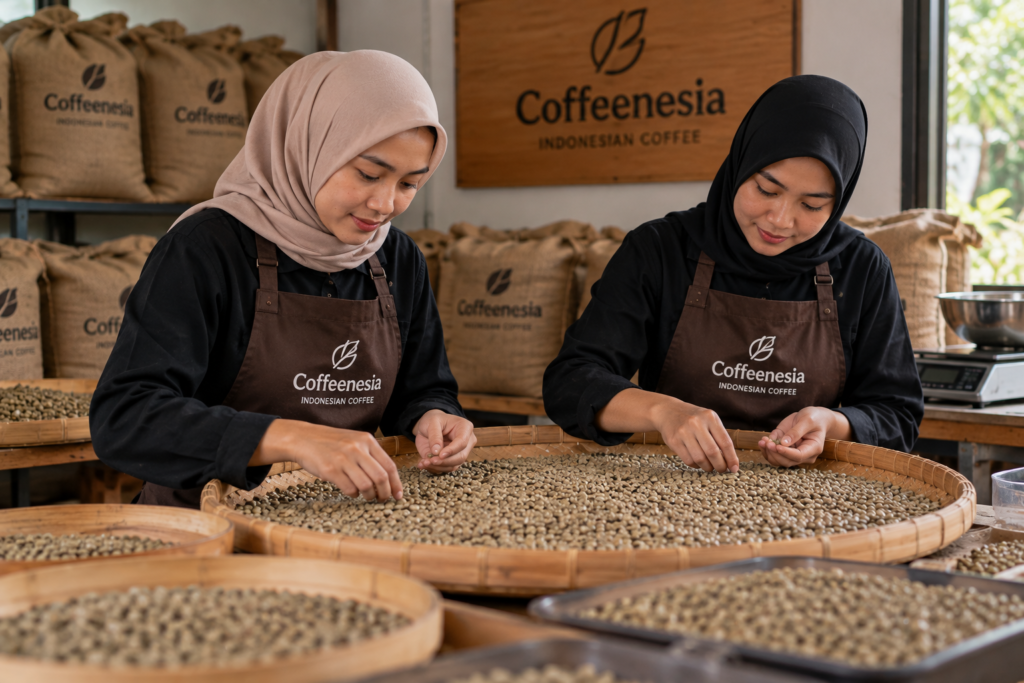
For stronger E-E-A-T, Coffeenesia should continue supporting these statements with first-party evidence rather than relying only on descriptive copy. Original photographs of farms, cherries, coffee processing, raised-bed drying, green-bean evaluation, cascara preparation, packaging, warehouse activities, cupping, and supplier interactions can provide useful evidence when each image includes an accurate caption. Product specifications, traceability records, quality-control documents, and sourcing documentation can further strengthen buyer trust when they are current and appropriate for public disclosure.
This distinction is important for both buyers and search systems because first-party evidence answers the question, “How does Coffeenesia know this?” Independent institutional sources answer a different question, “What evidence supports the broader Gayo sustainability context?” Combining both types of evidence creates a stronger E-E-A-T structure than repeating promotional claims without documentation.
From Gayo Origin to Commercial Buyers
Moving Gayo coffee toward domestic and international buyers requires more than agricultural production. Coffee also passes through quality evaluation, processing, grading, storage, packaging, documentation, commercial negotiation, and logistics before reaching a roaster, importer, distributor, café, or beverage business. Coffeenesia can therefore serve as an information and sourcing touchpoint connecting the Gayo origin with buyers researching Indonesian coffee and cascara.
International buyers should nevertheless evaluate each proposed transaction according to the actual product and supplier capability. The most useful sequence is Buyer Requirement → Origin → Sustainability Context → Product Specification → Sample → Quality Evaluation → Traceability → Commercial Terms → Logistics. This framework makes sustainability part of a professional sourcing decision rather than a standalone marketing message.
Buyers exploring larger-volume sourcing can continue to Coffeenesia’s Gayo Coffee Beans Grade 1 Bulk Export guide. Those researching Indonesia more broadly can also explore Indonesian Coffee for Export and Indonesian Coffee Exporter to connect sustainability research with practical B2B sourcing considerations.
Coffeenesia and the EFBA Business Ecosystem
Coffee sourcing does not operate in isolation from broader business development. Market positioning, buyer communication, supply planning, export readiness, financial planning, operations, and commercial strategy can influence whether an agricultural product successfully develops into a sustainable business. Coffeenesia’s coffee-focused information can therefore be complemented by the broader business-development perspective available through PT EFBA Digital Mulia.
For businesses evaluating Indonesian coffee as part of a wider commercial strategy, EFBA provides an additional external entity connecting product opportunities with business development. This relationship should remain contextually relevant rather than turning every Coffeenesia article into a promotional page. Coffeenesia should remain the primary coffee entity, while EFBA can support the broader business context where sourcing, market development, and commercial growth intersect.
Evidence and Independent References
A strong sustainability article should make it easy for readers to distinguish company information from independent evidence. Data on the size and productivity of the Gayo coffee landscape cited in this guide comes from Bank Indonesia’s August 2026 publication on Gayo coffee. Information about climate pressure, farmer productivity, Good Agricultural Practices, agroforestry, and the Sustainable Gayo Coffee initiative comes from WRI Indonesia and its related 2026 program information.
Information regarding the current European Union deforestation framework comes from the European Commission’s official EUDR information. Coffeenesia-specific statements in this article should remain limited to information that Coffeenesia can support through its current company, product, sourcing, and operational documentation. Keeping independent evidence and first-party company evidence clearly identifiable strengthens transparency for buyers and creates a more trustworthy knowledge resource.
FAQ About Gayo Coffee Sustainability
What is Gayo coffee sustainability?
Gayo coffee sustainability refers to the long-term ability of the Gayo coffee ecosystem to produce quality coffee while maintaining environmental, agricultural, economic, and social resilience. It can involve soil management, climate adaptation, agroforestry, farmer productivity, post-harvest practices, quality control, traceability, resource utilization, and access to viable markets.
Why is sustainability important for Gayo coffee?
Sustainability matters because long-term coffee supply depends on productive farms, resilient farming communities, healthy landscapes, effective processing, quality consistency, and market access. Climate pressure and productivity challenges can eventually affect coffee availability, quality, and commercial continuity.
How does agroforestry support Gayo coffee sustainability?
Appropriately managed agroforestry can support vegetation diversity, soil protection, microclimate management, and farm resilience. The results depend on local conditions, tree species, shade intensity, coffee varieties, soil, and farm management, so agroforestry should not be treated as one universal production formula.
What role does cascara play in sustainable coffee production?
Cascara can create additional value from coffee-cherry material beyond the coffee bean when it is appropriately selected, processed, dried, stored, and handled. This illustrates how coffee businesses can explore better utilization of agricultural resources and by-products rather than focusing only on the seed.
Why is traceability important for Gayo coffee?
Traceability connects a coffee with available information about its origin, processing, harvest, lot, and supply chain. It can support accurate product communication, supplier management, buyer due diligence, and preparation for markets that increasingly require greater supply-chain transparency.
Does the EUDR cover coffee?
Yes. Coffee is one of the commodities covered by the European Union Deforestation Regulation. According to current European Commission information, application begins on 30 December 2026 for large and medium-sized operators and on 30 June 2027 for most micro and small operators, although specific obligations depend on the operator and product.
How can buyers evaluate sustainable Gayo coffee suppliers?
Buyers can evaluate origin information, processing, traceability, physical specifications, representative samples, quality control, resource management, available volume, packaging, and supplier communication. Sustainability claims should be supported by evidence rather than accepted solely because terms such as sustainable, eco-friendly, or traceable appear in marketing materials.
What is Coffeenesia’s role in Gayo coffee sourcing?
Coffeenesia focuses on coffee and cascara connected with Gayo, Aceh, Indonesia and publishes information related to origin, processing, product characteristics, and sourcing. Commercial buyers should discuss the actual current product, specifications, sample, traceability information, quantity, packaging, and transaction requirements directly when evaluating a purchase.

Building a More Sustainable Gayo Coffee Supply Chain
Gayo coffee sustainability depends on the relationship between farms, farming communities, processing, quality management, resource utilization, traceability, suppliers, and markets. No single practice can make the entire coffee supply chain sustainable on its own. Instead, long-term resilience develops when improvements at farm level are connected with better post-harvest management, quality control, transparent sourcing information, economically viable market relationships, and continued adaptation to environmental challenges.
For global buyers, this means sustainability should be evaluated alongside coffee quality and commercial capability rather than treated as a separate marketing category. A practical sourcing framework is Origin → Farm Resilience → Processing → Quality → Traceability → Commercial Capability → Long-Term Supply. Asking for evidence at each relevant stage can help importers, roasters, distributors, cafés, and beverage companies make more informed decisions about Gayo coffee from Aceh.
Businesses researching Gayo-origin coffee and cascara can explore Coffeenesia for additional product and sourcing information, including the Gayo Coffee Beans guide and related Gayo coffee resources. Companies that also need broader support for business development, market strategy, or commercial expansion can visit PT EFBA Digital Mulia to explore opportunities for starting, strengthening, and developing a business together with the EFBA ecosystem.