
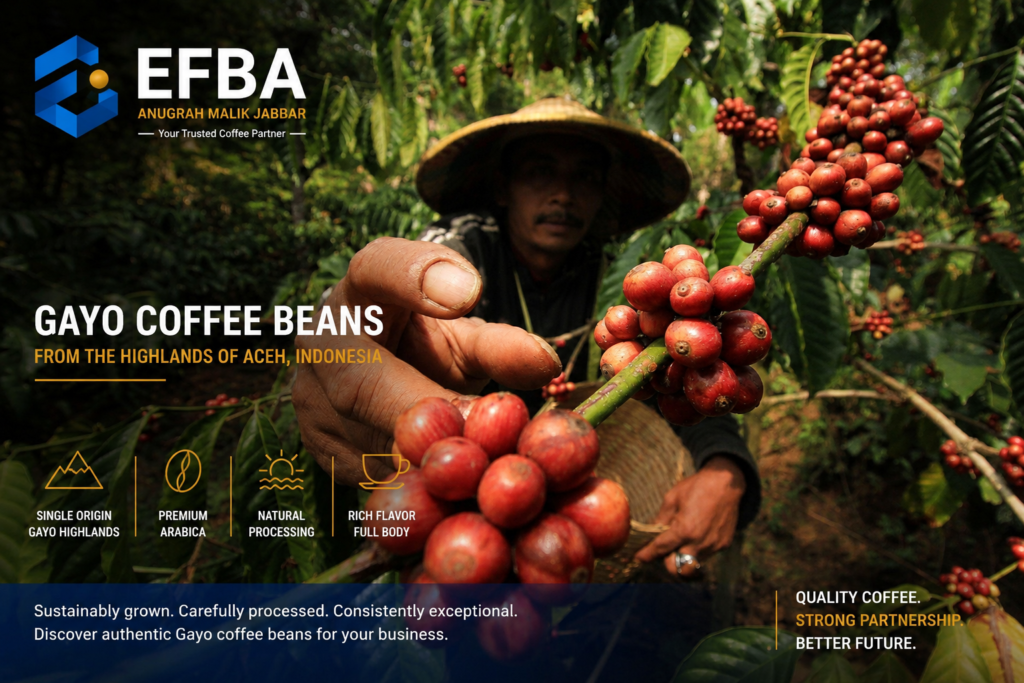
Gayo coffee beans are Indonesian coffee beans originating from the Gayo Highlands of Aceh, northern Sumatra. The region has a strong association with Arabica coffee production and is recognized for its geographical identity, highland growing environment, and role in Indonesia’s specialty coffee sector. For coffee roasters, importers, distributors, cafés, and coffee brands, Gayo coffee can provide multiple sourcing possibilities because individual lots may differ in processing method, physical specification, sensory profile, crop, traceability, and commercial format.
However, choosing Gayo coffee should involve more than purchasing beans simply because they carry the word “Gayo.” Origin, growing conditions, coffee variety, harvest decisions, processing, drying, storage, physical quality, roast development, and brewing can all influence the final cup. Therefore, professional buyers should evaluate the actual product through a structured framework of Origin → Processing → Specification → Sample → Quality Evaluation → Commercial Suitability before committing to larger orders.
This guide explains what Gayo coffee beans are, where they come from, how processing affects their characteristics, what buyers should evaluate, and how different businesses can select an appropriate coffee. It also connects product information with official Indonesian agricultural references and practical sourcing considerations, creating a more evidence-based resource for businesses researching Gayo coffee from Aceh, Indonesia.
What Are Gayo Coffee Beans?
Gayo coffee beans generally refer to coffee grown in the Gayo Highlands of Aceh, Indonesia, an area with a long association with Arabica coffee production. The term describes geographical origin rather than one fixed flavor, processing method, grade, or commercial specification. Consequently, buyers can encounter different Gayo coffees depending on producing area, variety, harvest, processing, drying, storage, sorting, and lot preparation.
Origin is particularly important because Kopi Arabika Gayo has an established geographical identity in Indonesia. Indonesia’s Directorate General of Estate Crops records Kopi Arabika Gayo from Gayo, Aceh as receiving Geographical Indication recognition in 2010. This official recognition provides useful context for buyers researching the relationship between Gayo coffee and its geographical origin, although commercial buyers should still evaluate the specifications and traceability of the individual coffee they intend to purchase.
In practical sourcing, the name Gayo should therefore become the beginning of product evaluation rather than the end of it. Buyers should ask which area the coffee comes from, how it was processed, which physical specifications apply, what the actual lot tastes like, and whether the supplier can provide information relevant to the proposed transaction. For additional background, read Aceh Gayo Coffee: 7 Amazing Reasons This Indonesian Coffee Is Special.
Where Do Gayo Coffee Beans Come From?
The origin of Gayo coffee beans is associated with the highland coffee-growing areas of Aceh in northern Sumatra. Government agricultural information identifies Aceh Tengah, Bener Meriah, and Gayo Lues as important areas associated with Arabica coffee in the Gayo Highlands. Coffee production in these highland environments is influenced by elevation, local growing conditions, plant material, farm management, harvest decisions, and post-harvest practices, which means geographical origin interacts with several other variables before the coffee reaches the buyer.
Research published through Indonesia’s Ministry of Agriculture repository provides additional evidence of how growing conditions can relate to coffee characteristics. A study of Gayo Arabica Geographical Indication coffee in Aceh Tengah and Bener Meriah evaluated samples grown at approximately 1,000–1,500 meters and 1,500–1,750 meters above sea level. The research reported differences in physical bean characteristics and cupping scores ranging from 82.75 to 85.25 for the samples studied, demonstrating why individual lots should be evaluated rather than assuming that every coffee from a broad origin will perform identically.
Therefore, professional buyers should look beyond the country name “Indonesia” and even beyond the regional name “Gayo.” More useful sourcing questions concern the actual producing area, lot, harvest, processing method, physical quality, sample performance, and available traceability. This more specific approach helps connect geographical identity with the characteristics of the coffee that will actually enter a roasting, distribution, or retail program.
What Do Gayo Coffee Beans Taste Like?
There is no single flavor description that accurately represents every lot of Gayo coffee beans. Depending on origin within the region, variety, cherry maturity, processing, drying, storage, roast development, and brewing method, buyers may encounter coffees with chocolatey, nutty, earthy, spicy, herbal, caramel-like, sweet, fruity, or more complex characteristics. Rather than treating these descriptors as guaranteed tasting notes, buyers should use them as possible profile directions that need to be confirmed through actual sample evaluation.
This variation can be commercially useful because different sensory profiles can support different product strategies. A specialty roaster may prefer a cleaner and more balanced lot for a single-origin filter program, while another buyer may seek deeper body and chocolate-forward characteristics for espresso or blending. Meanwhile, cafés and private-label brands may select a profile according to their target customers, brewing methods, price positioning, and desired roast development.
The most reliable way to understand a specific Gayo lot is therefore to connect Physical Specification + Processing Information + Representative Sample + Sensory Evaluation. Buyers should avoid purchasing solely from generalized descriptions such as “classic Gayo flavor” because agricultural products naturally vary between lots and harvests. Sample roasting and cupping provide much stronger evidence of commercial suitability.
Why Does Gayo Coffee Flavor Vary?
The sensory characteristics of coffee begin at origin but continue developing throughout the supply chain. A useful way to understand the process is Origin → Variety → Harvest → Processing → Drying → Storage → Roasting → Brewing. A change at any stage can influence the result in the cup, which explains why two coffees grown within the same broader region can taste noticeably different after processing and roasting.
For example, different post-harvest methods can change how sweetness, acidity, body, fruit character, and other sensory attributes are expressed. Likewise, one green coffee can produce different results under light, medium, or darker roast development. Professional buyers should consequently evaluate Gayo coffee as a complete product specification rather than relying solely on geographical origin or a predetermined tasting-note description.
Gayo Coffee Processing Methods
Processing is one of the most important variables to examine when selecting Gayo coffee beans. Depending on the producer, facility, lot, and desired product profile, buyers may encounter wet-hulled, washed, natural, honey, or other controlled processing approaches. Processing terminology is useful, but it should always be connected with the actual lot because execution, fermentation, drying, storage, and raw material quality also influence the final result.
Wet-Hulled Gayo Coffee
Wet-hulled processing, commonly associated with Sumatra, uses a distinctive post-harvest sequence in which parchment is removed while the coffee contains more moisture than it would during conventional fully washed processing. This method can contribute to the body and character often associated with traditional Sumatran coffee profiles. For buyers developing espresso, blends, or products positioned around classic Indonesian coffee characteristics, wet-hulled Gayo can be an important category to evaluate through representative samples.
Washed Gayo Coffee
Washed processing removes much of the fruit material before the coffee completes drying. Depending on the lot and execution, washed Gayo coffee may provide a cleaner sensory presentation that allows buyers to evaluate sweetness, acidity, balance, and origin characteristics more clearly. As a result, this style can be relevant to specialty roasters developing single-origin, filter, or premium retail products, although the actual cup profile should always be confirmed through sampling.
Natural Gayo Coffee
During natural processing, coffee cherries are dried with the fruit surrounding the beans. When processing and drying are carefully managed, natural coffees can develop stronger fruit expression, sweetness, and distinctive aromatic characteristics. Natural Gayo coffee can therefore be interesting for specialty roasters looking for more expressive profiles, limited releases, or differentiated filter products, but buyers should assess each lot individually because natural processing outcomes can vary significantly.
Honey-Processed Gayo Coffee
Honey processing removes the outer skin while retaining varying amounts of mucilage during drying. The resulting characteristics depend on the coffee itself as well as fermentation, drying, handling, and other processing decisions. For some buyers, honey-processed Gayo coffee may offer an interesting combination of sweetness, body, and clarity that can support specialty retail or signature products. Learn more in our dedicated Gayo Coffee Processing Guide.
How Processing Can Change Gayo Coffee
For commercial buyers, processing should not be treated merely as terminology on a product label. It can influence product positioning, roast development, brewing applications, and customer expectations. Although no processing method guarantees a specific tasting note, understanding the general direction of different methods can help buyers identify which samples deserve further evaluation for their product strategy.
| Processing | Potential Profile Direction | Possible Commercial Application |
|---|---|---|
| Wet-Hulled | Fuller body and deeper character | Espresso, blends, traditional Sumatra-style products |
| Washed | Cleaner and more balanced presentation | Single origin, filter, premium retail |
| Natural | Fruit-forward, sweet, expressive | Specialty filter, limited releases, differentiated products |
| Honey | Sweet, balanced, potentially complex | Specialty retail, filter, signature products |
The table should therefore be used as a screening framework rather than a flavor guarantee. A washed coffee can still differ substantially from another washed lot, just as two natural coffees can produce different sensory outcomes. Consequently, buyers should combine processing information with origin, physical specifications, crop information, and sample evaluation before deciding whether a coffee fits the intended commercial application.

Green vs. Roasted Gayo Coffee Beans
Before contacting a supplier, buyers should determine whether their business requires green or roasted Gayo coffee beans. The correct choice depends primarily on the buyer’s operational capabilities, product strategy, and desired control over roasting. Professional roasters generally purchase green coffee because it allows them to develop roast profiles for different applications, whereas cafés, retailers, hospitality businesses, and brands without roasting facilities may prefer roasted coffee closer to its final commercial form.
Gayo Green Coffee Beans
Gayo green coffee beans provide roasters with greater control over roast development and final product positioning. The same origin may be developed differently for light-roast filter coffee, medium-roast retail products, espresso, café blends, or private-label programs. Green coffee buyers should pay particular attention to processing, moisture, physical defects, bean size or screen information where relevant, crop and lot identification, storage conditions, sample quality, and consistency between the approved sample and commercial supply.
Because green coffee will undergo additional transformation during roasting, purchasing decisions should consider how the raw coffee performs during sample roasting and cupping rather than relying only on visual appearance. Roasters can then determine whether the coffee provides the acidity, sweetness, body, aroma, balance, and overall character needed for their target market. This evaluation also creates a useful reference when comparing several potential lots.
Roasted Gayo Coffee Beans
Roasted Gayo coffee can be more suitable for buyers that do not operate roasting facilities or want a product closer to the retail stage. In this case, evaluation should include roast level, roast date, whole-bean or ground format, packaging, sensory profile, recommended brewing application, available quantity, and storage requirements. Buyers should also consider transit time because roasted coffee has different freshness considerations from green coffee.
Therefore, the question is not whether green coffee is universally better than roasted coffee. Instead, businesses should select the format that matches their operating model and quality-control capability. A professional roaster may require green coffee with detailed specifications, while a café or private-label business may require a roasted product prepared according to agreed commercial requirements.
Gayo Arabica and Geographical Indication
Origin authenticity is particularly relevant when coffee is marketed according to geographical identity. Indonesia’s Directorate General of Estate Crops lists Kopi Arabika Gayo among Indonesian plantation products that have obtained Geographical Indication recognition and records Gayo, Aceh with recognition in 2010. For buyers, this provides an authoritative reference showing that Gayo Arabica has an established geographical identity within Indonesia’s agricultural sector.
However, Geographical Indication and commercial quality evaluation should not be treated as identical concepts. A buyer still needs to understand the actual lot, processing, physical specifications, sensory performance, traceability information, packaging, and commercial conditions. Consequently, businesses purchasing coffee specifically because of its Gayo identity should ask suppliers what origin and traceability information can be supported for the product being offered.
For independent verification, buyers can review information from the Directorate General of Estate Crops, Ministry of Agriculture of Indonesia. Buyers interested in research on physical and sensory quality can also review the Ministry of Agriculture repository study on Gayo Arabica coffee quality at different elevations.
7 Factors to Evaluate Before Buying Gayo Coffee Beans
Commercial buyers should evaluate more than price when purchasing Gayo coffee beans. Two quotations can represent very different coffees even when both use the same regional name. A professional comparison should therefore examine origin, processing, sensory information, physical quality, samples, supply consistency, and supplier capability together. The following seven factors provide a practical framework for roasters, importers, distributors, cafés, and coffee brands.
1. Confirm the Origin and Traceability
Ask where the coffee comes from and what level of traceability is available. Depending on the supply structure, useful information can include country, region, producing area, cooperative or producer group, farm, processing location, harvest, and lot identification. Not every coffee provides farm-level traceability, so buyers should focus on information that can actually be supported rather than assuming that all specialty coffee has the same documentation depth.
For Gayo coffee, regional information provides valuable context, but more specific lot information can make product evaluation stronger. A practical traceability framework is Indonesia → Aceh → Gayo → Producer or Group → Process → Harvest → Lot, using only the levels genuinely available for the coffee. This structure can also help buyers communicate origin accurately to downstream customers.
2. Check the Processing Method
Do not assume that all Gayo coffee beans use the same processing method. Ask whether the commercial lot is wet-hulled, washed, natural, honey processed, or prepared through another controlled method. Processing information can help specialty buyers anticipate a possible sensory direction, but it should always be verified by evaluating the actual sample because execution and raw-material quality can create substantial differences within the same processing category.
3. Review the Sensory Profile
Ask for available sensory or cupping information and compare it with the intended commercial application. Tasting notes should be treated as descriptive guidance rather than absolute guarantees because roast development, water, brewing method, and evaluation conditions can change how a coffee expresses itself. Whenever practical, buyers should conduct their own sample evaluation before committing to a larger order.
4. Evaluate Physical Quality
For green coffee, physical evaluation can include moisture, defect specification, appearance, bean size or screen information where relevant, processing, crop information, and overall lot consistency. These factors should be reviewed together with sensory performance because a professional purchasing decision should not depend on tasting notes alone. Research on Gayo Arabica has examined both physical quality and flavor, reinforcing the importance of combining these perspectives when evaluating a commercial coffee.
5. Request Representative Samples
Sampling is particularly valuable for B2B coffee purchases because it allows a roasting or quality team to evaluate the coffee before committing to larger quantities. Depending on the buyer’s operation, the process can follow Representative Sample → Physical Inspection → Sample Roast → Cupping → Brewing Test → Commercial Decision. Buyers should also confirm that the sample represents the commercial lot being discussed so the evaluation remains relevant to the actual purchase.
6. Evaluate Supply Consistency
A strong sample does not automatically establish long-term supply reliability. Buyers planning repeat purchases should discuss available volume, harvest availability, lot identification, acceptable variation, lead time, storage, packaging, repeat-order expectations, and shipment arrangements. Because coffee is an agricultural product, some variation between harvests and lots is natural; therefore, the objective should be consistency within agreed specifications rather than an unrealistic expectation that every harvest will taste exactly the same.
7. Choose a Supplier That Understands Your Requirements
Different buyers evaluate coffee differently, so the supplier should understand the intended business application. Specialty roasters may prioritize sample quality, traceability, processing, and sensory characteristics, while distributors may place greater emphasis on repeatability, packaging, and volume. Private-label businesses may require a particular roasted format, whereas international importers may focus on green coffee specifications, documentation, logistics, quantity, and shipment preparation.
For this reason, communicate your specifications clearly rather than requesting only a generic price list. Providing destination, desired coffee format, processing preference, approximate quantity, intended application, packaging requirements, and expected purchasing schedule gives the supplier more context to determine whether the available Gayo coffee beans fit your needs.
Gayo Coffee Beans for Different Buyers
Gayo coffee can serve several commercial segments, but each buyer should evaluate the product according to its own operational needs. A coffee that works well for a specialty filter program may not automatically be the best choice for a high-volume espresso blend or private-label retail product. Consequently, buyers should connect coffee characteristics with the intended market before selecting a lot.
Coffee Roasters
Roasters commonly evaluate green coffee so they can control roast development and determine how origin, processing, sweetness, acidity, body, aroma, and other sensory characteristics are expressed. A specialty roaster may compare several Gayo lots through sample roasting and cupping before selecting one for a single-origin, espresso, filter, or blend program. Therefore, representative samples and clearly documented specifications are particularly valuable for this buyer segment.
Cafés and Coffee Shops
Cafés may use Gayo coffee for espresso, manual brewing, single-origin menus, seasonal offerings, or signature blends. The appropriate processing method and roast profile depend on the brewing application and customer preference, so cafés should avoid choosing beans solely from origin reputation. Product consistency, roast freshness for roasted coffee, packaging, and repeat availability can also become important when the coffee is used as a regular menu item.
Coffee Distributors
Distributors generally need to consider both product quality and commercial repeatability because they may serve multiple downstream customers. In addition to flavor and origin, evaluation can include available volume, packaging, lot consistency, documentation, lead time, and supplier communication. A clearly defined specification makes it easier for distributors to position the coffee accurately and manage repeat purchasing.
Private-Label Coffee Brands
Private-label businesses can select coffee according to their desired market positioning, target customer, brewing application, and price segment. A premium specialty brand may prioritize traceability and distinctive sensory characteristics, whereas a broader retail product may prioritize consistency and accessibility. In either case, businesses should define the required green or roasted format, roast profile where applicable, packaging, quantity, and product specifications before requesting a final quotation.
Importers and International Buyers
Importers and international buyers generally require a more complete commercial picture because product quality must be connected with volume, packaging, documentation, logistics, destination requirements, and shipment planning. Before purchasing, communicate destination country, preferred product format, processing method, approximate volume, quality requirements, packaging, and expected shipment schedule. Buyers should also verify applicable import and customs requirements for their destination rather than assuming that requirements are identical across markets.
How to Build a Gayo Coffee Buying Specification
Before requesting a quotation, create a simple buying specification that explains what your business actually needs. This reduces vague supplier responses and makes different offers easier to compare. Instead of asking only for “the price of Gayo coffee,” buyers can specify the intended product, processing preference, quantity, destination, sample requirement, physical parameters, sensory direction, and packaging expectations.
| Requirement | Information to Provide or Request |
|---|---|
| Origin | Gayo Highlands, Aceh, Indonesia and more specific lot information where available |
| Product Format | Green beans or roasted coffee |
| Processing | Wet-hulled, washed, natural, honey, or available alternative |
| Physical Quality | Moisture, defect specification, screen information where relevant, crop or lot data |
| Sensory Requirement | Target profile or intended brewing and roasting application |
| Sample | Representative sample required before commercial approval |
| Quantity | Approximate required volume and purchasing frequency |
| Packaging | Required bag type, net weight, liner, labeling, or retail format where applicable |
| Destination | Country and relevant shipment destination |
| Schedule | Target purchasing or shipment period |
A structured buying specification improves both SEO usefulness and real-world buyer value because it answers the commercial questions behind searches for Gayo coffee suppliers, wholesale coffee, and Indonesian specialty coffee. More importantly, it helps businesses compare equivalent offers. Price becomes meaningful only when the buyer understands the product, quality specification, quantity, packaging, and commercial scope behind the quotation.
Gayo Coffee Sourcing with Coffeenesia

Coffeenesia focuses on coffee and cascara products connected with Gayo, Aceh, Indonesia. For buyers researching Gayo coffee beans, our content is structured to connect origin knowledge with practical sourcing considerations such as processing, product format, specifications, samples, quantity, packaging, and commercial requirements. This buyer-oriented approach helps businesses move from general origin research toward a more specific product evaluation.
Rather than assuming that every Gayo lot has identical characteristics, buyers should evaluate the actual product being offered. A useful sourcing sequence is Buyer Requirement → Gayo Origin → Processing → Product Specification → Representative Sample → Evaluation → Commercial Discussion. This framework is relevant to roasters, importers, distributors, cafés, and coffee brands because each segment can define different quality, volume, packaging, and operational requirements.
Coffeenesia also develops related educational resources that allow buyers to explore the subject in greater depth. Start with our Aceh Gayo Coffee guide for origin information, continue to the Gayo Coffee Processing Guide to understand post-harvest differences, and use this page as a practical reference when comparing Gayo coffee beans for commercial sourcing.
Coffeenesia Trust and First-Party Evidence
For stronger E-E-A-T, buyers should be able to distinguish between general educational information and evidence related to a specific supplier or coffee lot. Coffeenesia can strengthen this page further by displaying genuine first-party documentation such as original photographs of coffee samples, green-bean inspection, cupping or sample evaluation, packaging preparation, warehouse handling, product labels, and sourcing activities. Accurate captions should explain what is shown, where the activity took place when relevant, and how it relates to coffee quality or sourcing.
Likewise, claims about certifications, organic status, direct-farm relationships, export destinations, annual capacity, sustainability programs, traceability, or quality guarantees should only be published when Coffeenesia can support them with current documentation. This evidence-first approach improves trust because buyers receive verifiable information instead of generic statements such as “best supplier” or “highest quality.” For search engines and AI systems, clearly distinguishing factual evidence, independent references, and company-specific information also creates a more transparent entity profile.
Independent References for Gayo Coffee Research
This guide uses independent Indonesian agricultural references to support important origin and quality information. The Directorate General of Estate Crops identifies Kopi Arabika Gayo as a Geographical Indication product from Gayo, Aceh, recognized in 2010. Meanwhile, research available through the Ministry of Agriculture repository examines physical quality and sensory characteristics of Gayo Arabica GI coffee at different elevations in Aceh Tengah and Bener Meriah. These references provide independent context, while individual purchasing decisions should still be based on the actual commercial lot.
FAQ About Gayo Coffee Beans
What are Gayo coffee beans?
Gayo coffee beans are coffee beans associated with the Gayo Highlands of Aceh, Indonesia. The region has a strong association with Arabica coffee production, while individual lots can differ according to variety, producing area, processing, harvest, drying, storage, and preparation.
Where do Gayo coffee beans come from?
Gayo coffee originates from the highland coffee-growing areas of Aceh in northern Sumatra, Indonesia. Aceh Tengah, Bener Meriah, and Gayo Lues are important areas associated with Arabica production in the Gayo Highlands.
What do Gayo coffee beans taste like?
There is no single flavor profile for every Gayo coffee. Depending on the lot, processing, roast, and brewing method, buyers may encounter chocolatey, nutty, earthy, spicy, herbal, caramel-like, sweet, fruity, or more complex characteristics. Representative sample evaluation provides a more reliable indication than a general regional description.
Is Gayo coffee Arabica?
Gayo is strongly associated with Arabica coffee production, and Kopi Arabika Gayo is recognized as a Geographical Indication product in Indonesia. Buyers should still confirm the coffee type and specification of the individual product being offered.
What processing methods are used for Gayo coffee?
Depending on the producer and lot, buyers may encounter wet-hulled, washed, natural, honey, and other controlled processing approaches. Processing can influence the direction of the sensory profile, but the actual coffee should be evaluated through representative samples.
Should I buy green or roasted Gayo coffee beans?
Green coffee is generally suitable for professional roasters that want control over roast development, while roasted coffee may be more suitable for cafés, retailers, hospitality businesses, or brands without roasting facilities. The best format depends on the buyer’s business model.
What should commercial buyers check before purchasing Gayo coffee?
Buyers should evaluate origin, traceability, processing, physical specifications, sensory information, representative samples, available quantity, lot consistency, packaging, supplier capability, and commercial requirements before committing to a larger order.
How can I start sourcing Gayo coffee with Coffeenesia?
Prepare your desired coffee format, processing preference, intended application, approximate quantity, packaging, destination, and purchasing schedule before contacting Coffeenesia. Providing clear requirements helps create a more focused discussion about available products, specifications, samples, and commercial requirements.
Source Gayo Coffee Beans from Indonesia
Selecting Gayo coffee beans for a commercial program requires more than choosing a familiar origin name. Buyers should connect geographical origin with processing, physical specifications, sample quality, sensory performance, traceability, supply consistency, packaging, and commercial requirements. This approach provides a stronger basis for comparing coffees and reduces dependence on broad promotional descriptions that may not explain the actual lot being purchased.
For professional sourcing, begin with Requirement → Origin → Processing → Specification → Sample → Evaluation → Commercial Discussion. Roasters can use this process to identify suitable green coffee for roast development, while importers and distributors can extend the evaluation to volume, packaging, documentation, and shipment planning. Cafés and coffee brands can use the same framework to determine whether green or roasted coffee better fits their operations and target customers.
Explore Coffeenesia to learn more about coffee and cascara from Gayo, Aceh, Indonesia. For deeper research, continue to our Aceh Gayo Coffee guide and Gayo Coffee Processing Guide. When requesting product information, prepare your preferred coffee format, processing method, approximate quantity, destination, packaging requirements, and purchasing schedule so the sourcing discussion can focus on your actual business needs.
Businesses that also need support in developing or expanding their commercial strategy can explore PT EFBA Digital Mulia for broader business development and consulting information.