
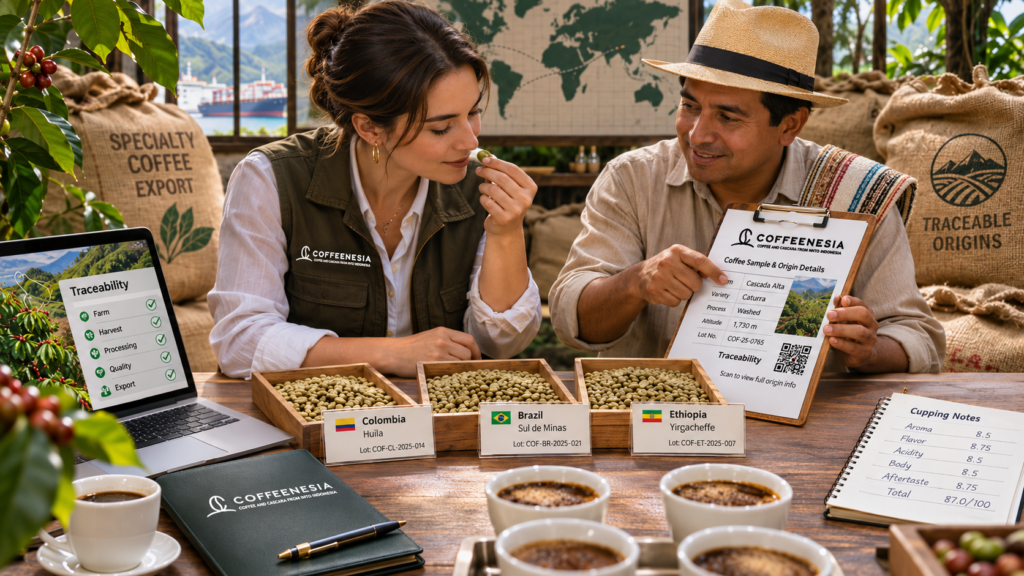
Specialty coffee sourcing is the process of selecting green coffee beans based on quality, origin, processing methods, traceability, and commercial requirements. Professional roasters evaluate where coffee comes from, how producers process it, whether samples meet sensory expectations, and whether suppliers can provide consistent quality before confirming wholesale purchases.
An effective specialty coffee sourcing strategy begins with origin verification, supplier evaluation, and representative green coffee samples. Roasters should also review processing methods, conduct controlled cupping, request lot-specific documentation, and confirm commercial availability. These steps support informed purchasing decisions while helping businesses build stronger supplier relationships.
What Is Specialty Coffee Sourcing?
Specialty coffee sourcing involves identifying and purchasing coffee with distinctive qualities that meet a buyer’s sensory, technical, and commercial expectations. The process considers green bean characteristics, growing conditions, processing practices, origin information, and supply chain transparency.
For roasters, selecting coffee involves more than choosing beans from a recognized producing country. Two coffees from the same region may produce different flavor profiles because of variety, harvesting conditions, processing methods, and storage practices.
For example, a specialty roaster purchasing Gayo Arabica from Indonesia may compare natural, full-wash, and semi-wash coffees before selecting beans for a particular roasting program. Each option requires sample evaluation, available origin information, and compatibility with the intended product.
A structured sourcing approach helps roasters connect these quality considerations with reliable supplier information and purchasing requirements.
Why Is Coffee Origin Traceability Important?
Origin traceability is an important part of specialty coffee sourcing because it helps buyers identify where coffee was produced and how it moved through the supply chain. Depending on the sourcing arrangement, records may connect a shipment to a country, region, cooperative, processing facility, farm, or individual production lot.
Traceability supports product identification, quality investigations, and sourcing transparency. It also allows roasters to communicate accurate origin information to customers without relying entirely on promotional descriptions.
However, traceability does not automatically prove environmental sustainability, organic certification, ethical labor practices, or regulatory compliance. Each claim requires appropriate supporting evidence.
1. Verify the Authenticity of Coffee Origins
Origin documentation helps buyers confirm whether coffee comes from the producing region stated by the supplier. Roasters can compare regional descriptions, supplier records, lot identification, and available production information.
For example, coffee labeled Gayo Arabica should have supporting information connecting the beans to the Gayo Highlands of Aceh. A regional name alone does not establish farm-level traceability.
2. Improve Consistency Across Purchasing Lots
Traceability records help roasters identify differences between harvests, processing batches, and supplier arrangements. These details become particularly useful when a company wants to reorder coffee with similar characteristics.
Although agricultural quality naturally varies, consistent documentation supports more reliable comparisons. Roasters can use previous cupping records and accepted samples to evaluate new shipments before purchasing.
3. Support Transparent Product Communication
Specialty coffee customers often value information about growing regions, varieties, and processing techniques. Verified origin information helps roasters explain coffee characteristics and distinguish products within their portfolio.
Businesses should communicate only information supported by reliable sourcing records. Claims such as single-farm origin, direct trade, organic production, or certified sustainability require appropriate evidence.
7 Steps for Specialty Coffee Sourcing and Origin Verification
A successful specialty coffee sourcing process combines supplier verification, product quality assessment, and commercial planning. The following seven steps help roasters evaluate suitable origins before committing to larger purchases.
1. Define Your Coffee Requirements
Start by identifying the intended roasting application, target flavor profile, required quantity, and customer preferences. A roaster developing single-origin filter coffee may prioritize clarity, acidity, and distinctive sensory characteristics.
Meanwhile, a business sourcing coffee for an espresso blend may prioritize body, consistency, sweetness, and compatibility with other components. Clear purchasing requirements help suppliers recommend suitable options.
2. Verify the Coffee Origin and Supplier
Request the producing region, supplier identity, variety, processing method, and available harvest information. Where relevant, ask whether the coffee originates from a cooperative, individual farm, or collection of producers.
If the supplier combines coffee from multiple farms, buyers should clarify the actual traceability level. A cooperative-level origin record differs from documentation identifying an individual farm or plot.
Origin verification should form part of every specialty coffee sourcing decision, particularly when buyers intend to communicate detailed production information to customers.
3. Review Processing Methods and Harvest Information
Processing influences the characteristics that roasters evaluate during sample roasting and cupping. Common methods include natural, washed, honey, and semi-washed processing.
Natural processing dries coffee cherries with the fruit intact, while washed processing removes the fruit before drying through its particular processing stages. Honey processing retains some mucilage during drying, and Indonesian semi-washed methods use different post-harvest handling.
These methods can influence flavor, body, and acidity, but results vary according to variety, fermentation, drying, and production conditions. Roasters should verify the actual lot rather than assuming a processing method always produces the same flavor.
4. Inspect Green Coffee Specifications
Before sample roasting, evaluate physical characteristics such as bean appearance, defects, moisture, size distribution, and unusual odors. Request technical specifications and relevant test results from the supplier when available.
Green bean inspection helps buyers identify problems that could influence roasting performance, storage, or product consistency. The purchasing agreement should establish measurable acceptance criteria using an appropriate grading or testing method.
5. Conduct Sample Roasting and Cupping
Use a consistent sample-roasting procedure to compare coffees under controlled conditions. Evaluate aroma, flavor, acidity, sweetness, mouthfeel, aftertaste, and overall suitability for the intended market.
Roasters can use the Specialty Coffee Association’s Coffee Value Assessment framework to distinguish sensory descriptions, quality impressions, physical characteristics, and origin-related information.
Sample evaluation is a critical stage of specialty coffee sourcing because it helps buyers determine whether a particular lot meets their intended roasting requirements.
For a practical evaluation process, read Coffee Sample Evaluation: How Roasters Assess Beans Before Bulk Orders.
6. Check Traceability and Commercial Documentation
Request documentation connecting the evaluated sample with the proposed commercial lot. Useful information may include lot identification, origin records, processing details, quantity, packaging, and available quality results.
For international purchases, buyers should also clarify shipment responsibilities, export documents, and destination-market requirements. Where additional sustainability or geolocation obligations apply, ordinary origin descriptions may not provide sufficient evidence.
7. Confirm Bulk Availability and Supplier Performance
Before approving a wholesale order, verify the available quantity, lot identity, packaging, lead time, and agreed specifications. Confirm whether the supplier can deliver the accepted coffee or an alternative that requires further evaluation.
For recurring purchases, monitor quality consistency, delivery performance, and responsiveness to quality concerns. These checks help buyers establish dependable sourcing relationships without assuming every future harvest will be identical.
Specialty coffee sourcing workflow:
Coffee Requirements → Origin Verification → Processing Review → Green Bean Inspection → Sample Roasting & Cupping → Traceability Documentation → Bulk Order Approval
What Documents Help Verify Traceable Coffee Origins?
Documentation plays an essential role in specialty coffee sourcing, particularly when buyers require consistent quality and transparent origin information. Coffee buyers should request records that match their required traceability level and the risks associated with the purchase.
| Document or Information | Verification Purpose |
|---|---|
| Supplier identity | Establish the party responsible for the transaction |
| Farm or cooperative information | Identify the declared producing source |
| Origin and regional records | Verify the stated coffee origin |
| Variety and processing details | Understand production characteristics |
| Harvest or crop information | Identify the relevant production period |
| Lot or batch number | Connect samples with commercial inventory |
| Green coffee specification | Establish measurable quality requirements |
| Sample or cupping report | Document sensory evaluation results |
| Shipment records | Connect packaged coffee with the transaction |
Not every supplier provides identical documentation. Smallholder coffee may pass through cooperatives and collection points, so buyers should establish whether available records support regional, cooperative, farm, or plot-level traceability.
Reliable records help roasters distinguish verified origin information from general product descriptions. They also provide a reference for evaluating future shipments and maintaining purchasing consistency.
How Do Processing Methods Influence Specialty Coffee Sourcing?
Processing methods affect the sensory characteristics that roasters may seek when selecting green coffee. Within specialty coffee sourcing, understanding post-harvest practices helps buyers identify coffees that may suit their roasting applications.
However, actual results depend on the specific lot and should be confirmed through sample testing.
| Processing Method | Common Sensory Tendencies | Potential Roasting Application |
|---|---|---|
| Natural | Fruit-forward character and fuller body | Distinctive single-origin offerings |
| Full Wash | Clean profile and defined acidity | Filter coffee and balanced espresso |
| Semi Wash | Rich body and lower perceived acidity | Espresso and traditional Indonesian profiles |
| Honey | Sweetness and rounded mouthfeel | Filter coffee and specialty blends |
| Experimental Fermentation | Diverse or pronounced fermented characteristics | Limited-release specialty products |
Coffeenesia’s Gayo Coffee Product Page describes natural, full-wash, semi-wash, honey, and experimental processing options. The page provides indicative sensory profiles and technical reference information for buyers considering different Gayo coffee styles.
However, product descriptions should not replace current lot-specific specifications or representative samples. Roasters should confirm processing, availability, and sensory results for the coffee they intend to purchase.
What Do Official Coffee Industry Sources Say About Traceability?
The Specialty Coffee Association (SCA) uses its Coffee Value Assessment (CVA) framework to evaluate coffee through four complementary dimensions: physical, descriptive, affective, and extrinsic.
Physical assessment examines characteristics such as defects, color, moisture, and bean size. Descriptive assessment records sensory attributes, while affective assessment evaluates perceived quality or preference.
Importantly, extrinsic assessment includes information beyond the cup, such as origin traceability, processing details, and certifications. This recognizes that coffee value cannot be understood entirely through a single tasting score.
For specialty coffee sourcing, this framework provides a useful reference because it encourages buyers to consider physical quality, sensory characteristics, and documented origin information together.
Official reference: SCA Coffee Value Assessment.
International Coffee Market Data in 2026
The International Coffee Organization (ICO) reported that its Composite Indicator Price averaged 262.18 US cents per pound in September 2026, representing an 8.7% decrease from August 2026.
The ICO also reported approximately 12.58 million 60-kg bags of coffee exports in August 2026, compared with 10.95 million bags in August 2025. These figures describe international coffee market activity rather than specialty coffee alone.
Changes in prices and trade volumes can influence sourcing budgets and supply planning. However, global market data cannot establish the quality, traceability, or availability of any individual coffee lot.
Official reference: International Coffee Organization – Coffee Market Reports.
How Does Coffeenesia Approach Specialty Coffee Sourcing?
Coffeenesia presents itself as an Indonesian specialty coffee and cascara supplier focused on Gayo Arabica from the highlands of Aceh. Its official website describes direct sourcing, cooperation with local producers, coffee processing oversight, quality control, and transparency regarding origin, variety, and processing methods.
For roasters exploring specialty coffee sourcing in Indonesia, this published information provides a starting point for evaluating origin characteristics and available product options. Buyers can review processing methods, discuss green bean requirements, and request additional information about specific lots before placing wholesale orders.
Coffeenesia’s sourcing approach emphasizes the relationship between coffee origin, post-harvest processing, and buyer requirements. Nevertheless, prospective customers should confirm current availability, product specifications, and supporting traceability records for each transaction.
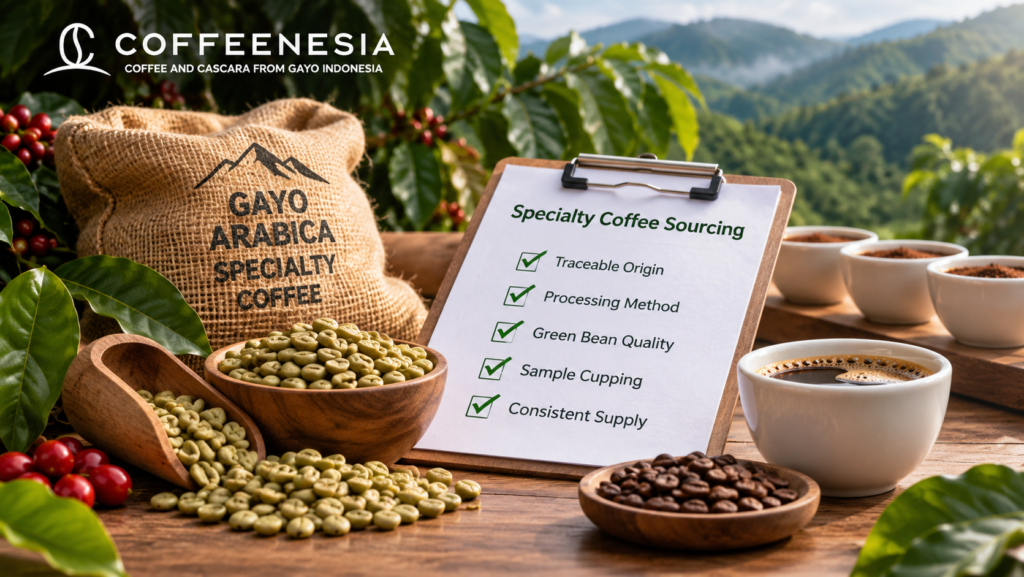
The company’s published approach emphasizes coffee selection, post-harvest handling, and product differentiation. These activities support specialty coffee sourcing by providing roasters with information about origin, processing methods, and green bean characteristics before wholesale purchasing.
Direct Sourcing From the Gayo Highlands
Coffeenesia identifies Gayo, Aceh, as the origin of its main specialty coffee offering. Its website describes relationships with farming communities and cooperatives, along with product options based on different processing methods.
For international buyers, this information provides an initial basis for evaluating Indonesian single-origin coffee. However, buyers should confirm farm-specific records, harvest details, and available traceability documentation for each lot before completing a transaction.
Coffee Quality Control and Sample Evaluation
Coffeenesia states that it oversees coffee and cascara processing and prioritizes product quality. Its published materials discuss harvesting ripe coffee cherries, post-harvest processing, drying, and quality considerations.
The company also publishes a detailed Coffee Sample Evaluation Guide explaining how roasters can assess representative green coffee samples, conduct cupping, and verify lot consistency before bulk purchasing.
Sample evaluation plays an important role in specialty coffee sourcing because it helps buyers compare product quality with their roasting requirements. However, Coffeenesia’s published materials do not independently establish laboratory results, certifications, or sensory scores for every available coffee lot.
Wholesale Coffee Options and Buyer Requirements
Coffeenesia publishes three partnership quantity tiers for specialty coffee and cascara: Merchant Tier at 25 kg, Wholesale Tier at 100 kg, and Distributor Tier above 250 kg.
These quantities provide useful starting points for prospective buyers planning wholesale purchases. Nevertheless, minimum orders, actual stock, pricing, packaging, and shipment arrangements should be confirmed for the selected coffee product.
For additional guidance, roasters can review Traceable Coffee Supplier: How to Source Coffee With Greater Transparency to understand Coffeenesia’s published approach to origin information and wholesale sourcing.
Coffeenesia and EFBA Agro International: Indonesian Coffee Supply
EFBA Agro International operates as an Indonesian agricultural commodity sourcing and export business. Its published product portfolio includes Gayo Arabica coffee, cascara, cassava derivatives, candlenut, and other agricultural commodities.
EFBA Agro describes procurement networks, product specifications, supplier relationships, and export coordination as part of its commercial operations. These services provide a broader agricultural sourcing context for international buyers.
Coffeenesia focuses specifically on Gayo coffee and cascara, offering product information for roasters, cafés, and wholesale buyers interested in Indonesian coffee origins. This focus makes its published materials relevant to businesses exploring specialty coffee sourcing from Indonesia.
Both companies provide sourcing-related information, but buyers should verify the contracting entity, applicable commercial terms, and responsibilities for each transaction. For broader business information, visit PT EFBA Digital Mulia.
How Can Roasters Start Specialty Coffee Sourcing From Gayo?
Roasters interested in Indonesian specialty coffee can begin by preparing a clear purchasing inquiry. An effective specialty coffee sourcing process should identify the intended product, sensory expectations, order quantity, and traceability requirements before contacting a supplier.
1. Identify Your Preferred Coffee Profile
Specify whether you are looking for filter coffee, espresso, or another roasting application. Include preferred processing methods, target sensory characteristics, and any green coffee specifications relevant to your operation.
Clear product requirements help suppliers identify suitable coffee options and reduce unnecessary sample evaluations. Buyers should also consider the intended customer segment and expected purchasing frequency.
2. Request Available Origin and Lot Information
Ask Coffeenesia about available Gayo Arabica options, processing methods, harvest information, and lot-specific documentation. Clarify the level of traceability required for your intended market.
Reliable origin records help buyers evaluate product authenticity and establish more transparent purchasing relationships. However, the available traceability level may differ between individual farms, cooperatives, and regional supply networks.
3. Evaluate Samples Before Bulk Orders
Discuss sample availability and conduct physical evaluation, controlled roasting, and cupping. Confirm that the sample represents the commercial inventory under consideration.
During specialty coffee sourcing, representative samples help buyers assess flavor characteristics, physical quality, and suitability for their roasting programs. Documenting evaluation results also supports more consistent purchasing decisions.
4. Confirm Commercial and Shipment Terms
Before purchasing, verify product availability, required quantity, packaging, price, lead time, quality acceptance criteria, and shipping responsibilities. These details help establish clear expectations between the buyer and supplier.
International buyers should also confirm applicable export documentation and destination-market requirements. Written purchasing terms can help both parties manage delivery expectations and reduce potential misunderstandings.
FAQ About Specialty Coffee Sourcing
1. What is specialty coffee sourcing?
Specialty coffee sourcing is the process of selecting green coffee based on sensory characteristics, physical quality, origin, processing methods, traceability, and commercial suitability. Roasters evaluate coffee samples and supplier information before purchasing. A structured approach helps ensure that selected beans meet the intended roasting program and product requirements.
2. What does traceable coffee mean?
Traceable coffee has information connecting the product to an identifiable origin or supply chain. Documentation may identify the producing region, cooperative, farm, processing facility, or production lot, depending on the available system. Buyers should verify the level of traceability rather than assuming that all single-origin coffees have complete farm-level records.
3. How do roasters verify coffee origins?
Roasters can request origin records, supplier details, cooperative information, processing documentation, harvest data, and lot identification. These records should correspond to the coffee offered for purchase. More detailed claims about individual farms or production practices may require additional supporting evidence.
4. Why is traceability important in specialty coffee?
Traceability supports origin verification, quality investigations, repeat purchasing, and transparent communication with customers. It also helps buyers distinguish different production lots and identify relevant supply chain information. However, traceability alone does not prove organic status, sustainability, or fair-trade certification.
5. How do roasters evaluate specialty green coffee beans?
Roasters inspect physical bean quality, evaluate moisture and defects, conduct controlled sample roasting, and perform sensory cupping. They also verify whether the evaluated sample represents the intended commercial lot. The SCA Coffee Value Assessment provides a structured framework for assessing physical, sensory, and extrinsic characteristics.
6. What is the difference between single-origin and traceable coffee?
Single-origin coffee refers to coffee associated with a defined geographic source, although the level of geographic specificity may vary. Traceability concerns the records connecting coffee to its origin and supply chain. A single-origin label does not automatically establish complete farm-level documentation.
7. Is Gayo Arabica suitable for specialty coffee roasters?
Gayo Arabica offers different processing styles and potential sensory profiles that specialty roasters can evaluate. Coffeenesia publishes natural, washed, semi-washed, and honey processing options. Buyers should test representative samples to determine suitability for their intended roasting and brewing applications.
8. Does traceable coffee always have better quality?
No. Traceability helps establish product identity and supply chain information, while quality depends on physical condition, processing, storage, and sensory characteristics. Buyers need both origin verification and sample evaluation to make informed sourcing decisions.
9. Can roasters buy wholesale Gayo coffee from Coffeenesia?
Coffeenesia publishes wholesale sourcing options for Gayo specialty coffee, including partnership tiers starting at 25 kg. Buyers should confirm the available coffee lot, minimum order, sample arrangements, packaging, and commercial conditions before purchasing.
10. How can international buyers contact Coffeenesia?
International buyers can contact Coffeenesia through its official website and provide their preferred origin, processing method, flavor profile, expected quantity, and delivery destination. The team can then discuss available product options, sourcing information, and the next steps for a wholesale inquiry.
Source Traceable Indonesian Specialty Coffee With Coffeenesia
Successful specialty coffee sourcing requires more than choosing beans from a recognized producing region. Roasters need dependable origin information, physical quality specifications, representative samples, suitable sensory characteristics, and clear commercial arrangements.
A structured approach helps buyers compare coffee origins, select products for specific roasting applications, and develop more transparent supplier relationships. Traceability becomes particularly valuable when it connects reliable production records with the actual coffee lot being purchased.
Coffeenesia provides Indonesian specialty coffee sourced from the Gayo Highlands of Aceh, with published information about origin, processing methods, quality considerations, and wholesale purchasing options. Its product portfolio offers a starting point for roasters exploring traceable Indonesian green coffee.
Looking for Gayo Arabica for your specialty roasting program?
Contact Coffeenesia or explore its Gayo Coffee Products to discuss available origins, processing methods, samples, purchasing quantities, and wholesale supply requirements.
Build a more transparent specialty coffee sourcing strategy with verified origin information, representative sample evaluation, and informed green coffee purchasing decisions.

Prepare your target roast profile, preferred processing method, technical specifications, and expected order volume to make your specialty coffee sourcing process more efficient. Clear purchasing requirements help Coffeenesia identify suitable coffee options for your business.
Build a reliable and transparent coffee supply relationship with Coffeenesia Indonesia through documented origins, consistent sample evaluation, and informed green coffee purchasing decisions.