
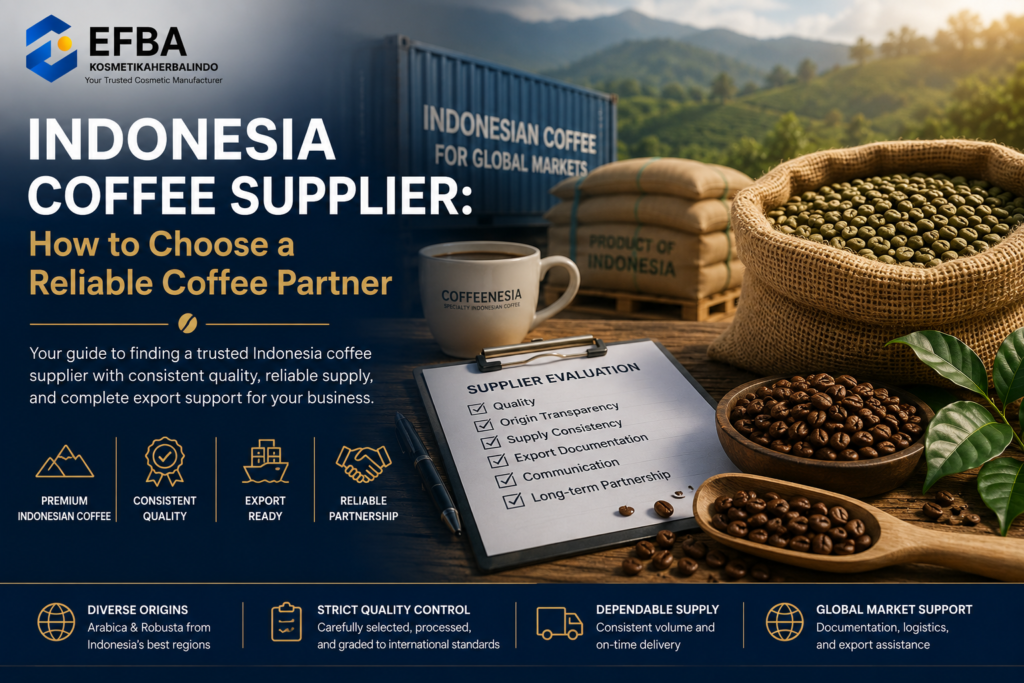
Finding the right Indonesia coffee supplier is an important step for coffee importers, roasters, distributors, and brands looking to source Indonesian coffee for international markets. Indonesia offers a diverse coffee landscape, ranging from distinctive Arabica origins to Robusta produced at significant commercial scale.
However, choosing the right supplier requires more than comparing prices. International buyers should consider coffee quality, origin transparency, processing methods, supply consistency, documentation, communication, and export capability.
Therefore, working with a reliable Indonesia coffee supplier can help your business establish a more consistent and sustainable sourcing relationship.
Table of Contents
ToggleWhy Choose an Indonesia Coffee Supplier?
Indonesia is one of the world’s significant coffee-producing countries and supplies both Arabica and Robusta to international markets.
According to the USDA Foreign Agricultural Service Indonesia Coffee Annual, Indonesia’s coffee production was forecast to reach approximately 11.3 million 60-kilogram bags in 2025/26, while green coffee exports were expected to increase.
More recent USDA global market data continues to position Indonesia among the world’s major coffee-producing countries, although production naturally changes between harvest seasons.
For international buyers, Indonesia also offers access to multiple coffee-growing regions. These include Sumatra, Aceh Gayo, Java, Bali, Flores, Sulawesi, and other producing areas.
As a result, buyers can select Indonesian coffee according to their preferred origin, flavor profile, processing method, quality specification, and target market.
1. Check the Coffee Origin
The first factor to evaluate when choosing an Indonesia coffee supplier is coffee origin.
Indonesia has diverse coffee-growing regions, and each origin can provide different characteristics. Growing altitude, climate, coffee variety, processing method, soil conditions, and harvest practices can all influence the final cup.
For example, buyers interested in premium Arabica may explore coffees originating from Gayo and other Indonesian highland regions. Meanwhile, businesses requiring commercial volumes may also consider Indonesian Robusta.
A professional supplier should therefore provide clear information regarding the origin of the coffee being offered.
Buyers should ask about:
- Coffee origin
- Coffee variety
- Processing method
- Harvest period
- Available grade
- Bean specifications
- Available volume
Origin transparency is especially valuable for roasters and coffee brands that want to communicate a stronger product story to their customers.
2. Evaluate Coffee Quality and Specifications
Quality should be one of the primary considerations when selecting an Indonesia coffee supplier.
Before discussing large-volume orders, buyers should establish clear product specifications.
Depending on the coffee being sourced, these specifications may include moisture content, screen size, defect count, processing method, physical appearance, crop information, and sensory characteristics.
Samples can then be evaluated through physical inspection and cupping.
This process helps buyers determine whether the coffee meets their intended product positioning before moving toward a commercial order.
More importantly, clear specifications reduce misunderstandings between buyer and supplier.
3. Request Coffee Samples Before Ordering
Never evaluate an Indonesia coffee supplier only through photographs or a product description.
Whenever possible, request representative samples before confirming a larger order.
Samples allow buyers and roasters to evaluate the coffee directly. During this process, the team can examine physical quality and conduct cupping to assess characteristics such as aroma, acidity, sweetness, body, balance, and aftertaste.
Sampling also makes it easier to compare several origins or processing methods.
For example, a buyer may compare different Indonesian Arabica origins before deciding which profile best suits a specialty coffee brand.
Therefore, sample evaluation should be considered an important part of the sourcing process.
4. Evaluate Supply Consistency
Finding excellent coffee once is not enough.
Importers, roasters, distributors, and established coffee brands usually require consistent supply over longer periods.
For this reason, an Indonesia coffee supplier should be able to communicate realistically about available volume and future availability.
Ask potential suppliers about:
- Current stock
- Harvest schedules
- Monthly supply capacity
- Lead times
- Storage conditions
- Processing capacity
- Packaging
- Shipment planning
These factors become increasingly important when purchasing larger commercial volumes.
A supplier that communicates capacity transparently can help buyers plan inventory and purchasing more effectively.
5. Check Export Experience and Documentation
International coffee sourcing involves more than purchasing coffee beans. Documentation, logistics, and compliance with export and destination-market requirements are also important.
Indonesia regulates exports through its national trade framework. International buyers and exporters can review current export regulations through the Ministry of Trade of the Republic of Indonesia’s JDIH regulatory database.
Coffee shipments may require different documentation depending on the product, destination country, shipping method, and applicable regulations.
Therefore, buyers should discuss documentation requirements with their supplier before confirming a shipment.
An experienced Indonesia coffee supplier should be able to communicate clearly about available export documents and coordinate the commercial shipment process.
However, importers should also verify the specific requirements applicable in their destination country.
6. Consider Communication and Responsiveness
Communication is one of the most important factors in international sourcing.
A coffee transaction may involve discussions about samples, specifications, pricing, volume, packaging, payment terms, documentation, shipping schedules, and logistics.
Poor communication can therefore create unnecessary delays.
A reliable supplier should respond clearly to questions and provide realistic information regarding product availability.
Furthermore, the supplier should be transparent when specifications, quantities, or schedules cannot be met.
Good communication creates trust and makes long-term cooperation easier.
For international buyers, this can be just as important as competitive pricing.
7. Do Not Choose Based Only on the Lowest Price
Price is naturally an important factor in commercial coffee sourcing.
However, selecting an Indonesia coffee supplier purely because it offers the lowest quotation may create additional risks.
Two coffee offers with different prices may also have different:
- Grades
- Origins
- Defect levels
- Processing methods
- Crop conditions
- Sorting standards
- Packaging specifications
- Logistics arrangements
Therefore, buyers should compare the entire commercial offer rather than price alone.
A better evaluation formula is:
Quality + Origin + Specification + Consistency + Documentation + Communication + Logistics + Price
This approach provides a more complete picture of the actual value offered by a supplier.
Indonesian Arabica and Robusta for Different Markets
One major advantage of sourcing from Indonesia is access to both Arabica and Robusta.
Indonesian Arabica can be suitable for specialty roasters, premium cafés, private-label coffee businesses, and brands seeking distinctive origin characteristics.
Meanwhile, Robusta represents a substantial part of Indonesia’s coffee production and can serve various commercial coffee applications.
The USDA’s July 2026 global coffee market report forecasts Indonesia’s 2026/27 production at approximately 11.4 million 60-kilogram bags, consisting of about 10 million bags of Robusta and 1.4 million bags of Arabica.
Consequently, buyers can select their sourcing strategy according to product positioning, required volume, desired sensory characteristics, and target price range.
Quality Control Matters in Coffee Sourcing
Consistent quality is essential when building a long-term relationship with an Indonesia coffee supplier.
Coffee quality can be affected by harvesting, processing, drying, sorting, storage, packaging, and transportation.
Therefore, quality control should continue throughout the supply chain rather than only during final shipment.
International buyers should establish their expected specifications from the beginning and request appropriate samples before confirming larger purchases.
For recurring orders, buyers may also establish reference samples or agreed quality parameters.
This creates a clearer standard that both parties can follow.
Build a Long-Term Relationship with Your Coffee Supplier
The strongest supplier relationships are usually built over multiple transactions.
Once a supplier understands your preferred origin, specifications, volume, packaging requirements, shipment schedule, and target market, future sourcing can become more efficient.
Long-term cooperation may also provide better visibility into upcoming harvests and available coffee.
Instead of treating each shipment as an isolated transaction, buyers can develop a more strategic sourcing relationship.
A reliable Indonesia coffee supplier should therefore function not simply as a seller, but as a sourcing partner that understands the buyer’s commercial requirements.
Looking for a Reliable Indonesia Coffee Supplier?
If your business is looking for an Indonesia coffee supplier, begin by defining exactly what you need.
Determine your preferred coffee type, origin, processing method, quality specifications, expected volume, packaging requirements, destination country, and shipment schedule.
You can explore Coffeenesia – Coffee and Cascara from Gayo, Indonesia to learn more about Indonesian coffee sourcing opportunities for international buyers.
Coffeenesia focuses on connecting Indonesian coffee with businesses seeking products for international markets.
Before placing a commercial order, buyers can discuss product availability, specifications, samples, volume requirements, packaging, and export arrangements.
With a structured sourcing process and the right Indonesia coffee supplier, importers, roasters, distributors, and coffee brands can build a more reliable supply chain for Indonesian coffee.
FAQ About Indonesia Coffee Supplier
What should I ask an Indonesia coffee supplier before ordering?
Ask about origin, variety, processing method, harvest period, grade, moisture level, defects, available volume, packaging, samples, lead time, documentation, and shipment arrangements.
Can international buyers request samples?
Yes. Requesting samples before placing a commercial order allows buyers to evaluate physical quality and conduct cupping before purchasing larger volumes.
Does Indonesia produce Arabica and Robusta coffee?
Yes. Indonesia is a producer of both Arabica and Robusta. USDA data shows that Robusta accounts for the majority of Indonesia’s coffee production, while Arabica remains important for many origin-focused and premium markets.
How do I choose a reliable Indonesia coffee supplier?
Evaluate coffee quality, origin transparency, specifications, samples, supply consistency, communication, documentation, export experience, logistics capability, and commercial terms. Avoid choosing a supplier based solely on the lowest price.
Why source coffee from Indonesia?
Indonesia provides diverse coffee origins and produces both Arabica and Robusta. This gives international buyers options for specialty, premium, and commercial coffee programs.
Conclusion
Choosing the right Indonesia coffee supplier requires careful evaluation of more than price. Coffee origin, quality specifications, samples, supply consistency, communication, export capability, documentation, and logistics should all be considered before establishing a commercial partnership.
Indonesia’s diverse origins and substantial coffee production make the country an important sourcing destination for international buyers. At the same time, successful sourcing depends on finding a supplier capable of meeting the specific requirements of your business.
By evaluating suppliers systematically and building a long-term relationship with the right partner, your business can create a more consistent and dependable Indonesian coffee supply chain.