
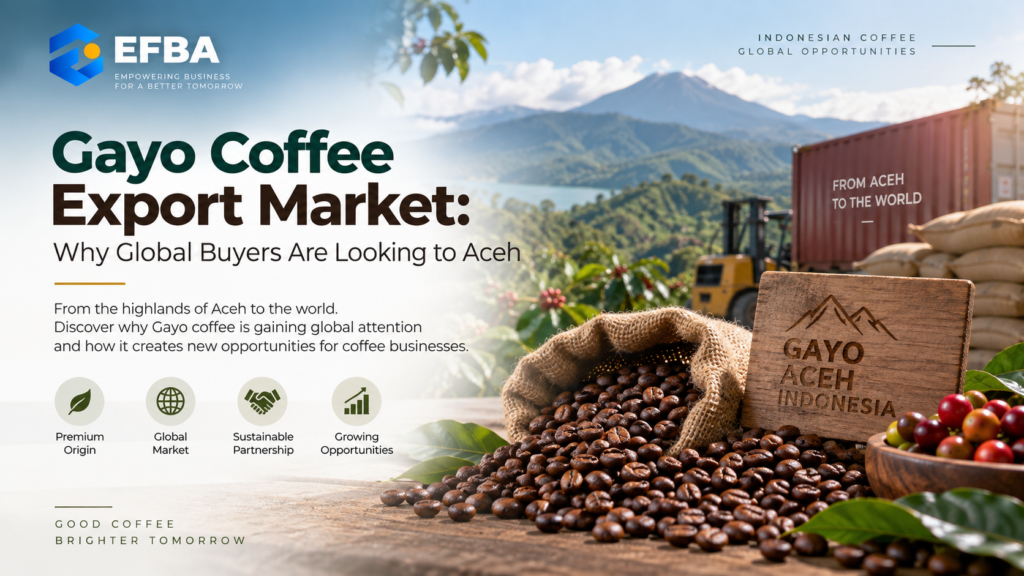
The Gayo coffee export market is gaining international attention as global coffee buyers look beyond price and volume toward origin, quality consistency, traceability, processing, sustainability, and reliable supply relationships. Aceh offers a strong combination of Arabica production, recognized geographical identity, specialty coffee potential, and an established connection with international markets.
For importers, roasters, distributors, cafés, and beverage businesses, however, sourcing Gayo coffee should not depend on origin reputation alone. Buyers need to evaluate the actual lot, processing method, specifications, samples, documentation, supply capacity, traceability, and commercial terms before placing an order.
Recent developments reinforce the commercial relevance of this origin. Bank Indonesia reported in 2026 that the Gayo Highlands cover approximately 120,000 hectares of coffee farms. The same publication documented an Aceh coffee business reaching markets including the United States, South Korea, China, and Japan.
What Is the Gayo Coffee Export Market?
The Gayo coffee export market refers to the international sourcing, trade, and distribution ecosystem surrounding coffee produced in the Gayo Highlands of Aceh, Indonesia.
Gayo is particularly associated with Arabica coffee. WRI Indonesia, citing Ministry of Agriculture data, reported that Aceh averaged approximately 66,000 tonnes of Arabica coffee production annually, with production reaching around 69,000 tonnes in 2022.
Meanwhile, Bank Indonesia reported in August 2026 that approximately 120,000 hectares of coffee farms extend across the Gayo Highlands. Average farmer productivity was reported at around 750 kg per hectare per year, compared with estimated potential of 1.5–2 tonnes per hectare.
These figures demonstrate the scale of the region while also highlighting opportunities to strengthen productivity, post-harvest management, consistency, and access to global markets.
For international buyers, therefore, Gayo is more than an Indonesian coffee origin. It can become part of a long-term sourcing strategy based on measurable quality and transparent supply relationships.
Why Is the Gayo Coffee Export Market Important?
Several factors support the position of the Gayo coffee export market within international coffee sourcing.
First, Gayo has a recognized geographical identity. Furthermore, the region has an established Arabica production base and a strong connection with specialty coffee.
International trade data also confirms that coffee remains relevant to Aceh’s exports. BPS Aceh reported that coffee and spices were among commodities exported from Aceh to the United States in December 2025.
That figure should not be interpreted as the total export volume specifically for Gayo coffee. Nevertheless, it confirms that coffee continues to participate in Aceh’s international trade.
Bank Indonesia also documented in 2026 an Aceh coffee business that had reached export markets including the United States, South Korea, China, and Japan. Again, this represents a documented business example rather than the entire destination profile of Gayo coffee.
For buyers evaluating Indonesian coffee origins, these developments make Aceh worth examining more closely.
1. Gayo Has a Recognized Geographical Identity
Origin is one of the strongest foundations of specialty coffee positioning.
Indonesia’s Directorate General of Intellectual Property lists Kopi Arabika Gayo as a registered Geographical Indication from Aceh under registration number IG.00.2009.000003.
The Directorate General of Estate Crops under Indonesia’s Ministry of Agriculture also lists Kopi Arabika Gayo among plantation products protected by Geographical Indication.
For global buyers, this geographical identity provides an important foundation for origin communication.
A transparent sourcing chain may include:
Country → Region → Producer → Variety → Process → Lot → Quality
As a result, buyers can evaluate coffee beyond a generic “Indonesia coffee” label and develop more specific product positioning around Aceh and Gayo.
For further origin information, buyers can explore Gayo Coffee Origin on Coffeenesia.
2. Aceh Has a Significant Arabica Production Base
Supply availability becomes increasingly important when a buyer moves from samples to wholesale or recurring procurement.
According to Bank Indonesia in August 2026, approximately 120,000 hectares of coffee farms are located across the Gayo Highlands.
However, production area does not automatically mean that every specification, grade, processing method, or quantity will always be available.
Coffee remains an agricultural commodity. Therefore, harvest conditions, weather, post-harvest processing, grading, moisture levels, lot availability, and seasonal conditions can influence supply.
Professional buyers should consequently confirm current specifications and availability directly with the supplier before committing to larger purchases.
3. Specialty Coffee Creates Stronger Market Differentiation
The Gayo coffee export market is not driven solely by volume.
Specialty coffee buyers commonly evaluate origin, sensory characteristics, processing, consistency, traceability, and the story behind a particular lot.
WRI Indonesia describes Gayo as one of Indonesia’s specialty coffee origins and highlights the relationship between coffee production and the natural environment of the Gayo Highlands.
This positioning creates opportunities across several B2B segments, including:
- coffee importers;
- specialty roasters;
- distributors;
- cafés;
- hospitality businesses;
- beverage companies; and
- coffee brands.
However, buyers should not assume that every coffee originating from Gayo automatically meets a particular specialty specification.
Quality needs to be evaluated at the individual lot level.
Buyers can learn more about available sourcing options through Gayo Coffee Beans Grade 1 Bulk Export.
4. Processing Matters in the Gayo Coffee Export Market
Origin tells buyers where coffee comes from. Processing helps determine what happens after harvest.
Post-harvest management can influence physical quality, consistency, sensory characteristics, and commercial suitability.
Therefore, international buyers should ask suppliers about:
- cherry selection;
- processing method;
- drying;
- sorting;
- moisture management;
- storage;
- grading; and
- lot separation.
WRI Indonesia’s Sustainable Gayo Coffee activities in 2026 included farmer training covering cultivation, harvesting, post-harvest handling, and coffee-quality evaluation.
For buyers, this reinforces an important sourcing sequence:
Origin → Harvest → Processing → Drying → Sorting → Storage → Export Preparation
Each stage matters.
Coffeenesia also publishes information about its approach to Gayo coffee sourcing and processing. Buyers can review current information directly through Coffeenesia.
5. Traceability Strengthens Buyer Confidence
Traceability has become increasingly important within the Gayo coffee export market.
Global buyers may need more information about where coffee originates, how it was processed, which lot is being purchased, and how the supply chain is documented.
A useful traceability structure can include:
Origin → Producer/Farm → Variety → Harvest → Process → Lot → Specification → Shipment
This information can support internal quality control, purchasing decisions, sustainability programs, product storytelling, and regulatory due diligence.
Coffeenesia states on its official website that it provides information concerning the origin, variety, and processing methods of its coffee and cascara products. The company also describes direct sourcing and quality-control practices within its Gayo supply chain.
These are company-published statements. Therefore, professional buyers should still evaluate current samples, specifications, documentation, commercial terms, and supply availability before placing an order.
For broader sourcing information, see Indonesian Coffee for Export.
6. Sustainability Is Becoming a Commercial Consideration
Sustainability is increasingly connected to long-term supply security rather than marketing alone.
Coffee production depends on healthy agricultural landscapes, suitable climate conditions, productive farms, farmer capability, and resilient supply chains.
WRI Indonesia’s Sustainable Gayo Coffee initiative focuses on improving productivity and coffee quality while supporting sustainable production in Bener Meriah, Aceh.
Following floods and landslides in late 2025, the initiative was also integrated with recovery efforts aimed at restoring farmer livelihoods and affected coffee production systems.
During 2026, WRI Indonesia continued activities covering Good Agricultural Practices, soil management, pest management, harvesting, post-harvest processing, and coffee-quality evaluation.
For international buyers, this creates a broader perspective on sourcing.
Reliable coffee supply depends not only on today’s inventory but also on whether the production ecosystem can remain productive and resilient over time.
Buyers interested in this topic can explore Gayo Coffee Sustainability.
7. European Buyers Need Greater Supply-Chain Transparency
Regulatory developments also affect the Gayo coffee export market, particularly for coffee entering Europe.
Coffee is among the commodities covered by the European Union Deforestation Regulation framework.
According to the European Commission’s current implementation timeline, the regulation applies from 30 December 2026 for large and medium operators and from 30 June 2027 for most micro and small operators.
This does not mean every Indonesian coffee supplier has exactly the same legal obligations as an EU operator. Responsibilities depend on each actor’s position and role within the supply chain.
Nevertheless, European buyers may increasingly request information related to origin, traceability, geolocation, due diligence, and supply-chain documentation from upstream partners.
Therefore, exporters and buyers should discuss destination-market requirements before shipment rather than assuming that general export documentation will satisfy every market.
What Should Global Buyers Check Before Buying Gayo Coffee?
A lower price does not necessarily represent better purchasing value.
Professional buyers should evaluate both the product and the supplier’s ability to communicate accurate information.
Before purchasing, consider:
- coffee origin;
- sourcing area;
- variety;
- harvest information;
- processing method;
- green or roasted format;
- grade;
- defect specification;
- moisture specification where applicable;
- cupping or sensory information where available;
- lot consistency;
- packaging;
- minimum order quantity;
- current supply capacity;
- traceability;
- commercial documentation;
- shipment terms; and
- destination-market requirements.
This approach makes sourcing decisions more measurable and reduces uncertainty between buyer and supplier.
For bulk purchasing information, buyers can also explore Wholesale Coffee Beans Indonesia.
Green Beans or Roasted Coffee: Which Should Buyers Choose?
The correct format depends on the buyer’s business model. Importers and roasters often evaluate green coffee because they can control roasting according to their market, equipment, and target flavor profile. Meanwhile, distributors, cafés, hospitality businesses, and retail brands may require different formats.
Before requesting a quotation, buyers should prepare a sourcing brief such as: Product → Origin → Process → Grade → Specification → Quantity → Packaging → Destination → Delivery Requirement
A detailed purchasing brief allows suppliers to evaluate whether suitable inventory or lots are currently available. For businesses exploring Indonesian supply more broadly, see Indonesian Coffee Beans.
Quality, Transparency, and Trust in Coffee Export
Strong international coffee relationships depend on more than an attractive origin story. Quality needs evidence. Likewise, transparency requires accurate information, while trust develops through consistency over multiple transactions.
For that reason:
- Quality without transparency creates uncertainty.
- Traceability without consistent quality does not solve the buyer’s commercial requirements.
- Marketing without verifiable information can weaken trust.
International buyers should therefore evaluate samples, specifications, lot information, documentation, commercial terms, and current supply capability before completing a transaction.
This principle applies to Coffeenesia as it does to any other B2B coffee supplier.
How Coffeenesia Approaches Gayo Coffee Sourcing
Coffeenesia positions its business around Indonesian coffee and Gayo coffee sourcing from Aceh.
According to information published on its official website, Coffeenesia describes direct sourcing, processing, quality control, and product information concerning origin, variety, and processing methods.
The website also publishes partnership quantities for different buyer requirements. Because these are company-published statements, buyers should verify current product specifications, available quantities, samples, packaging, commercial documentation, and shipment requirements during the purchasing process.
This provides a more reliable basis for evaluating whether a specific Coffeenesia product fits the buyer’s requirements. For wholesale requirements, visit Gayo Coffee Wholesale or review Coffeenesia’s Indonesian Coffee for Export information.
Export Requirements Depend on the Destination Market
There is no single regulatory requirement that applies identically to every international coffee transaction. Requirements depend on the product, destination country, packaging, buyer, importer, and role of each supply-chain participant. BPOM regulates food and drug products within Indonesia’s regulatory framework. However, an international coffee shipment may also involve Indonesian export requirements and destination-country rules concerning food safety, customs, labeling, traceability, documentation, or due diligence.
Therefore, BPOM registration or another Indonesian requirement should not be presented as automatically satisfying every international market. For Europe, for example, buyers should review applicable EUDR requirements through the European Commission. Suppliers and buyers should confirm the rules for the actual shipment and destination before exporting.
Gayo Coffee Export Market and the Future of Aceh
The future of the Gayo coffee export market depends on more than increasing international demand.
Long-term competitiveness requires the region to combine quality, productivity, traceability, sustainable farming, supply consistency, documentation, and international market access.
WRI Indonesia has highlighted challenges including climate change, changing rainfall patterns, extreme weather, and environmental degradation that can affect coffee productivity and quality.
At the same time, programs involving farmer training, sustainable agriculture, post-harvest improvement, forest protection, quality development, and market access can strengthen the coffee ecosystem.
Bank Indonesia’s 2026 reporting also illustrates how mentoring, exhibitions, buyer meetings, and market development can help connect Aceh coffee businesses with international opportunities.
The commercial pathway can therefore be summarized as: Origin Identity → Quality → Consistency → Traceability → Sustainability → Documentation → Market Access
Why Gayo Matters for International Coffee Buyers
Gayo offers international buyers a combination of recognizable origin, Arabica production, specialty coffee potential, and an evolving sustainability ecosystem. Nevertheless, professional sourcing should remain specification-driven. Buyers should evaluate the actual coffee rather than purchasing solely because a product carries the Gayo name.
That means reviewing: Sample → Quality → Process → Specification → Lot → Traceability → Documentation → Commercial Terms. This approach protects buyers while also supporting the long-term commercial reputation of Gayo as an origin.
From Coffee Sourcing to Business Development
Finding a reliable coffee supply is only one part of developing a coffee business.
Importers, distributors, roasters, cafés, and coffee brands also need to consider target customers, pricing, positioning, distribution channels, operational planning, and growth strategy.
Coffeenesia operates within the broader EFBA ecosystem. Businesses interested in developing commercial opportunities around Indonesian products can learn more through EFBA.
Meanwhile, entrepreneurs developing cafés or coffee-related businesses can also explore EFBA’s coffee business consulting services.
Connecting sourcing with business strategy can help buyers evaluate coffee not simply as a commodity but as part of a sustainable commercial model.
FAQ About the Gayo Coffee Export Market
What is the Gayo coffee export market?
The Gayo coffee export market covers international sourcing and trade involving coffee originating from the Gayo Highlands of Aceh, Indonesia. Buyers may include importers, roasters, distributors, cafés, hospitality businesses, retailers, and beverage companies.
Why is the Gayo coffee export market attracting global buyers?
Global buyers may consider Gayo because of its recognized geographical identity, Arabica production base, specialty-coffee potential, processing diversity, and opportunities for traceable sourcing.
Is Gayo coffee protected as a Geographical Indication?
Yes. Indonesia’s Directorate General of Intellectual Property lists Kopi Arabika Gayo as a registered Geographical Indication from Aceh under registration number IG.00.2009.000003.
Which countries buy Gayo coffee?
There is no single current official dataset in the sources used here representing every destination for all Gayo coffee. However, Bank Indonesia documented an Aceh coffee business in 2026 reaching the United States, South Korea, China, and Japan. BPS Aceh also recorded coffee and spices among Aceh exports to the United States in December 2025.
Is Gayo coffee suitable for specialty coffee buyers?
Gayo is recognized as an Indonesian specialty-coffee origin. However, buyers should evaluate individual lots through samples, specifications, processing information, and quality assessment rather than assuming every Gayo coffee has identical characteristics.
What should buyers check before importing Gayo coffee?
Buyers should review origin, process, variety, grade, specifications, samples, lot consistency, packaging, quantity, traceability, documentation, commercial terms, shipment conditions, and destination-market requirements.
Why is traceability important for Gayo coffee exports?
Traceability helps buyers connect coffee with its origin, production information, processing, and lot. It can support quality assurance, transparency, sustainability programs, product communication, and regulatory due diligence.
Does EUDR affect Gayo coffee exports to Europe?
Coffee falls within the EUDR framework. According to the European Commission’s current timetable, application begins on 30 December 2026 for large and medium operators and 30 June 2027 for most micro and small operators. Exact responsibilities depend on the role of each supply-chain actor.
Explore the Gayo Coffee Export Market with Coffeenesia
The Gayo coffee export market gives global buyers access to one of Indonesia’s recognized Arabica origins. However, successful sourcing requires more than choosing coffee based on regional reputation.
A professional purchasing process should follow:
Origin → Sample → Quality → Process → Specification → Traceability → Documentation → Commercial Terms → Shipment
Coffeenesia provides information about Gayo coffee and cascara sourcing from Aceh for international and B2B buyers.
Before ordering, buyers should discuss current product specifications, samples, quantities, processing, packaging, documentation, pricing, and shipment requirements.
Explore Coffeenesia or review Gayo Coffee Beans Grade 1 Bulk Export to begin evaluating available sourcing options.
Ultimately, the opportunity in the Gayo coffee export market is not simply access to Indonesian coffee. Its stronger commercial value comes from connecting Aceh’s origin identity with measurable quality, transparency, traceability, sustainable production, and reliable international supply relationships.