
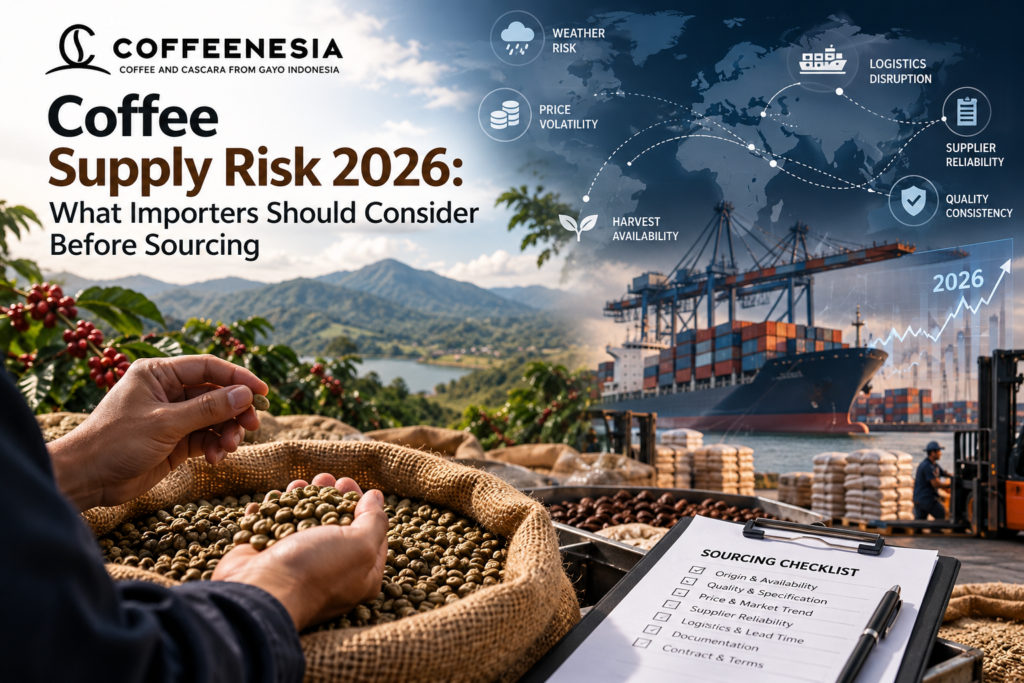
Coffee supply risk 2026 is not limited to whether coffee is available. Importers should evaluate price volatility, origin availability, harvest conditions, quality consistency, processing, specifications, supplier reliability, documentation, lead time, logistics, and shipment terms before confirming a purchase.
The global coffee market remains active, but supply conditions can change quickly. The International Coffee Organization reported that its Composite Indicator Price averaged 287.29 US cents/lb in August 2026. Meanwhile, concerns about El Niño and tight near-term Arabica supply contributed to price movements during the month. Later, expectations of improved supply and favorable rainfall in Brazil helped reverse part of that pressure. International Coffee Organization
For importers, these developments highlight an important principle:
Coffee Availability ≠ Guaranteed Lot Availability
A producing country may have substantial export volumes. However, a specific origin, grade, process, screen size, cup profile, or shipment window can remain limited.
Therefore, importers should use a structured sourcing process:
Requirement → Origin → Availability → Specification → Sample → Quality Evaluation → Commercial Terms → Documentation → Logistics → Shipment
What Is Coffee Supply Risk in 2026?
Coffee supply risk 2026 refers to the possibility that an importer cannot obtain the required coffee at the expected quality, quantity, price, specification, timing, or commercial terms.
This coffee supply risk 2026 can begin at farm level and continue through processing, storage, contracting, documentation, inland transportation, port handling, and international shipment. Therefore, importers need to evaluate the complete supply chain instead of judging a supplier only from a product photo or quoted price.
A practical framework is:
Farm → Harvest → Processing → Quality → Storage → Supplier → Contract → Logistics → Importer
A disruption at one stage can affect the following stages. For example, changes in harvest availability may influence lot selection. Likewise, differences in processing or storage can affect physical and sensory quality.
Why Coffee Supply Risk Matters More to Importers
Coffee is an agricultural commodity. Its supply depends on harvest cycles, weather, regional conditions, post-harvest handling, processing capacity, market demand, and international trade.
The International Coffee Organization reported 12.23 million 60-kg bags of world coffee exports in July 2026, compared with 11.84 million bags in July 2025. For the first ten months of coffee year 2025/26, exports reached 118.39 million bags, almost unchanged from 118.43 million bags during the comparable previous period. International Coffee Organization
However, the composition changed. ICO reported that Arabica exports for the twelve months ending July 2026 reached 80.96 million bags, down from 86.37 million a year earlier. Meanwhile, Robusta exports reached 60.01 million bags versus 54.67 million previously. International Coffee Organization
For buyers, the lesson is straightforward:
Global Supply → Coffee Type → Origin → Grade → Process → Lot Availability
Global export volume alone cannot tell an importer whether the exact coffee required for a purchasing program is available. Therefore, coffee supply risk 2026 requires buyers to look beyond national or global volume figures and confirm availability at lot level.
7 Coffee Supply Risks Importers Should Evaluate in 2026
1. Origin and Harvest Availability
The first risk involves assuming that an origin remains available throughout the year with the same quantity and specification.
Coffee follows agricultural and harvest cycles. As a result, availability can change between crop periods, while weather and farm conditions can influence production and post-harvest activity.
An importer looking for Indonesian coffee should therefore ask more specific questions than simply, “Do you have Arabica?”
The sourcing request should define:
Origin → Variety → Process → Grade → Quantity → Harvest/Crop → Shipment Window
For Gayo coffee, for example, the buyer may need to distinguish between general Gayo Arabica availability and a particular lot with the desired processing method and quality specification.
Coffeenesia focuses on coffee and cascara from the Gayo Highlands of Aceh and publishes Gayo Arabica as its core coffee origin. Buyers can explore the characteristics of the origin through Gayo Coffee Arabica Beans Wholesale from Indonesia. https://coffeenesia.id/
2. Price Volatility
Price should be treated as a variable rather than a permanent supplier promise.
ICO describes its Composite Indicator Price as a key global coffee reference used by public, private, and academic sectors for cost assessment and budgeting. The August 2026 I-CIP averaged 287.29 US cents/lb, virtually unchanged from July’s 287.26 cents/lb. Nevertheless, the monthly market experienced movements associated with supply expectations and weather concerns. International Coffee Organization
For importers, this means they should evaluate quotations together with validity periods, quantity, specification, Incoterm, payment conditions, and shipment timing.
A commercial comparison should therefore look like:
Coffee Price + Quality + Logistics + Documentation + Lead Time + Risk
rather than:
Lowest Price = Best Supplier
The lowest initial quotation may not produce the lowest total procurement cost if the coffee later fails specification, requires replacement, arrives late, or creates additional logistics costs.
Consequently, price volatility remains an important part of coffee supply risk 2026, particularly for buyers planning recurring purchases.
3. Quality and Specification Mismatch
One of the most practical sourcing risks occurs when coffee matches the product name but fails to match the buyer’s actual requirement.
“Gayo Arabica” alone is not a complete purchasing specification.
Importers should clarify variables such as origin, processing method, grade, moisture, defects, physical characteristics, packaging, and expected cup profile where relevant.
Use this sequence:
Product Name → Origin → Process → Grade → Moisture → Defects → Physical Quality → Cup Profile → Packaging
For specialty or quality-sensitive purchasing, request a representative sample before making a larger commercial commitment whenever feasible.
Then follow:
Sample → Sample Roast → Cupping → Evaluation → Approval → Commercial Order
This approach helps buyers separate marketing descriptions from measurable product requirements.
4. Processing and Post-Harvest Variation
Coffee quality does not depend only on where it grows. Harvest maturity, processing, drying, sorting, storage, and handling also influence the final green coffee.
As a result, two lots from the same origin can perform differently.
Coffeenesia states that it directly sources Gayo coffee and oversees production steps to support quality consistency. Its website also describes traceability around origin, variety, and processing method. https://coffeenesia.id/
For importers, the practical approach is to evaluate each commercial lot based on specification and sample. This is safer than assuming every shipment from one origin will remain identical.
Origin Creates Context → Processing Shapes Quality → QC Verifies the Lot
This lot-level approach also helps importers manage coffee supply risk 2026 more systematically.
5. Supplier Reliability Risk
A supplier is not evaluated only by whether it can send coffee once.
Importers should determine whether the supplier can communicate specifications clearly, provide samples, confirm realistic availability, prepare appropriate packaging, manage documentation within its stated scope, and communicate changes before they become shipment problems.
A useful supplier review is:
Supplier → Product → Specification → Sample → Availability → Documentation → Communication → Shipment
Coffeenesia’s official website states that the business focuses on premium single-origin Indonesian coffee and cascara from Gayo. It also publishes direct sourcing, quality control, traceability, customizable packaging, and wholesale partnership tiers as elements of its sourcing model. https://coffeenesia.id/
Those company-published capabilities provide useful starting points for buyer due diligence. However, importers should still confirm the requirements for each actual order.
6. Logistics and Lead-Time Risk
A coffee purchase is not complete when the supplier finishes processing the beans.
The coffee still needs to move through packaging, inland transportation, export preparation, port handling, international freight, customs processes, and destination delivery.
Therefore:
Ready Stock ≠ Delivered Stock
Importers should establish who handles each part of the transaction and confirm the applicable Incoterm.
Before confirming a shipment, align:
Product + Quantity + Price + Packaging + Incoterm + Payment + Documentation + Lead Time + Destination
This approach reduces ambiguity between buyer and supplier. In addition, it makes potential delays easier to identify and manage.
7. Inventory and Reorder Risk
Importers should also consider what happens after the first shipment arrives.
Waiting until inventory is almost depleted before placing the next order can create exposure to production schedules, harvest availability, freight delays, and changing commercial conditions.
A simple procurement framework is:
Current Stock → Average Usage → Procurement Lead Time → Safety Stock → Reorder Point
The appropriate safety stock will differ between businesses. For example, a specialty roaster buying small seasonal lots may use a different strategy from a distributor supplying recurring wholesale customers.
Therefore, the key is to connect sourcing decisions with inventory planning. This approach allows importers to manage coffee supply risk 2026 beyond the first purchase.
What Indonesia’s 2026 Coffee Export Data Tells Importers
Indonesia remains an active coffee exporter.
According to BPS-Statistics Indonesia, coffee exports from January through July 2026 reached 208.1 thousand metric tons. Monthly exports increased from 14.4 thousand tons in March to 49.7 thousand tons in July. Badan Pusat Statistik Indonesia
In value terms, BPS recorded US$1.0076 billion in Indonesian coffee exports from January through July 2026. July alone accounted for US$221.4 million, compared with US$120.0 million in January. Badan Pusat Statistik Indonesia
These numbers demonstrate significant trade activity. However, importers should interpret them correctly.
National Export Volume ≠ Availability of a Specific Gayo Lot
National statistics combine different origins, coffee types, qualities, buyers, and transactions. Therefore, they cannot confirm whether a particular Gayo Arabica grade, process, quantity, or shipment window is currently available.
For sourcing decisions, buyers still need lot-level confirmation.
Weather Risk Does Not Affect Every Indonesian Origin Equally
Weather is an important coffee supply risk, but buyers should avoid treating Indonesia as one uniform production zone.
Indonesia has multiple coffee-producing regions with different elevations, climates, harvest patterns, varieties, and processing traditions. Therefore, a weather event affecting one area does not automatically mean every Indonesian coffee origin faces the same supply problem.
For Gayo sourcing, importers should ask:
What is happening at origin? → How is the current harvest? → What lots are available? → What specifications can be confirmed?
This approach is more useful than making purchasing decisions from broad headlines alone.
For broader Indonesian agricultural sourcing, EFBA Agro International publishes Gayo Arabica coffee among its agricultural commodity portfolio. Its dedicated guide for international buyers also emphasizes specifications, traceability, post-harvest handling, and export support when evaluating an Indonesian Arabica supplier.EFBA Agro International
How Importers Can Reduce Coffee Supply Risk Before Ordering
Managing coffee supply risk 2026 starts with a simple step: define the purchasing requirement before asking for a quotation.
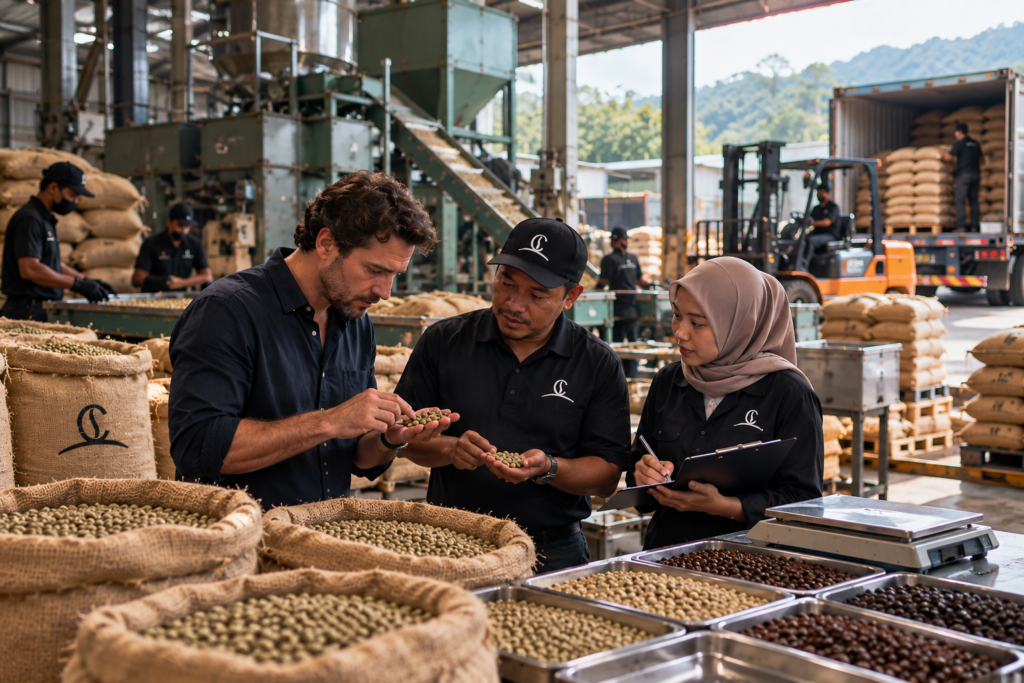
A buyer should prepare a sourcing brief containing the product, origin, processing method, grade, target quantity, quality requirements, packaging, destination, preferred shipment window, and commercial requirements. With these details ready, suppliers can respond with information that matches the actual purchasing need.
Then use:
Buyer Requirement → Supplier Matching → Specification → Sample → Evaluation → Commercial Confirmation → Shipment
If some requirements remain flexible, separate them into three levels:
Must Have → Preferred → Flexible
For example, origin and grade may be mandatory, while packaging format or shipment timing may allow some flexibility.
As a result, both parties can focus on suitable coffee instead of spending time discussing products that cannot meet the buyer’s core requirements. This approach also gives importers better visibility into coffee supply risk 2026 before they commit to an order.
Why Sample Approval Matters Before Bulk Coffee Sourcing
A product page can help buyers discover coffee, but it should not replace lot evaluation when managing coffee supply risk 2026.
For commercial sourcing, a sample provides information that marketing copy cannot fully communicate. Importers and roasters can examine physical quality, roast behavior, aroma, cup profile, defects, and overall suitability for the intended market.
Therefore, a more disciplined purchasing sequence is:
Specification → Sample → Evaluation → Feedback → Confirmation → Commercial Order
For buyers interested in Gayo coffee, Coffeenesia publishes wholesale products such as Gayo Coffee Beans Grade 1 Bulk Export and Gayo Coffee Beans Specialty 60kg Bulk Wholesale. These pages can help buyers understand available product positioning before discussing current lot specifications. https://coffeenesia.id/
Coffeenesia’s Role in Gayo Coffee Sourcing
Coffeenesia positions itself as a source of single-origin Indonesian coffee and cascara from the Gayo Highlands of Aceh. Its official website states that it uses direct sourcing, oversees coffee and cascara production for quality control, and provides transparency regarding origin, variety, and processing methods. https://coffeenesia.id/
The company also publishes wholesale partnership quantities beginning with a 25 kg Merchant Tier, followed by a 100 kg Wholesale Tier and a Distributor Tier above 250 kg. Packaging options published by Coffeenesia range from smaller pouches to larger bags and can be adapted to market needs. https://coffeenesia.id/
These published options may help buyers start at different procurement scales. However, actual availability, specification, quotation, packaging, lead time, and shipment terms should still be confirmed for each inquiry.
For importers, the practical Coffeenesia sourcing process can therefore be understood as:
Buyer Requirement → Gayo Product Matching → Specification → Sample → Buyer Evaluation → Commercial Confirmation
This process gives buyers a clearer basis for assessing coffee supply risk 2026 because the discussion focuses on the actual coffee required rather than broad origin descriptions alone.
How EFBA Agro Supports the Wider Commodity Perspective
Coffee sourcing is part of a broader agricultural supply chain. Therefore, managing coffee supply risk 2026 also requires an understanding of how origin, supplier, quality, documentation, and logistics connect with one another.
EFBA Agro International publishes Gayo Arabica coffee among its Indonesian agricultural commodities alongside products such as cascara, cassava-based products, and other agricultural goods. Its coffee sourcing guidance emphasizes that international buyers should consider quality specifications, sourcing reliability, traceability, and post-harvest handling. Efba Agro International
(logo efbaagro)
This broader commodity perspective matters because agricultural procurement involves more than product selection.
Origin → Supplier → Specification → Quality → Documentation → Logistics → Buyer
For importers building an Indonesian sourcing portfolio, evaluating these links can reduce procurement uncertainty and provide a more practical framework for managing coffee supply risk 2026.
Business Risk Planning Beyond the Coffee Lot
Importers should also consider how a supply disruption affects the wider business. In the context of coffee supply risk 2026, a delayed shipment or unavailable lot can affect more than the purchasing department.
If a shipment is delayed or a preferred lot becomes unavailable, the consequences can extend to roasting schedules, customer contracts, inventory, cash flow, pricing, and product availability.
The business impact can be mapped as:
Supply Disruption → Inventory → Production → Sales → Cash Flow → Customer Commitment
This is where broader business planning becomes relevant. PT EFBA Digital Mulia operates in business consulting and development, providing a complementary business perspective beyond commodity sourcing itself. EFBA
For importers, the goal is not to eliminate every risk. Agricultural sourcing will always contain variables. Instead, businesses should identify the exposure early enough to prepare alternatives and protect purchasing continuity.
Coffee Importer Checklist Before Sourcing in 2026
A practical coffee supply risk 2026 checklist can help importers review the main purchasing variables before placing an order.
Before placing an order, importers should be able to answer these questions:
- Origin: Where exactly does the coffee come from?
- Product: Arabica, Robusta, specialty coffee, or another specification?
- Process: Washed, natural, honey, wet-hulled, or another process?
- Quality: What grade, moisture, defect, physical, and sensory parameters apply?
- Sample: Can the lot or representative product be evaluated before a larger order?
- Quantity: Is the required volume currently available?
- Packaging: What packaging format will be used?
- Commercial Terms: What price, payment conditions, and Incoterm apply?
- Lead Time: When can the supplier realistically prepare the shipment?
- Documentation: Which documents can the supplier provide and which does the importer require?
- Contingency: What happens if the required lot, shipment window, or specification changes?
A strong procurement decision connects all of them:
Quality + Availability + Commercial Terms + Documentation + Logistics + Supplier Communication
Together, these factors give buyers a more complete view of coffee supply risk 2026 before they commit capital to a shipment.
FAQ
What are the main coffee supply risks in 2026?
The main coffee supply risk 2026 factors include price volatility, harvest and origin availability, quality variation, specification mismatch, processing differences, supplier reliability, documentation, logistics delays, and inventory planning. The relevance of each factor depends on the origin and purchasing requirement.
Is there a coffee shortage in 2026?
It is more accurate to evaluate specific coffee types and origins than to describe the entire market as simply being in shortage. ICO reported stable overall exports during the first ten months of coffee year 2025/26 compared with the previous period, while Arabica and Robusta export trends differed. International Coffee Organization
Therefore, buyers evaluating coffee supply risk 2026 should look beyond a general shortage narrative and check the specific origin, grade, process, and lot they need.
Is Indonesian coffee available for export in 2026?
Yes, Indonesia continues exporting significant volumes of coffee. BPS recorded 208.1 thousand metric tons of coffee exports from January through July 2026, valued at approximately US$1.008 billion. This national figure does not guarantee availability of a specific origin, grade, process, or lot. Badan Pusat Statistik Indonesia
For that reason, importers should assess coffee supply risk 2026 at the lot level rather than relying only on national export figures.
What should importers check before buying coffee from Indonesia?
Importers should confirm origin, processing method, grade, moisture and defect requirements where applicable, sample quality, quantity, packaging, commercial terms, documentation, shipment timing, and supplier communication.
These checks help buyers identify the main sources of coffee supply risk 2026 before confirming a commercial order.
Should importers request coffee samples before ordering?
For quality-sensitive or specialty coffee purchases, sample evaluation can reduce specification risk. Buyers can compare physical characteristics and cup performance against their requirements before making a larger commercial commitment.
This step also helps reduce coffee supply risk 2026 related to quality mismatch and lot inconsistency.
Does a low coffee price mean a better sourcing deal?
Not necessarily. Buyers should consider total procurement cost, including quality, freight, documentation, lead time, potential delays, and the financial impact of a rejected or unsuitable lot.
Therefore, price alone should not determine a sourcing decision when assessing coffee supply risk 2026.
How can importers reduce coffee supply risk?
To manage coffee supply risk 2026, define purchasing specifications clearly, evaluate samples, confirm current lot availability, agree commercial and shipment terms in writing, maintain appropriate inventory planning, and prepare alternatives for critical sourcing requirements.
Can Coffeenesia supply Gayo coffee for wholesale buyers?
Coffeenesia publishes wholesale Gayo coffee and cascara sourcing from Aceh, with partnership tiers beginning at 25 kg and options for larger wholesale and distributor volumes. Buyers should contact Coffeenesia to confirm current lot availability, specification, pricing, packaging, and shipment terms for the intended destination. https://coffeenesia.id/
Source Gayo Coffee with Better Risk Visibility
Coffee supply risk 2026 should not stop importers from sourcing. Instead, it should change how sourcing decisions are made. Rather than purchasing based only on origin and price, buyers should evaluate availability, specification, sample quality, commercial terms, documentation, logistics, and supplier communication.
A stronger sourcing process is:
Requirement → Supplier → Specification → Sample → Quality Evaluation → Availability → Commercial Terms → Documentation → Logistics → Shipment → Reorder Planning
For buyers seeking Gayo Arabica from Indonesia, Coffeenesia provides single-origin coffee sourcing from the Gayo Highlands, with published direct-sourcing, traceability, quality-control, packaging, and wholesale options.https://coffeenesia.id/

Start with your required origin, process, specification, quantity, packaging, destination, and shipment window. Then confirm the current lot before making the commercial decision. For wider Indonesian agricultural sourcing, explore EFBA Agro International, while broader business development and risk planning can be explored through PT EFBA Digital Mulia.