
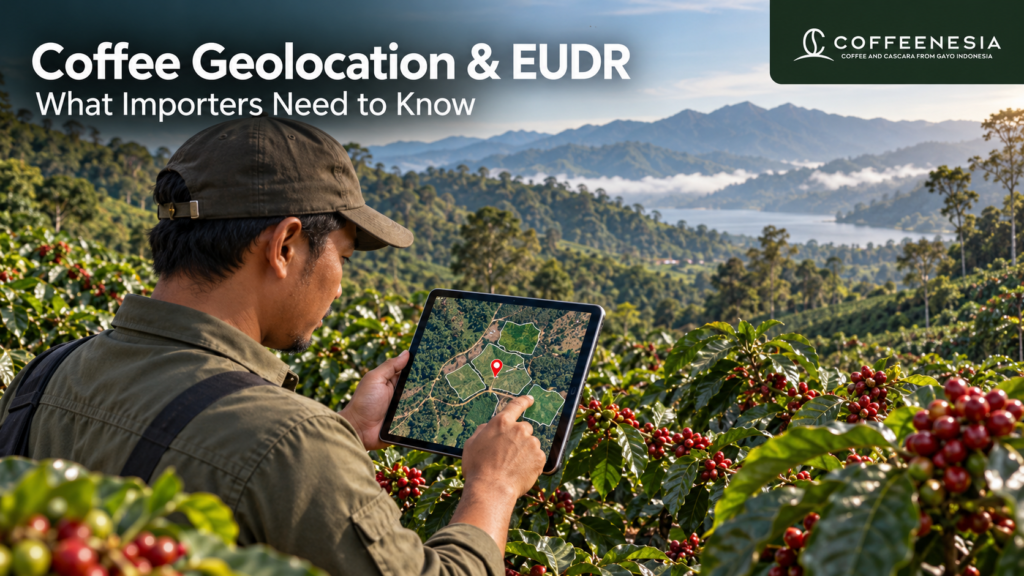
Coffee Geolocation EUDR: Requirements, Traceability, and Compliance for Buyers
Coffee geolocation EUDR refers to identifying the geographic locations of the production plots behind a coffee shipment under the European Union Deforestation Regulation. For coffee importers, coffee geolocation EUDR requirements involve collecting plot-level coordinates, connecting production locations to specific lots, and supporting the wider due diligence process. However, coordinates alone do not establish compliance. Operators must also address deforestation-free production, relevant legislation, and the applicable due diligence requirements. EUR-Lex
Why Coffee Geolocation Matters for EUDR Compliance
The EU Deforestation Regulation links market access for covered commodities with evidence about where products originated. For coffee buyers, an origin description such as “Gayo, Indonesia” provides useful commercial information, but it does not identify individual production plots. Similarly, a warehouse address or cooperative office location cannot replace the geographic information for the farms where the coffee was produced. This is why coffee geolocation EUDR compliance requires reliable plot-level information linked to the relevant coffee supply chain.
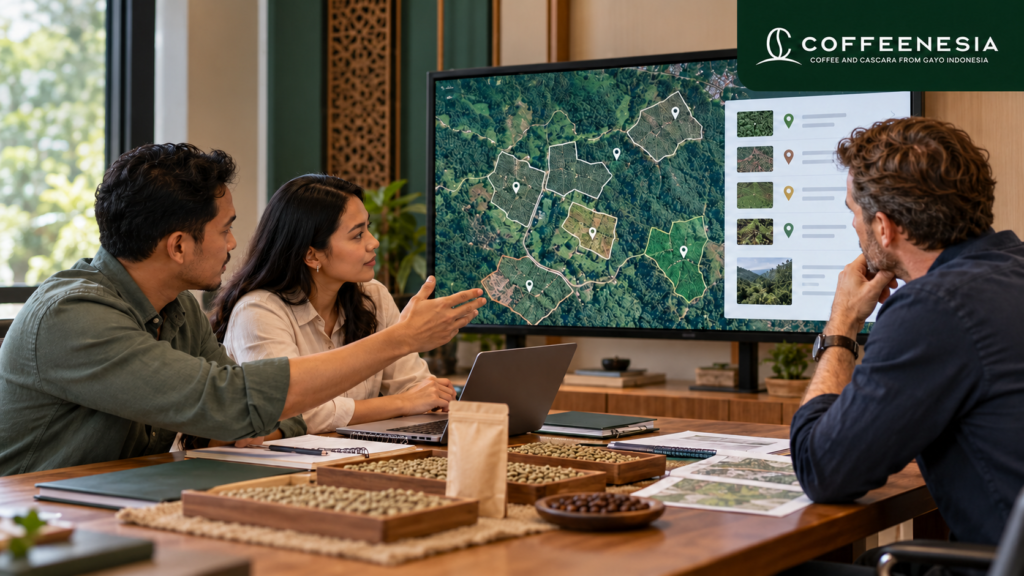
The requirement becomes particularly important when suppliers aggregate coffee from several smallholders. An attractive origin story cannot establish which farms contributed to a specific shipment. Buyers should therefore request records linking production plots, collection batches, processing lots, and export lots. These records help turn coffee geolocation EUDR data into practical traceability evidence that can support the operator’s due diligence process.
What Are the Coffee Geolocation EUDR Requirements?
1. Identify Every Contributing Production Plot
Article 9 requires geolocation information for all production plots contributing to the relevant product, together with the production date or time range. If one coffee lot contains beans from several plots, the information must cover all contributing plots. Reporting only the largest farm can leave gaps in the supply-chain record.
For buyers reviewing coffee geolocation EUDR documentation, the key question is whether the supplier can connect each contributing plot to the relevant coffee lot. Establish how farm information is collected, maintained, and preserved during aggregation and processing. EUR-Lex
2. Use Points or Polygons According to Plot Size
Article 2 defines geolocation through latitude and longitude coordinates with at least six decimal digits. For coffee production plots larger than four hectares, operators must provide polygons containing enough coordinate points to describe each plot’s perimeter. For plots of four hectares or less, a geolocation point can satisfy the standard location requirement.
These coffee geolocation EUDR requirements concern the size and location of the production plot, not the total size of the supplier’s business.
| Production plot | Standard geolocation requirement |
|---|---|
| Four hectares or less | At least one latitude and longitude point, using at least six decimal digits |
| More than four hectares | A polygon describing the plot perimeter |
| Several plots contributing to one lot | Geolocation information covering all contributing plots |
The table summarizes the standard requirements relevant to coffee sourcing. Specific provisions may apply to eligible micro or small primary operators, so businesses should confirm their legal role before relying on an exception. A small Indonesian supplying farm does not automatically exempt an EU importer from its own obligations. Importers should assess their role and the applicable requirements. European Commission
3. Check Geolocation Data Quality Before Accepting the Lot
Coordinate precision does not prove that the correct production location has been recorded. As a practical procurement check, compare the submitted coordinates with the stated origin, plot identifier, and available supporting records. Review polygon boundaries and investigate missing or inconsistent information before accepting the documentation.
For effective coffee geolocation EUDR verification, suppliers and buyers should agree on a correction process for inaccurate coordinates, incomplete plot records, and discrepancies between production and export lot identifiers. This helps identify documentation gaps before shipment preparation is complete.
Coffee Geolocation EUDR: Why Coordinates Do Not Replace Due Diligence
A mapped farm is not automatically a compliant farm. Under the EUDR, the deforestation-free requirement concerns production on land that has not undergone deforestation after 31 December 2020. Operators must also address relevant legislation in the country of production. Coffee geolocation EUDR data helps identify the land that must be assessed, but it does not replace the assessment itself. EUR-Lex
The European Commission describes due diligence as a process involving information collection, risk assessment, and risk mitigation where necessary. Certification or third-party verification can provide supporting information, but operators must assess whether that information meets the regulation’s requirements. Where an assessment identifies more than negligible risk, appropriate mitigation is necessary before proceeding.
Consequently, coffee geolocation EUDR compliance should not rely solely on a supplier’s sustainability statement or a map of the production area. Buyers should review the available evidence and identify any unresolved gaps that could affect the responsible operator’s due diligence assessment. European Commission
Official EUDR Application Dates and Indonesia’s Risk Classification
As checked on 16 October 2026, the European Commission publishes the following application dates. Large and medium operators face application from 30 December 2026. Eligible micro and small operators established as such by 31 December 2024 benefit from application from 30 June 2027, subject to the regulation’s conditions. Importers should determine eligibility using the applicable legal criteria rather than informal descriptions such as “small business.” European Commission
| Item | Published official position |
|---|---|
| Large and medium operators | Application from 30 December 2026 |
| Eligible micro and small operators | Application from 30 June 2027 |
| Indonesia country classification | Standard risk |
| Newly added products, including soluble coffee | Application from 30 December 2027 under the published scope update |
Indonesia appears in the European Commission’s standard-risk category. This classification does not prohibit Indonesian coffee imports or establish that an individual shipment is non-compliant. However, it does not provide the low-risk basis for simplified due diligence. Buyers should assess the relevant supply chain and supporting evidence for each purchase, including the coffee geolocation EUDR records available for the proposed lot. European Commission
The Commission also distinguishes newly added products from coffee products already within scope. Its published update gives newly added products, including soluble coffee, an application date of 30 December 2027. Importers should verify the product’s classification against the current Annex I rather than assuming that every coffee product follows the same scope or transition arrangements. European Commission
What Documents Should Coffee Importers Request?
Build the documentation request around a specific proposed lot. Start with the production locations and records connecting those locations to the goods. Then review the supporting evidence needed for legality and deforestation assessment. Agree on the required format and delivery deadline before committing to shipment.
A practical coffee geolocation EUDR checklist can help buyers identify the information they need to request from suppliers.
| Information | What the importer should clarify |
|---|---|
| Product identity | Coffee type, quantity, product classification, and lot reference |
| Production origin | Country, plot identifiers, and point or polygon data |
| Production period | Relevant harvest or production date range |
| Supply-chain records | Connections between farms, collection, processing, storage, and export lots |
| Compliance evidence | Relevant legality and deforestation-free supporting information |
| Data management | Responsible contact, correction procedure, and change notifications |
Treat this table as a procurement checklist rather than a complete legal filing template. An invoice, certificate of origin, or cupping report serves a different purpose from plot-level evidence. Ask suppliers to explain any gaps before combining quality approval with compliance approval. Keep sensitive producer information within agreed access and handling arrangements.
How to Handle Coffee Blends and Aggregated Lots
Aggregation requires particular care because several farms can contribute to one export lot. Consider an illustrative lot sourced from ten plots: mapping only eight does not establish the origin of the remaining contribution. The buyer should resolve that gap before treating the lot as fully documented.
For coffee geolocation EUDR traceability, suppliers should maintain clear records when coffee moves through collection, processing, storage, and shipment. Check whether lot identifiers remain consistent and whether records explain any splitting or combining of batches. Request clarification when quantities or references do not reconcile. These practical checks help buyers identify traceability gaps and support the wider due diligence process.
Coffeenesia’s Role in Origin-Based Coffee Sourcing
Coffeenesia’s website describes Gayo sourcing, quality control, and transparency regarding origin, variety, and processing methods. Its Gayo coffee product page presents several processing options and technical specifications. Importers can use this information to begin discussions about product suitability and available lots. For additional background, read the Gayo coffee export guide. You can also visit Coffeenesia.
For coffee geolocation EUDR inquiries, request the actual documentation available for the proposed shipment. Website statements about origin and traceability do not independently demonstrate that every lot has a complete EUDR evidence package. Confirm coordinate availability, plot coverage, supporting records, and outstanding gaps before purchase. The responsible EU operator retains its applicable due diligence obligations.
For wider Indonesian commodity sourcing, EFBA Agro International publishes agricultural supply and export-coordination services, including coffee. Coffeenesia’s website also identifies it as a member of EFBA Digital Mulia. These links provide commercial context for buyers exploring the wider network, but they do not replace shipment-specific compliance checks or establish that any particular lot meets EUDR requirements.
FAQ About Coffee Geolocation EUDR
What is coffee geolocation EUDR?
Coffee geolocation EUDR refers to the geographic information identifying the production plots where coffee was grown. It helps connect a coffee shipment to its origin and supports the information collection required under the EU Deforestation Regulation. However, geolocation alone does not establish full compliance.
What coordinates are required for coffee geolocation EUDR?
Under the standard requirements, coordinates must use latitude and longitude with at least six decimal digits. Plots larger than four hectares require polygons describing their perimeters, while plots of four hectares or less can generally use a geolocation point. Buyers should confirm the applicable requirements for the specific operator and product.
Does coffee geolocation EUDR prove that coffee is deforestation-free?
No. Geolocation identifies the production land that needs to be assessed. Operators must also evaluate whether the coffee meets the deforestation-free requirement and whether relevant production-country legislation has been complied with. The required due diligence process goes beyond collecting coordinates.
What documents should buyers request for coffee geolocation EUDR?
Buyers should request plot-level coordinates or polygons, production-period information, lot identifiers, and records connecting farms to collection, processing, and export lots. They should also review supporting information relevant to legality and deforestation-free production. The exact documentation needed depends on the product, operator, and applicable requirements.
Can buyers change coffee origins if geolocation records are incomplete?
An alternative origin may be considered if the replacement coffee meets product specifications, commercial requirements, and applicable regulatory obligations. Buyers should verify its production locations and supporting records before approving the replacement. Switching origins does not remove the need for the responsible operator to conduct due diligence.
Can Coffeenesia or EFBA Agro guarantee coffee geolocation EUDR compliance?
Do not assume compliance from a website description or general sourcing statement. Buyers should request and review the documentation for the actual proposed lot, including plot coverage, coordinate availability, and relevant supporting evidence. The responsible operator remains accountable for its applicable due diligence obligations.
Discuss Coffee Geolocation EUDR Requirements with Your Supplier
Managing coffee geolocation EUDR requirements starts with understanding where the coffee was produced and how its origin can be traced through the supply chain. Check plot coordinates, production records, lot identifiers, quality information, and supporting compliance evidence before confirming a purchasing decision.
For sourcing inquiries, visit Coffeenesia to discuss coffee origin, available products, and lot-specific documentation. You can also explore EFBA Agro International for wider Indonesian agricultural sourcing information. Ask for current evidence relating to the actual shipment and assess any documentation gaps before proceeding.
Frequently Asked Questions
Does every coffee farm need a polygon for EUDR?
Under the standard rules, coffee plots larger than four hectares require polygons. Plots of four hectares or less can use a geolocation point. Coordinates must use at least six decimal digits. Importers should confirm whether any specific legal simplification applies to their situation.
Is a cooperative’s address enough for coffee geolocation?
A cooperative address identifies an organization rather than the production plots. Standard EUDR requirements concern the land where the coffee grew. If several farms contribute to a lot, the records must cover those contributing plots. Buyers should also verify the connection between those plots and the shipment.
Does coffee certification guarantee EUDR compliance?
Certification can contribute useful supporting information. It does not automatically satisfy the operator’s due diligence obligations. Buyers must assess the evidence against the applicable requirements. Geolocation, legality, traceability, and risk assessment still need attention.
Can importers source Indonesian coffee under EUDR?
Indonesia’s standard-risk classification does not prohibit coffee imports. The responsible operator must meet the applicable EUDR requirements. Buyers should request shipment-specific origin records and supporting evidence. Supplier selection should consider documentation readiness alongside quality and commercial terms.
Discuss Your Coffee Sourcing Requirements with Coffeenesia

Begin with your destination market, coffee specifications, volume, and intended shipment date. Include your coffee geolocation EUDR documentation requirements in the initial inquiry. Ask which plot-level records and supporting documents are available for the proposed lot. Contact Coffeenesia to discuss sourcing options and documentation availability before confirming your purchase.