
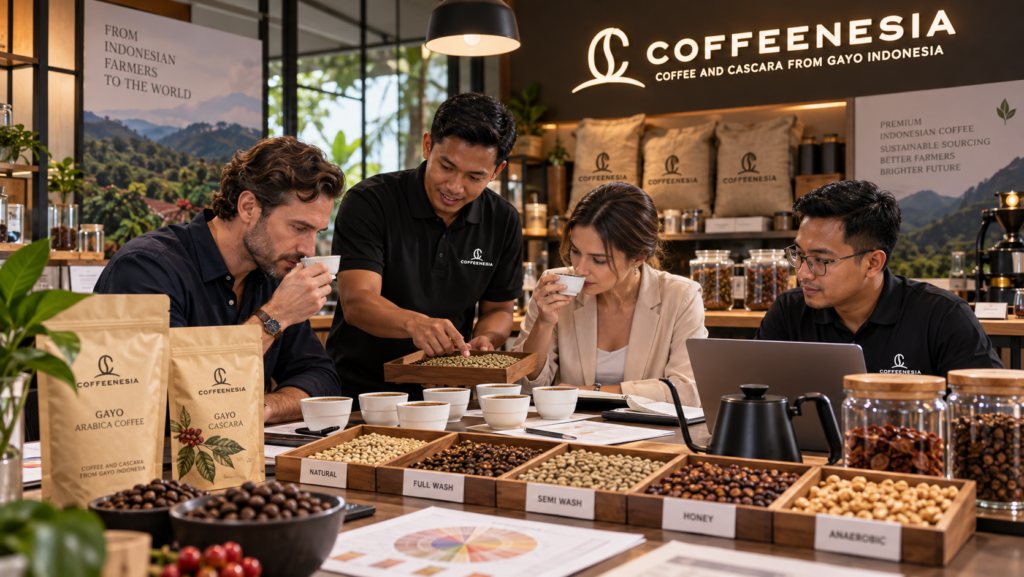
Finding a sustainable coffee supplier Indonesia buyers can rely on requires more than comparing price, origin, and cupping notes. Global importers, specialty roasters, distributors, cafés, and beverage companies should evaluate how coffee is sourced, processed, traced, quality-controlled, packed, and supplied before establishing a long-term purchasing relationship.
Indonesia offers a large and diverse coffee supply base. USDA’s latest available 2025/26 estimate puts Indonesian coffee production at 12.5 million 60-kg bags, while green-bean exports are estimated at 7.8 million bags. Meanwhile, Indonesia’s official BPS plantation statistics provide coffee production, planted-area, export, import, destination-country, and provincial data, confirming coffee’s continuing role as an important Indonesian agricultural commodity.
However, sustainability should not be treated simply as a marketing label. Buyers should examine origin traceability, relationships with farmers, agricultural practices, post-harvest management, quality consistency, environmental practices, packaging, documentation, and supply continuity. Therefore, selecting a sustainable coffee supplier Indonesia requires both sustainability assessment and commercial due diligence.
A practical sourcing framework is:
Origin → Farmer Network → Farming Practices → Harvest → Processing → Quality Control → Traceability → Packaging → Logistics → Buyer
This is also where Coffeenesia positions its sourcing model. Its official website states that Coffeenesia works directly with the Gayo coffee ecosystem, manages its own farms, works with local farmers and the Gayo Coffee Cooperative, oversees processing, and provides traceability regarding origin, variety, and processing method.
For global buyers, the goal is therefore not simply to find coffee from Indonesia. Instead, the objective is to identify a supplier that can explain where the coffee comes from, how it is processed, how quality is controlled, and how the supply relationship can be maintained over time.
What Is a Sustainable Coffee Supplier in Indonesia?
A sustainable coffee supplier Indonesia buyers can work with should connect commercial coffee requirements with responsible sourcing and long-term supply-chain management. Sustainability can include environmental, social, agricultural, economic, and operational considerations. However, buyers should ask for concrete practices rather than relying only on broad claims.
For example, traceability helps buyers understand the origin of the beans. Farmer relationships can improve communication at origin, while responsible processing and quality control help protect the commercial consistency that roasters and distributors need.
A useful way to assess a supplier is:
Sustainable Coffee = Responsible Origin + Farmer Relationship + Environmental Practices + Quality + Traceability + Commercial Reliability
These elements matter because sustainability and commercial performance are interconnected. A farming system that cannot remain productive, a supply chain that cannot identify its origin, or a supplier that cannot maintain quality may create long-term sourcing risk.
Therefore, evaluating a sustainable coffee supplier Indonesia should include both responsible sourcing practices and commercial reliability. Indonesia’s Ministry of Agriculture also identifies climate adaptation, soil and water conservation, shade management, improved planting material, and farmer capacity as important elements for maintaining the sustainability of national coffee production.
Why Indonesia Matters to Global Coffee Buyers
Indonesia combines large-scale coffee production with highly differentiated origins. Coffee grows across several islands and production environments, creating opportunities for buyers looking for both commercial supply and distinctive specialty profiles.
The USDA’s December 2025 semi-annual report revised Indonesia’s 2025/26 production estimate upward to 12.5 million 60-kg bags, an increase of 18% from 2024/25 in its estimate. The same report estimated green-bean exports at 7.8 million bags, supported by improved production and international demand.
Official BPS data also show Indonesia exports coffee to numerous international destinations. Its updated 2000–2025 destination table includes markets such as Japan, Singapore, the United States, Germany, Italy, Malaysia, and others, illustrating the established international trade network for Indonesian coffee.
For specialty buyers, however, national production volume is only the beginning. Buyers can examine coffee through several sourcing layers:
Indonesia → Region → Farm/Cooperative → Variety → Processing → Lot → Cup Profile
Understanding these layers helps buyers move from purchasing generic Indonesian coffee toward sourcing a product with a clearer identity. In addition, choosing a sustainable coffee supplier Indonesia can provide a more structured way to evaluate origin, traceability, quality, and long-term sourcing potential.
What Global Buyers Should Look for in a Sustainable Coffee Supplier Indonesia
Not every coffee supplier operates with the same sourcing model. Therefore, before placing an order, international buyers should evaluate a sustainable coffee supplier Indonesia beyond its price list and product photos.
The following factors provide a practical sourcing checklist.
1. Clear Coffee Origin and Traceability
Origin should be one of the first questions a buyer asks. A supplier should be able to explain where the coffee originates and provide relevant information about the production area, processing method, variety, and lot specifications when available.
Traceability can be understood as:
Country → Region → Production Area → Farmer/Group → Processing → Lot → Buyer
Coffeenesia states that it provides transparency regarding origin, variety, and processing methods across its products. Its primary coffee operation is connected to the Gayo Highlands in Aceh, while the company’s coffee page publishes specifications for individual processing methods.
For example, Coffeenesia lists its Natural Process coffee as originating from Gayo, Takengon, Aceh, at approximately 1,300–1,500 meters above sea level, with Ateng, Bourbon, and Typica among the stated varieties.
For global buyers, this level of information is considerably more useful than a bag labelled only “Indonesia Arabica.” Therefore, a sustainable coffee supplier Indonesia should be able to communicate relevant origin and traceability information before buyers move toward larger commercial orders.
2. Direct Relationships with Farmers and Cooperatives
Sustainable sourcing begins at farm level. A supplier that maintains relationships with farmers or cooperatives can have better visibility into harvest conditions, processing, quality requirements, and production challenges.
However, buyers should distinguish between direct relationships and vague claims about “supporting farmers.”
Coffeenesia’s official website states that its story begins in the Gayo Highlands and identifies the company as part of the Gayo Coffee Cooperative. It also states that Coffeenesia manages its own farms and works with local coffee communities, while purchases contribute to the well-being of local farmers and the broader Gayo coffee ecosystem.
Its published sourcing model therefore connects:
Farmers → Gayo Coffee Cooperative → Processing → Coffeenesia → Global Buyer
This farmer connection is especially relevant for buyers seeking a stronger origin story alongside commercial coffee supply. In addition, evaluating farmer and cooperative relationships can help buyers understand how a sustainable coffee supplier Indonesia connects commercial sourcing with its origin network.
3. Responsible Farming Practices
Sustainability should also reach the farm itself. When assessing a sustainable coffee supplier Indonesia, global buyers should therefore look beyond the warehouse and examine relevant practices at the production level.
For example, buyers can ask about shade management, soil conservation, water use, chemical inputs, biodiversity, climate adaptation, and other practices relevant to the specific production environment.
Indonesia’s Ministry of Agriculture currently highlights adaptive cultivation technologies, climate-tolerant planting materials, shade-tree management, soil and water conservation, and farmer capacity development as measures for protecting coffee production against climate risk.
Coffeenesia also publishes its own environmental commitments on its website. The company states that it promotes eco-friendly and regenerative practices, minimizes water use, converts remaining coffee pulp into natural compost, and has a stated commitment to pesticide-free production.
However, these are company-published practices rather than an independent sustainability certification claim. Global buyers that require a particular certification should therefore request the specific certificate and its current scope directly rather than assuming certification from sustainability language alone. Pasted markdown
4. Selective Harvesting and Post-Harvest Control
High-quality green coffee starts before the beans reach the warehouse. Therefore, harvest selection and post-harvest handling deserve attention during supplier evaluation.
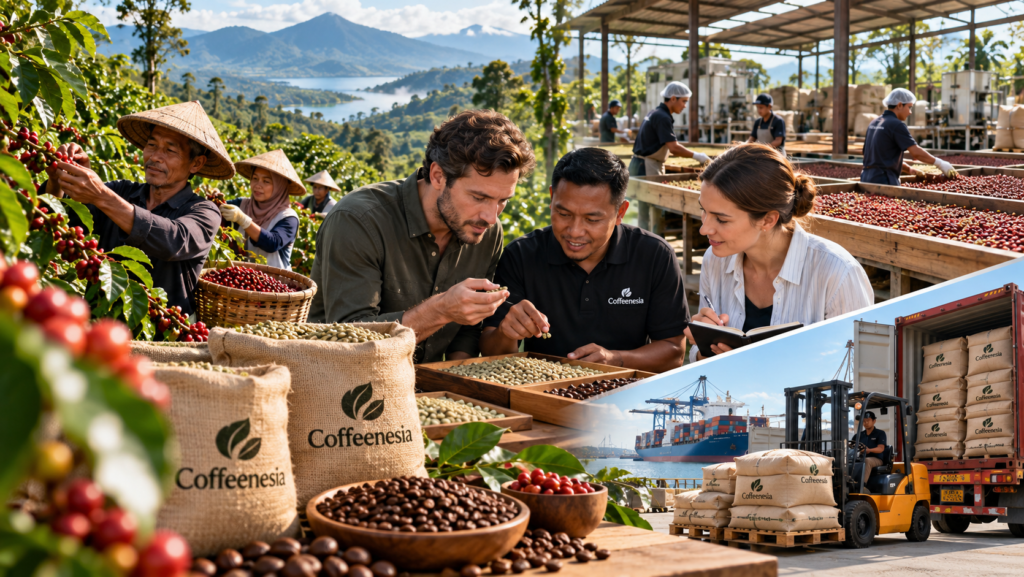
Coffeenesia states that its farmers use selective red picking, harvesting ripe red cherries before processing. According to the company’s published method, harvested cherries then move quickly into processing, followed by separation, washing where relevant, and controlled drying.
The process can be summarized as:
Ripe Cherry Selection → Harvest → Processing → Drying → Sorting → Quality Evaluation → Storage
Post-harvest handling matters because inconsistent picking, uncontrolled fermentation, uneven drying, or poor storage can change the final cup profile.
For this reason, global buyers should ask suppliers about the actual process rather than relying solely on origin reputation. Post-harvest control should also become part of the evaluation when selecting a sustainable coffee supplier Indonesia.
5. Consistent Quality Specifications
Sustainability does not replace quality. A sustainable coffee supplier Indonesia still needs to meet the commercial and technical specifications agreed with the buyer.
Importers and roasters should discuss moisture, defect tolerance, screen size, processing, sensory profile, lot size, crop information, and other specifications relevant to their roasting program before purchasing.
Coffeenesia publishes technical specifications for several Gayo processing styles. Its Natural Process, for example, lists moisture at 11–12.5%, screen size 15–18, and a published defect specification of below 3%. Meanwhile, the Full Wash offering also lists 11–12.5% moisture and screen 15–18.
Different lots and processing methods can have different specifications. Therefore, buyers should confirm the current specification for the exact lot before contracting.
A practical buyer checklist is:
Origin → Crop/Lot → Process → Variety → Moisture → Defects → Screen → Cup Profile → Sample → Commercial Approval
Ultimately, a supplier should be comfortable discussing these points before a buyer commits to a larger purchase.
6. Processing Options That Match Buyer Requirements
One of the advantages of specialty coffee sourcing is the ability to select processing methods according to the target cup profile.
Coffeenesia currently publishes several Gayo processing options, including:
Natural → Full Wash → Semi Wash → Honey Aerobic → Honey Anaerobic → Wine Process
Each process produces different sensory characteristics. The company’s Natural Process emphasizes fruit-forward sweetness and a fuller body, while Full Wash is positioned toward cleaner, brighter characteristics.
Meanwhile, Semi Wash delivers the heavier body and lower acidity often associated with Indonesian coffee. The Honey and experimental fermentation options target buyers seeking greater sweetness or complexity.
This matters commercially because a specialty roaster may need something very different from a café chain, distributor, or private-label brand. Therefore, a sustainable coffee supplier Indonesia should not only offer coffee but also help buyers understand which available origin, processing method, and specification may fit their purchasing requirements.
Instead of asking only:
“What coffee do you have?”
Global buyers can ask:
“Which origin, processing method, and specification fit our target roast and customer?”
7. Responsible Use of Coffee By-Products
Sustainable coffee sourcing can also consider what happens to the coffee cherry after the bean is removed.
Coffee processing creates biological material that can become waste if it has no further use. Coffeenesia takes a different approach by developing Gayo Cascara, made from the dried outer fruit of selected coffee cherries.
The company states that its cascara comes from ripe Arabica cherries and is sun-dried under direct supervision. In addition, Coffeenesia states that remaining coffee pulp is converted into natural compost as part of its zero-waste approach.
The circular model can be visualized as:
Coffee Cherry → Coffee Bean + Cascara → Remaining Organic Material → Compost
However, this does not mean that every coffee by-product automatically becomes commercially usable. Processing, hygiene, product specifications, food regulations, and buyer-market requirements still need to be evaluated.
Nevertheless, cascara demonstrates how a supplier can seek additional value from the coffee cherry instead of treating everything outside the bean as waste. For buyers evaluating a sustainable coffee supplier Indonesia, by-product management can therefore become another point to discuss when assessing environmental practices.
8. Packaging and Wholesale Flexibility
8. Packaging and Commercial Order Flexibility
A sustainable coffee supplier Indonesia still needs to function as a practical B2B partner. Sustainability alone is not enough if packaging, order quantities, and commercial requirements cannot match the buyer’s needs.
Therefore, buyers should discuss packaging size, protection against moisture, labeling, shipping format, minimum order quantity, samples, and whether packaging can adapt to the destination market.
Coffeenesia states that its packaging options range from small pouches and airtight formats to larger bags, depending on coffee or cascara requirements. Its official website currently publishes three partnership tiers: Merchant Tier at 25 kg, Wholesale Tier at 100 kg, and Distributor Tier above 250 kg.
However, these published quantities provide an initial reference rather than a universal quotation. Availability, price, packaging, processing, crop, and shipping terms should still be confirmed for each transaction.
For buyers evaluating a sustainable coffee supplier Indonesia, this tiered approach may provide flexibility to begin with a smaller commercial volume before expanding.
9. Supply and Export Readiness
Global coffee sourcing does not end when quality is approved. A sustainable coffee supplier Indonesia serving international markets also needs to consider the operational requirements between product approval and delivery.
International buyers should therefore discuss documentation, packing, warehousing, logistics coordination, shipment terms, destination requirements, and communication throughout the purchasing process.
Coffeenesia states that it provides sourcing and export solutions from its warehouse in Indonesia and positions its supply for importers, roasters, cafés, and international buyers. Its published articles also describe wholesale support covering quality inspection, moisture and defect grading, logistics, and export documentation.
A practical procurement flow is:
Inquiry → Requirement → Product/Lot Selection → Sample → Specification Approval → Commercial Terms → Packing → Documentation → Shipment
Before committing to recurring volume, buyers should establish these requirements and confirm which services fall within the supplier’s actual scope.
10. Long-Term Partnership Capability
The cheapest supplier today is not necessarily the most suitable supplier for the next three years. Therefore, buyers assessing a sustainable coffee supplier Indonesia should consider whether the supplier can support a longer-term sourcing relationship.
Coffee is an agricultural product. Harvest cycles, climate, quality variation, logistics, and international demand can influence availability. As a result, a sustainable sourcing relationship requires communication and realistic supply planning.
Buyers should ask:
Can the supplier communicate crop changes? → Can it maintain agreed specifications? → Can it offer alternatives when a particular lot becomes unavailable? → Can it explain where the next supply will come from?
These questions become especially important for roasters and distributors building a product around a specific origin.
Coffeenesia’s published model focuses on direct sourcing, traceability, quality control, farmer relationships, and long-term community development in Gayo.
Nevertheless, global buyers should verify these elements against the requirements of each procurement contract.
Indonesian Coffee Supply and Export Data
Indonesia remains a significant coffee-producing and exporting country. This production base creates opportunities for importers and roasters searching for a sustainable coffee supplier Indonesia, although national production figures alone cannot determine the capability of an individual supplier.
USDA’s latest available estimate places 2025/26 Indonesian coffee production at 12.5 million 60-kg bags, including Arabica and Robusta. Its report attributes the improvement partly to better yields, favorable weather, farm inputs, pruning, and recovery in major Robusta-producing regions.
The same report estimates Indonesia’s 2025/26 green-bean exports at 7.8 million bags, 27% above its estimate for 2024/25. However, these figures are USDA estimates for the marketing year rather than final BPS customs statistics.
Meanwhile, BPS provides the official Indonesian statistical perspective. Its Indonesian Permanent Estate Crops Statistics 2025, released August 31, 2026 and revised September 16, covers coffee area and production by province as well as exports and imports by HS code, destination, and origin country.
More recent BPS monthly data show that coffee export value reached approximately US$1.008 billion from January through July 2026, based on the sum reported in the agency’s agricultural export table as of its September 21 update. This figure covers the period available in that table, not the full 2026 calendar year.
For buyers, these figures demonstrate the scale of Indonesia’s coffee sector. However, national export performance does not replace supplier-level due diligence when selecting a sustainable coffee supplier Indonesia.
The distinction can be summarized as:
National Supply → Regional Origin → Supplier Capability → Lot Quality → Buyer Approval
That distinction is critical because national supply capacity does not automatically guarantee individual supplier performance.
Why Climate Resilience Matters in Sustainable Coffee Sourcing
Climate risk has become a practical sourcing issue rather than an abstract environmental discussion. Consequently, climate resilience deserves attention when evaluating a sustainable coffee supplier Indonesia for long-term purchasing.
Indonesia’s Ministry of Agriculture reported in August 2026 that changing rainfall patterns, rising temperatures, and more frequent extreme weather can affect coffee growth and bean quality. Its mitigation strategy includes climate monitoring, mapping production centers, soil and water conservation, adaptive planting material, and farmer support.
The ministry also reports that Indonesia had approximately 1.274 million hectares of coffee area in 2024, including producing, immature, and damaged or non-producing plant areas.
For buyers, this means sustainability can also be viewed through supply resilience. A buyer evaluating a sustainable coffee supplier Indonesia should therefore ask how origin partners manage:
Rainfall Variability → Soil → Water → Shade → Plant Health → Harvest Quality → Supply Continuity
A supplier that understands conditions at farm level may be better positioned to communicate emerging sourcing risks than one that operates only as a transactional intermediary.
What Coffee Products Can Global Buyers Source from Coffeenesia?
Coffeenesia’s verified core portfolio centers on single-origin Gayo specialty coffee and Gayo cascara. The company’s website states that the coffee and cascara originate from the same Gayo coffee ecosystem, creating a connected origin story for buyers.
For international buyers comparing products from a sustainable coffee supplier Indonesia, the portfolio provides several sourcing directions across coffee processing styles, bulk supply, and cascara.
For coffee, buyers can explore multiple processing styles through Coffeenesia’s Gayo Coffee collection. Published options include Natural, Full Wash, Semi Wash, Honey Aerobic, Honey Anaerobic, and Wine Process, with sensory and technical specifications provided for each.
For buyers interested in circular coffee products, Gayo Coffee Cascara provides another sourcing option. Coffeenesia describes its cascara as coming from single-origin Gayo farms and publishes sensory and technical information for the product.
Another relevant B2B option is Gayo Coffee Beans Grade 1 Bulk Export, which Coffeenesia positions for roasters, importers, and coffee businesses requiring bulk supply.
This gives buyers several possible sourcing directions:
Specialty Green Coffee → Process-Specific Gayo Coffee → Bulk Gayo Coffee → Cascara → Wholesale/Distributor Supply
However, actual availability should always be confirmed before purchasing because coffee is seasonal and Coffeenesia explicitly lists some micro-lot processing options as limited availability.
Coffeenesia and Its Partnership with Gayo Coffee Farmers
Farmer relationships are central to Coffeenesia’s published sourcing story. They are also relevant when buyers evaluate how a sustainable coffee supplier Indonesia connects its commercial operations with coffee producers at origin.
The company states that it established its farm in the Gayo Highlands and works within the Gayo Coffee Cooperative ecosystem. Its website also explains that Coffeenesia manages its own farms, works with farmers, oversees production stages, and aims to improve local farmer well-being through its coffee and cascara business.
This relationship supports a farm-to-buyer model:
Selected Gayo Farmers → Selective Red Picking → Processing → Drying → Quality Control → Coffeenesia → Global Buyers
Coffeenesia’s method page states that farmers selectively harvest ripe red cherries. Coffee and cascara then undergo post-harvest processing and slow drying, while the company says it personally oversees production to support consistency.
Furthermore, the farmer relationship connects to community development. Coffeenesia states that orders help support farmer well-being, young coffee producers and local entrepreneurs, as well as environmental preservation in the Gayo Highlands.
These statements describe Coffeenesia’s own published sourcing and community model. Therefore, buyers requiring independent verification, specific sustainability certifications, audit reports, or chain-of-custody documentation should request those documents according to their procurement standards. Pasted markdown
Coffeenesia: Sustainable Indonesian Coffee and Cascara for Global Buyers
Coffeenesia specializes in premium single-origin Indonesian coffee and cascara from the Gayo Highlands of Aceh. Its official website emphasizes four sourcing principles: direct sourcing, quality control, traceability, and sustainable innovation.
For buyers looking for a sustainable coffee supplier Indonesia, these principles provide useful starting points for evaluating Coffeenesia’s sourcing model. However, commercial buyers should still verify specifications, availability, documentation, and any certification requirements relevant to their procurement standards.
Coffeenesia states that its approach connects coffee production with the people and environment behind the product. Specifically, the company says it works with the Gayo coffee farming community, oversees production, uses coffee fruit for cascara, turns remaining pulp into compost, minimizes water usage, and supports farmer and community development.
For B2B buyers, Coffeenesia also publishes technical information across multiple processing methods and offers different commercial order tiers. As a result, importers and roasters have a starting point for discussing specifications rather than sourcing solely by generic origin name.
Coffeenesia’s role can therefore be summarized as:
Gayo Origin → Farmer Partnership → Processing → Quality Control → Traceability → Coffee & Cascara → Wholesale Supply → Global Buyer
For broader Indonesian agricultural sourcing, buyers can also explore EFBA Agro International. Meanwhile, EFBA Digital Mulia provides information about the wider EFBA business ecosystem.
FAQ Sustainable Coffee Supplier Indonesia
What should buyers look for in a sustainable coffee supplier Indonesia?
When selecting a sustainable coffee supplier Indonesia, buyers should evaluate origin traceability, farmer relationships, farming practices, processing, quality specifications, moisture and defect parameters, packaging, documentation, supply continuity, and communication.
In addition, sustainability claims should be supported by concrete practices or documentation appropriate to the buyer’s procurement requirements.
Is Indonesia a major coffee-producing country?
Yes. USDA currently estimates Indonesian coffee production at 12.5 million 60-kg bags for the 2025/26 marketing year. Meanwhile, BPS publishes official annual statistics covering Indonesian coffee production, plantation area, exports, imports, and destination markets.
This production scale gives global buyers access to a broad coffee sourcing base. However, buyers should still evaluate individual supplier capabilities rather than assuming national production scale automatically reflects supplier-level performance.
Where does Coffeenesia source its coffee?
Coffeenesia’s verified core sourcing operation focuses on the Gayo Highlands of Aceh, Indonesia. The company states that it manages its own farms, works within the Gayo Coffee Cooperative ecosystem, and sources through local farming communities.
For buyers comparing a sustainable coffee supplier Indonesia, this origin information provides an important starting point for assessing traceability and sourcing relationships.
Does Coffeenesia work directly with coffee farmers?
According to its official website, yes. Coffeenesia states that it works with farmers in the Gayo Highlands, manages its own farms, belongs to the Gayo Coffee Cooperative ecosystem, and oversees stages of coffee and cascara production.
Nevertheless, buyers requiring specific evidence of farmer relationships, audits, or chain-of-custody documentation should request the appropriate documentation directly.
What types of Gayo coffee does Coffeenesia offer?
Its published coffee range includes Natural, Full Wash, Semi Wash, Honey Aerobic, Honey Anaerobic, and Wine Process options. Specifications and availability vary by process, while some experimental micro-lots are listed as limited availability.
Therefore, buyers should confirm the current lot and processing availability before placing an order.
Does Coffeenesia supply green coffee in bulk?
Yes. Coffeenesia publishes bulk and wholesale Gayo coffee offerings aimed at importers, roasters, distributors, cafés, and other coffee businesses.
Its website currently lists Merchant, Wholesale, and Distributor order tiers. However, current availability and commercial terms should be confirmed directly.
For B2B buyers seeking a sustainable coffee supplier Indonesia, these tiers can provide a starting point for discussing commercial volume.
What is cascara and why is it relevant to sustainable coffee sourcing?
Cascara is the dried outer fruit of the coffee cherry. Coffeenesia processes Gayo Arabica coffee cherries into both coffee and cascara and states that remaining pulp is used as compost as part of its zero-waste approach.
Therefore, cascara provides an example of how coffee by-products can potentially gain additional value rather than automatically becoming waste.
Is Coffeenesia’s coffee traceable?
Coffeenesia states that it provides transparency regarding origin, variety, and processing method. Its coffee pages also publish origin, altitude, variety, moisture, defect, screen-size, and sensory information for several processing options.
However, buyers should confirm the exact documentation available for the lot they intend to purchase. Traceability documentation can be especially important when evaluating a sustainable coffee supplier Indonesia for recurring international procurement.
What is the MOQ for Coffeenesia?
Coffeenesia currently publishes three partnership levels: Merchant Tier at 25 kg, Wholesale Tier at 100 kg, and Distributor Tier above 250 kg for its premium coffee and cascara offering.
Nevertheless, buyers should request a current quotation because product availability, packaging, shipping, and commercial terms can vary.
How can global buyers start sourcing from Coffeenesia?
Buyers can begin by specifying the required product, processing method, quantity, target specification, packaging, destination country, and expected purchasing schedule.
Next, buyers can use Coffeenesia’s wholesale quotation or contact channel to discuss current products, specifications, availability, and supply requirements.
For companies specifically searching for a sustainable coffee supplier Indonesia, the initial discussion should cover both sustainability requirements and commercial specifications. This approach helps ensure that origin, quality, documentation, quantity, packaging, and supply expectations are clear before progressing toward a larger purchase.

Source Indonesian Coffee with Greater Transparency
Choosing a sustainable coffee supplier Indonesia should not be reduced to finding the lowest price per kilogram. Global buyers need to understand the origin, farmer relationships, processing, quality parameters, traceability, environmental practices, logistics capability, and long-term reliability behind every shipment.
A stronger sourcing process follows:
Define Requirement → Verify Origin → Evaluate Supplier → Review Specification → Request Sample → Cup & Approve → Confirm Commercial Terms → Arrange Shipment → Review Performance → Build Long-Term Supply
Coffeenesia offers a sourcing model built around Gayo coffee, selected farming communities, multiple post-harvest processes, quality control, traceability, cascara utilization, and wholesale supply. Its official website provides buyers with published origin and technical information that can serve as a starting point for further procurement discussions. https://coffeenesia.id/
For roasters, importers, distributors, cafés, and beverage businesses seeking Indonesian origin coffee, the next step is simple: define the coffee profile and commercial requirements first, then ask the supplier to demonstrate how the proposed lot meets them.