
What Is Coffee Bean Grading?
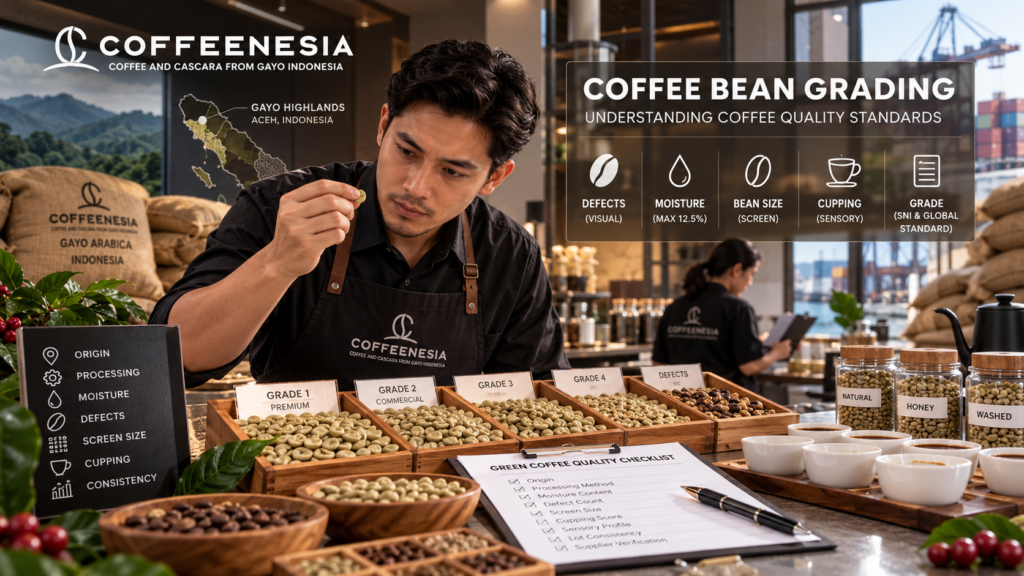
Coffee bean grading is the process of evaluating green coffee according to measurable physical and quality characteristics such as defects, moisture content, bean size, cleanliness, processing condition, and sensory performance. For wholesale buyers, coffee bean grading provides a more objective basis for comparing lots before approving samples, negotiating specifications, or committing to recurring purchases.
However, buyers should not assume that one grade tells the entire story. Indonesian SNI standards, international coffee-quality programs, and specialty coffee assessment systems use different criteria and purposes. The Specialty Coffee Association’s current Coffee Value Assessment (CVA), for example, evaluates coffee through physical, descriptive, affective, and extrinsic assessments rather than reducing quality to one score. Specialty Coffee Association – Coffee Value Assessment
For importers and roasters, a practical coffee bean grading and procurement sequence should therefore follow:
Origin → Processing → Physical Grade → Moisture → Defects → Screen Size → Sample → Cupping → Specification Approval → Commercial Order
This approach becomes particularly important when purchasing hundreds of kilograms or recurring container-scale volumes. A supplier description such as “premium,” “Grade 1,” or “specialty” should become the beginning of verification, not the end of it. Buyers need measurable specifications that connect the supplier’s quality description with the actual commercial lot.
Why Coffee Bean Grading Matters for Global Buyers
Coffee is an agricultural product, so beans from the same origin can show differences between harvests, farms, processing methods, storage conditions, and individual lots. For this reason, coffee bean grading gives importers, roasters, and distributors a structured way to compare physical characteristics before making a purchasing decision.
Global buyers also need specifications that both parties can understand before shipment. Clear specifications reduce ambiguity around acceptable defects, moisture, bean size, processing, sensory profile, packaging, and lot consistency. Moreover, documented specifications create a better reference when buyers evaluate repeat orders.
The goal of coffee bean grading is not simply to decide whether coffee is “good” or “bad.” Instead, grading should help a commercial buyer answer a more useful question:
Does this lot match our intended market, roast profile, quality target, and purchasing specification?
A specialty roaster may prioritize cup character, traceability, processing, and physical consistency. Meanwhile, a large distributor may place additional emphasis on repeatable specifications, volume availability, storage stability, and consistency between purchasing cycles.
Therefore:
Higher Grade ≠ Automatically Right for Every Buyer
The right coffee should match both quality requirements and commercial application. Consequently, buyers should use grading as part of a broader procurement assessment rather than as a standalone purchasing decision.
Indonesian Coffee Quality Standards: What Does SNI Require?
Indonesia has an official standard for green coffee beans: SNI 2907:2008 – Biji kopi. BSN’s current catalogue lists the standard as applicable and also lists SNI 2907:2008 Konfirmasi 2026, making it directly relevant when discussing Indonesian coffee quality in 2026. BSN – SNI 2907:2008 Biji Kopi
According to a 2026 publication from Indonesia’s Ministry of Agriculture referring to SNI 01-2907-2008, general green-coffee requirements include no live insects, no rotten or moldy odor, maximum moisture of 12.5%, and maximum foreign matter of 0.5%. The standard then evaluates specific quality through characteristics such as bean size and defect values. Ministry of Agriculture – Coffee Quality Based on Defect Value
For global buyers, these requirements provide an important foundation for coffee bean grading in Indonesia. However, SNI requirements and buyer-specific commercial specifications should remain distinct.
The evaluation framework can follow:
General Requirements → Physical Classification → Defect Grade → Buyer Specification
SNI provides an Indonesian reference framework. Nevertheless, an international buyer can negotiate additional commercial specifications depending on the target market, roasting application, contract, and destination requirements. Therefore, procurement teams should document both the grading reference and any additional requirements before confirming a bulk order.
How Does the Indonesian Coffee Defect Grading System Work?
Indonesia’s SNI system determines coffee quality partly through a weighted defect-value system. According to the Ministry of Agriculture’s April 2026 explanation, evaluators inspect a 300-gram sample, separate defects by category, apply the corresponding defect weights, and calculate the total defect value. Ministry of Agriculture – Defect Grading Explanation
This defect evaluation represents an important part of coffee bean grading because different defects do not necessarily carry the same value. Buyers should therefore understand how a supplier determines the stated grade instead of relying only on labels such as Grade 1 or premium coffee.
The resulting quality classifications are:
| Indonesian SNI Quality | Total Defect Value |
|---|---|
| Mutu 1 | Maximum 11 |
| Mutu 2 | 12–25 |
| Mutu 3 | 26–44 |
| Mutu 4a | 45–60 |
| Mutu 4b | 61–80 |
| Mutu 5 | 81–150 |
| Mutu 6 | 151–225 |
The Ministry notes that Arabica quality 4 is not divided into 4a and 4b in the same way as Robusta. Therefore, buyers also need to consider the coffee species and applicable classification when interpreting a supplier’s grade.
When a supplier offers Grade 1 Indonesian coffee, a buyer should not stop at the label. Ask which grading standard supports the grade and request the relevant lot specification.
A better procurement question is:
“Grade 1 according to which standard, based on what sample, and for which lot?”
That question can prevent misunderstandings between exporters, importers, and roasters. More importantly, it turns coffee bean grading into a verifiable purchasing criterion instead of a marketing description.
10 Coffee Bean Grading Checks Before Buying in Bulk
Global buyers should combine physical inspection with sensory and commercial evaluation. Effective coffee bean grading becomes especially important when moving from a small sample to a recurring wholesale relationship because inconsistencies become more significant as purchasing volume increases.
The following checks help buyers move systematically from origin verification to physical quality, sensory assessment, and commercial approval.
1. Verify the Coffee Origin and Lot Identity
Start with identity before evaluating grade. A reliable coffee bean grading process needs a clear connection between the sample being evaluated and the commercial lot that the buyer may eventually purchase.
Ask for information about country, region, producing area, variety where available, processing method, harvest information, and lot identification. Origin does not determine quality by itself, but it gives buyers essential context for evaluating and comparing coffee.
SCA’s current Coffee Value Assessment recognizes this distinction through its Extrinsic Assessment, which evaluates information beyond the cup, including origin traceability, processing information, and certifications where applicable. SCA Coffee Value Assessment
For Gayo coffee, for example, a buyer may want to understand whether the lot comes from the Gayo Highlands, its processing method, and how the supplier maintains traceability through sourcing and processing. This information helps connect physical evaluation with the origin and identity of the coffee.
Coffeenesia states that it provides transparency regarding origin, variety, and processing methods across its products. Its official website also describes sourcing from the Gayo Highlands of Aceh and participation within the Gayo coffee cooperative ecosystem.
For procurement, the basic sequence should be:
Origin → Producer/Sourcing Area → Process → Lot → Specification
Once buyers establish those details, they can evaluate whether the submitted sample accurately represents the coffee under commercial discussion.
2. Check Moisture Content
Moisture is one of the most important measurable characteristics within coffee bean grading. Buyers should examine it alongside storage, packaging, and shipment conditions rather than treating the moisture percentage as an isolated quality score.
Indonesia’s SNI sets a maximum moisture content of 12.5% for green coffee. The International Coffee Organization’s Coffee Quality-Improvement Programme likewise established a target moisture range of 8% to 12.5% for exported Arabica and Robusta coffee under its program, using ISO 6673 as the measurement method.
However, buyers should avoid interpreting moisture as an isolated quality score. Instead, evaluate the measurement in the context of the commercial lot and its expected journey to the destination market.
Use:
Moisture Reading → Storage Condition → Lot Condition → Packaging → Transit Plan
For international shipments, these factors interact throughout storage and transportation. Therefore, procurement teams should request the moisture specification for the commercial lot rather than relying only on a generic product description.
When comparing several suppliers, record the moisture information alongside the other coffee bean grading specifications. This creates a more consistent comparison between samples and commercial offers.
3. Evaluate Defect Count and Defect Type
Defect evaluation forms another core part of coffee bean grading. Not every defect has the same significance, and Indonesian SNI uses weighted defect values rather than simply counting every imperfect bean equally.
The system recognizes defects such as black beans, partially black beans, broken beans, brown beans, immature beans, insect-damaged beans, husk-related material, and foreign matter. Evaluators then assign different values according to defect type.
Therefore, buyers should ask for more than:
“How many bad beans are there?”
A better question is:
“What defect system does this lot use, and what is its total defect value?”
The distinction matters because a small number of severe defects can have a different quality implication from several minor physical imperfections. Moreover, understanding the defect system allows buyers to compare lots using a consistent reference.
For recurring purchases, include the acceptable defect specification in the purchase agreement whenever possible. This gives both buyer and supplier a clearer benchmark when assessing subsequent shipments.
4. Check Bean Size and Screen Consistency
Bean size can influence sorting, roast behavior, and how consistently a lot responds to heat. Therefore, screen analysis can complement coffee bean grading, particularly when a buyer requires consistent physical characteristics across commercial volumes.
Size alone does not determine flavor quality, and larger beans do not automatically mean better coffee. However, inconsistent sizing can complicate roast development when a production roaster needs repeatable results.
SCA’s current physical assessment includes size alongside color, defects, and moisture content. Indonesian SNI also classifies beans according to size categories. Specialty Coffee Association – CVA
For a global buyer, screen size should therefore become a specification rather than a marketing phrase.
Ask:
Screen Size → Size Distribution → Tolerance → Lot Consistency
Roasters should pay particular attention when the coffee will support a repeatable production roast. A sample with attractive cup characteristics may still create operational problems if the commercial shipment differs substantially in physical consistency.
5. Inspect Color, Odor, Cleanliness, and Physical Condition
Visual and olfactory inspection remains an important part of coffee bean grading because it helps buyers identify obvious physical inconsistencies before roasting and cupping. This assessment should complement measurable characteristics such as moisture, defects, and screen size.
SCA’s physical assessment includes color, while Indonesian standards require coffee to be free from live insects and rotten or moldy odor. SNI also limits foreign matter to a maximum of 0.5%.
Before accepting a lot, inspect whether the beans show unexpected discoloration, excessive foreign material, contamination signs, abnormal odors, or other inconsistencies. Buyers can organize this receiving inspection through a simple sequence:
Appearance → Smell → Cleanliness → Defects → Moisture → Size
These checks do not replace laboratory analysis or cupping. Instead, they create an additional quality-control layer before roasting and help procurement teams identify whether a lot requires further evaluation.
6. Understand the Processing Method
Two coffees from the same region can taste and behave differently because producers process them differently. For this reason, coffee bean grading should not ignore processing information when buyers compare commercial lots.
Processing affects how buyers interpret the lot’s physical and sensory characteristics. Therefore, specifications should identify the processing method rather than stating only origin and grade.
Coffeenesia’s Gayo Coffee describes multiple processing approaches within its coffee portfolio. Coffeenesia’s published products include processing options such as Washed, Honey, and Natural.
For buyers, processing information should connect to commercial application:
Processing → Sensory Character → Roast Strategy → Target Market
A roaster sourcing a clean single-origin profile may evaluate a lot differently from one looking for a more fermentation-forward coffee for a limited release. Therefore, buyers should compare processing information alongside physical specifications instead of comparing two coffees solely by grade.
7. Cup the Sample Before Approving the Commercial Lot
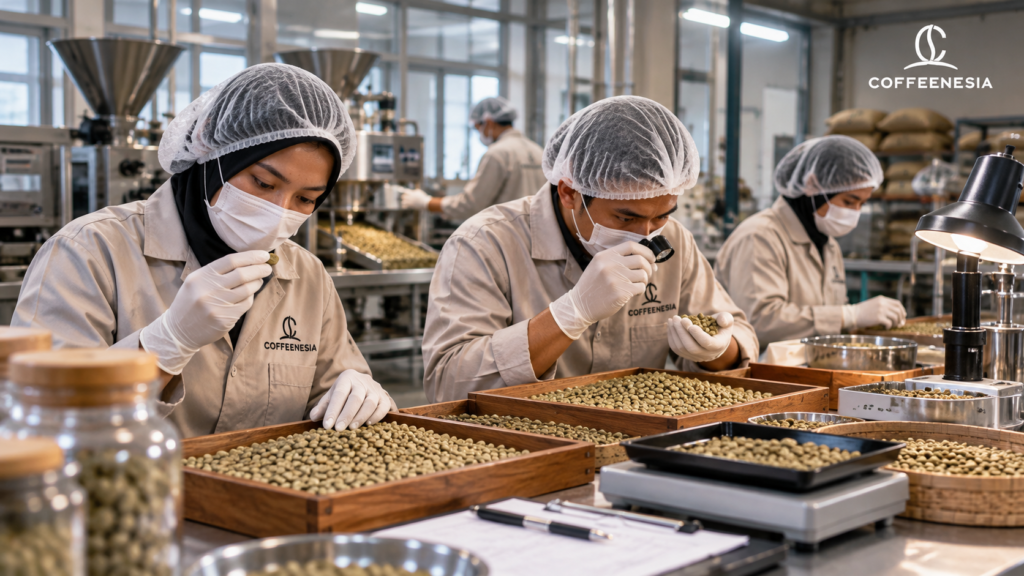
Physical coffee bean grading cannot tell buyers everything about how coffee tastes. Buyers should combine physical evaluation with sensory assessment whenever cup quality forms part of the purchasing specification.
SCA’s current Coffee Value Assessment explicitly separates Physical Assessment from Descriptive Assessment. The descriptive component records sensory attributes such as aroma, flavor, texture, and aftertaste using standardized terminology. SCA Coffee Value Assessment
This distinction is critical for global buyers because a coffee can meet physical specifications while still failing to match the desired sensory profile. Conversely, an interesting cup profile should not cause buyers to ignore physical consistency and shipment specifications.
A practical evaluation sequence is:
Green Sample → Physical Check → Sample Roast → Cupping → Buyer Evaluation → Approval
During cupping, buyers can evaluate whether the lot fits its intended application, such as single origin, espresso component, filter offering, house blend, or another commercial program. For large orders, the buyer should also agree with the supplier on how the approved sample relates to the commercial lot.
In other words, coffee bean grading and cupping should complement each other. Physical analysis tells the buyer what the beans look like and how they meet measurable criteria, while sensory evaluation helps determine whether the coffee fits the intended market.
8. Do Not Treat a Cupping Score as the Entire Grade
A common sourcing mistake is treating one numerical score as a complete description of quality. A comprehensive coffee bean grading assessment should consider physical characteristics separately from sensory description, buyer preference, and traceability.
The SCA’s current CVA framework provides a broader picture by combining physical, descriptive, affective, and extrinsic assessments. SCA explains that the framework aims to capture why a coffee has value and which markets may value it. Specialty Coffee Association – Coffee Value Assessment
Therefore:
Physical Quality ≠ Sensory Description ≠ Buyer Preference ≠ Traceability
These elements interact, but they are not interchangeable. For procurement teams, this means a supplier specification should not consist only of a cup score.
A stronger buyer file might contain:
Origin → Process → Moisture → Defect Grade → Screen Size → Physical Condition → Sensory Profile → Lot Information
Combining these data points gives importers and roasters a clearer picture of the coffee they are evaluating. More importantly, it creates a documented reference that buyers can use when comparing the approved sample with future commercial lots.
9. Approve Specifications Before Moving from Sample to Bulk Order
A good sample does not automatically guarantee that every future shipment will match it. Therefore, buyers should use the results of coffee bean grading, cupping, and sample evaluation to establish a clear commercial specification before committing to a significant volume.
Before purchasing a significant quantity, convert the sample evaluation into an agreed specification. Depending on the transaction, this can include origin, process, crop or harvest information, grade, defect tolerance, moisture, screen size, sensory expectations, packaging, quantity, and shipment terms.
The workflow becomes:
Requirement → Supplier Matching → Sample → Coffee Bean Grading → Cupping → Specification Approval → Purchase Order → QC → Shipment
This step matters because coffee is an agricultural product rather than a manufactured component with perfectly identical characteristics. Clear specifications give buyers and suppliers a common reference for evaluating whether the commercial lot remains within the agreed quality parameters.
For recurring orders, buyers should also define how the supplier handles reasonable agricultural variation and what happens if a lot falls outside the agreed specification. This approach makes coffee bean grading more useful for procurement because the results become part of an actionable purchasing standard rather than remaining only a sample assessment.
10. Evaluate Lot-to-Lot Consistency and Long-Term Supply
The first successful shipment proves that one transaction can work. However, it does not automatically prove that the supplier can maintain comparable quality across multiple purchasing cycles.
For recurring wholesale procurement, buyers should combine coffee bean grading with lot records and ongoing quality evaluation. This approach helps procurement and roasting teams identify changes in defects, moisture, physical characteristics, processing, or sensory performance between shipments.
A practical cycle follows:
Harvest → Availability → Lot Specification → Coffee Bean Grading → QC → Shipment → Buyer Evaluation → Feedback → Next Lot
Ask how the supplier handles harvest changes, product availability, quality control, alternative lots, and communication when conditions change. Buyers should also understand whether the supplier can provide comparable specifications when the original lot or harvest is no longer available.
This is where supplier capability becomes as important as the individual coffee sample. A long-term buyer does not merely purchase beans; the buyer manages quality consistency, inventory risk, roast planning, and supply continuity across multiple orders.
Coffee Bean Grading: SNI, ICO, and SCA Are Not the Same Thing
Global buyers should avoid combining different coffee bean grading and quality-assessment systems as though they were interchangeable. Each framework serves a different purpose, so buyers should understand what each system actually measures before using it as a purchasing requirement.
SNI 2907:2008 provides Indonesia’s standard for green coffee, including general requirements and classifications based on physical characteristics and defects. BSN currently lists the standard as applicable and records its 2026 confirmation.
ICO’s Coffee Quality-Improvement Programme established target standards for export coffee under its program. Resolution 420 specifies no more than 86 defects per 300 g for Arabica and 150 for Robusta, together with an 8%–12.5% moisture range, subject to the provisions of the programme.
Meanwhile, the SCA Coffee Value Assessment (CVA) provides a broader framework for understanding coffee through physical, descriptive, affective, and extrinsic assessments. Consequently, buyers should not interpret an SNI physical grade, an ICO quality target, and an SCA assessment as three versions of the same measurement.
For procurement, use each framework according to its purpose rather than asking which one is universally “best.”
| Framework | Main Use in Buyer Evaluation |
|---|---|
| Indonesian SNI | Indonesian green-coffee quality requirements and defect classification |
| ICO Quality Programme | International target quality measures for export coffee under the programme |
| SCA CVA | Broader physical, sensory, and value assessment for specialty coffee |
Understanding these differences strengthens coffee bean grading decisions because buyers can specify exactly which criteria they expect. More importantly, suppliers and buyers can avoid using terms such as “Grade 1” or “specialty” without defining the underlying assessment.
What Should Global Buyers Ask a Coffee Supplier?
Before requesting a commercial invoice, buyers should first request enough information to understand exactly what they are purchasing. The supplier should be able to provide product information that allows the buyer to evaluate the coffee against its intended application and quality requirements.
A useful inquiry should cover:
Origin → Variety → Process → Harvest/Lot → Grade → Defects → Moisture → Screen → Sensory Profile → Packaging → Quantity → Availability
Then ask for a representative sample. Buyers can use the sample for coffee bean grading, physical inspection, sample roasting, and cupping before deciding whether the coffee fits their procurement requirements.
Avoid starting negotiations only with:
“What is your price per kilogram?”
Price becomes meaningful only after both parties define the product. A Grade 1 coffee, a specialty lot with specific processing, and a commercial-grade coffee may serve completely different buyers, so comparing their prices without comparing specifications can create a misleading sourcing decision. Pasted text
What Does “Grade 1 Coffee” Mean in Indonesia?
Under the SNI defect-value classification explained by Indonesia’s Ministry of Agriculture, Mutu 1 has a maximum total defect value of 11 based on evaluation of a 300-gram sample. This classification provides a measurable physical reference rather than simply describing coffee as “high quality.” Pasted text
However, Grade 1 still does not tell the buyer everything about flavor. Coffee bean grading and sensory evaluation answer different questions, which is why professional buyers should evaluate both before approving a commercial lot.
Consider two separate questions:
Physical question: Does the coffee meet the required defect and physical specification?
Sensory question: Does the coffee taste appropriate for our intended product?
A professional purchasing decision needs both answers. A lot may meet the expected physical grade but still fail to match the sensory profile required for a particular single-origin product, espresso blend, filter coffee, or other commercial application.
Coffeenesia currently publishes a Gayo Coffee Beans Grade 1 bulk offering from Aceh for roasters, importers, and coffee businesses. Buyers considering a commercial order should still align the required lot specification, sample evaluation, and purchasing criteria before confirming volume.
Why Moisture and Defects Matter in Bulk Coffee Procurement
At small sample scale, minor inconsistency can appear manageable. At wholesale scale, however, the same inconsistency can affect multiple roasting batches, inventory planning, product consistency, and customer expectations.
That is why moisture and defects remain important components of coffee bean grading. Moisture, defect values, screen distribution, cleanliness, and storage condition can influence how procurement and roasting teams manage incoming coffee. SCA includes moisture, defects, color, and size in its physical assessment, while Indonesian SNI establishes requirements related to moisture, cleanliness, and defect classification. Pasted text
For global buyers, quality control should therefore continue after purchase:
Pre-Shipment Sample → Commercial Lot → Receiving Inspection → Coffee Bean Grading Check → Storage → Roast Evaluation
If the coffee becomes part of a recurring program, retain lot records so the team can compare one shipment with the next. These records make it easier to identify meaningful changes in physical specifications or roasting performance over time.
Coffee Quality Should Match the Intended Market
The “best” coffee is not necessarily the coffee with the most expensive specification. A wholesale buyer needs coffee that fits the business model, intended product, customer expectations, and operational requirements.
For example:
Specialty Roaster → Traceability + Sensory Character + Physical Quality
Distributor → Specification Consistency + Volume + Supply Reliability
Café Chain → Repeatable Roast Performance + Sensory Target + Supply Planning
Private Brand → Product Positioning + Target Cost + Quality Specification + Repeatability
This is why coffee bean grading works best when procurement begins with the buyer’s requirements rather than a supplier’s marketing label. The buyer should first define the intended application and then identify the physical, sensory, and commercial specifications that support it. Pasted text
Coffeenesia Expertise in Gayo Coffee Quality and Sourcing
Coffeenesia focuses on premium single-origin Indonesian coffee and cascara sourced from the Gayo Highlands of Aceh. According to its official website, Coffeenesia manages farm activities, works within the Gayo Coffee Cooperative ecosystem, oversees production stages, and provides transparency around origin, variety, and processing methods. Pasted text
The company describes its quality approach through four core elements:
Direct Sourcing → Quality Control → Traceability → Sustainable & Innovative Sourcing
For international coffee buyers, the most relevant element is the connection between origin information and physical product quality. Coffeenesia states that it oversees stages of coffee and cascara production to support quality consistency and provides traceability information regarding origin, variety, and processing.
This approach can support coffee bean grading because buyers need clear product identity before comparing physical specifications between samples and commercial lots. Origin, processing, lot information, moisture, defects, and sensory evaluation work more effectively when procurement teams can connect those characteristics to a clearly identified coffee.
Coffeenesia’s published portfolio includes Gayo Arabica offerings for wholesale buyers, including Grade 1 and specialty coffee products. The company also publishes different processing options across its Gayo coffee portfolio.
Therefore, buyers can begin procurement discussions with a defined requirement rather than simply requesting “Indonesian coffee.”
Use:
Buyer Requirement → Gayo Coffee Selection → Sample → Coffee Bean Grading → Specification Review → Quality Evaluation → Commercial Order
This sequence creates a clearer foundation for wholesale sourcing because buyers evaluate the product before moving into volume and commercial terms.
Coffeenesia for Wholesale and Global Coffee Buyers
Coffeenesia’s official website positions its coffee and cascara products for wholesale partnerships and global markets. The company currently publishes partnership tiers beginning at 25 kg for Merchant, 100 kg for Wholesale, and above 250 kg for Distributor. Pasted text
For global buyers, these tiers can provide a starting point for discussing volume. However, volume should come after the buyer defines and evaluates the required specification.
A stronger sequence is:
Quality Requirement → Sample → Coffee Bean Grading → Approval → Volume → Packaging → Commercial Terms → Shipment
Buyers seeking Gayo coffee can review Coffeenesia’s single-origin Gayo coffee and Grade 1 offering before discussing the required commercial lot, quality specification, sample, and volume.
For broader Indonesian agricultural sourcing requirements, EFBA Agro International operates in agricultural commodity sourcing and wholesale supply, including coffee-related products. The broader EFBA ecosystem can also be referenced through EFBA where corporate context is relevant.
A Practical Coffee Procurement Checklist
Before approving a bulk coffee purchase, buyers should combine supplier information, coffee bean grading, sample evaluation, and commercial requirements. A structured checklist prevents procurement teams from relying only on descriptions such as “premium,” “specialty,” or “Grade 1.”
Use the following questions:
- What is the exact origin?
- What variety does the lot contain?
- Which processing method does the producer use?
- What harvest or crop information is available?
- Which grading system defines the stated grade?
- What is the defect value or defect specification?
- What moisture specification applies?
- What screen size or distribution applies?
- Is the lot free from abnormal odor and contamination indicators?
- Is a representative green sample available?
- Has the buyer cupped the sample?
- Does the sensory profile match the intended roast or product?
- Can the supplier identify the commercial lot?
- What packaging will protect the coffee during shipment?
- How will the supplier manage repeat orders and harvest variation?
Do not approve a high-volume purchase solely because a product page says “premium,” “specialty,” or “Grade 1.” Translate those descriptions into measurable specifications whenever possible, then compare the approved sample with the actual commercial lot. Pasted text
Build Coffee Procurement around Specification, Not Marketing Labels
Coffee bean grading gives buyers a structured way to evaluate green coffee, but no single metric captures the entire purchasing decision. Physical grade becomes more useful when buyers connect it with origin, traceability, processing, sensory performance, and long-term supply capability.
Use a broader framework:
Origin → Traceability → Processing → Coffee Bean Grading → Moisture → Defects → Screen Size → Cupping → Specification → Supply Capability
For Indonesian coffee, SNI provides an important physical quality reference. ICO adds international target measures through its Coffee Quality-Improvement Programme, while SCA’s current CVA framework separates physical, descriptive, affective, and extrinsic aspects of coffee evaluation. Pasted text
Coffeenesia connects this procurement process with Gayo coffee sourcing from Aceh. Global roasters, importers, distributors, and coffee businesses can explore Coffeenesia’s Gayo coffee portfolio and discuss origin, processing method, coffee bean grading requirements, sample approval, volume, and purchasing requirements before moving to a wholesale order.
Ultimately, professional coffee procurement should not ask only:
“Is this good coffee?”
It should answer:
“Does this coffee meet our physical, sensory, commercial, and supply requirements?”
That distinction turns grading from a marketing label into a practical procurement tool.

The objective is not simply to buy a bag labelled “high grade.”
It is to buy the right lot, under the right specification, for the right market.
Frequently Asked Questions about Coffee Bean Grading
What is coffee bean grading?
Coffee bean grading is the process of evaluating green coffee using characteristics such as defects, moisture, bean size, physical condition, and other criteria defined by a particular grading framework. Specialty coffee evaluation can also incorporate sensory, preference, traceability, and processing information.
What is Grade 1 coffee in Indonesia?
According to the SNI-based classification explained by Indonesia’s Ministry of Agriculture, Mutu 1 coffee has a maximum total defect value of 11 in a 300-gram sample. Buyers should still evaluate moisture, size, processing, sensory characteristics, and other agreed specifications. Bali BRMP
What moisture level is required for Indonesian green coffee?
SNI 2907:2008 specifies a maximum moisture content of 12.5%. The ICO Coffee Quality-Improvement Programme uses a target range of 8% to 12.5% for Arabica and Robusta under its program, subject to its stated provisions. Bali BRMP
Does Grade 1 mean specialty coffee?
Not automatically. A physical grade and a specialty-coffee evaluation answer different questions. Buyers should separately review physical quality, sensory characteristics, processing, traceability, and the requirements of their target market.
What should buyers check before purchasing coffee beans in bulk?
Check origin, variety, processing method, harvest/lot information, grading system, defect specification, moisture, screen size, physical condition, sensory profile, packaging, volume availability, and supplier capability. Buyers should also evaluate a representative sample before committing to a large order.
Why is screen size important in coffee grading?
Screen size helps describe the physical size and consistency of green beans. It can help roasters evaluate lot uniformity and plan roasting, although larger beans do not automatically mean better flavor.
Should buyers cup coffee before placing a wholesale order?
Yes, especially when sensory quality matters to the purchasing specification. SCA’s current CVA separates physical assessment from descriptive sensory assessment, illustrating why physical grading alone cannot describe the entire coffee. Specialty Coffee Association
Does Coffeenesia supply Grade 1 Gayo coffee?
Coffeenesia currently publishes a Grade 1 Gayo coffee bulk offering sourced from Aceh. International buyers should discuss the specific commercial lot, sample, specifications, quantity, and purchasing requirements with Coffeenesia before ordering. https://coffeenesia.id/