
Welcome to the 2026 coffee landscape, my friends. We are currently navigating a wild ride of weather anomalies shifting historic harvest seasons, making it tougher than ever to secure stable profiles. On top of that, we are dealing with tight margins in an incredibly crowded F&B market, where every single gram of coffee counts. That’s being the reason why choosing the right wholesale green coffee beans supplier / partners do matter.
Let’s be completely honest about the classic cheap price trap that catches so many passionate roasters. We all know the temptation of chasing dirt-cheap bulk unroasted coffee beans from sketchy, unverified brokers who promise the world. But you know how that story usually ends when you finally charge the drum.
An unpredictable batch filled with uneven moisture levels ruins your morning, messes up your Rate of Rise (ROR) curves, and leads to a pile of baked, unmarketable beans. Chasing those phantom savings upfront inevitably costs you way more in wasted production hours and discarded batches.
If you want to keep your sanity and protect your bottom line, finding a clean, physically stable source of wholesale green coffee beans is the ultimate secret. It ensures your signature espresso blends and single-origins taste exactly the same, batch after batch, month after month. We are all in this together, and we know that consistency is what keeps your retail and wholesale clients coming back for more.
Let’s Get a Little Nerdy: Density, Moisture, and Why Your Roast Curve Drifts
When we throw raw materials into a roaring drum, thermodynamics takes over completely. We cannot afford to guess what is happening inside the chamber, especially with energy costs fluctuating the way they are this year. We need a predictable foundation to ensure our heat application is efficient.
That is why we look incredibly closely at screen sizes, bean density measured in grams per liter (g/L), and moisture levels. Our team always aims to keep that moisture sweet spot tightly locked between 10% and 12%. Anything outside this window means you are playing Russian roulette with your burners.
When you buy from erratic green coffee wholesale channels, you often inherit a nightmare of wonky water activity. High or uneven water activity forces you to constantly fight your burners and airflow just to keep your ROR from crashing. This chaotic thermal behavior leads to uneven bean development, tipping, or those dreaded flat, baked flavor profiles.
To combat this, we use advanced AI-driven optical sorting as a standard procedure before bagging. This step ensures that when you source raw coffee beans wholesale, you receive uniform density and zero structural surprises. Let’s look at how a stable lot changes your entire production day.
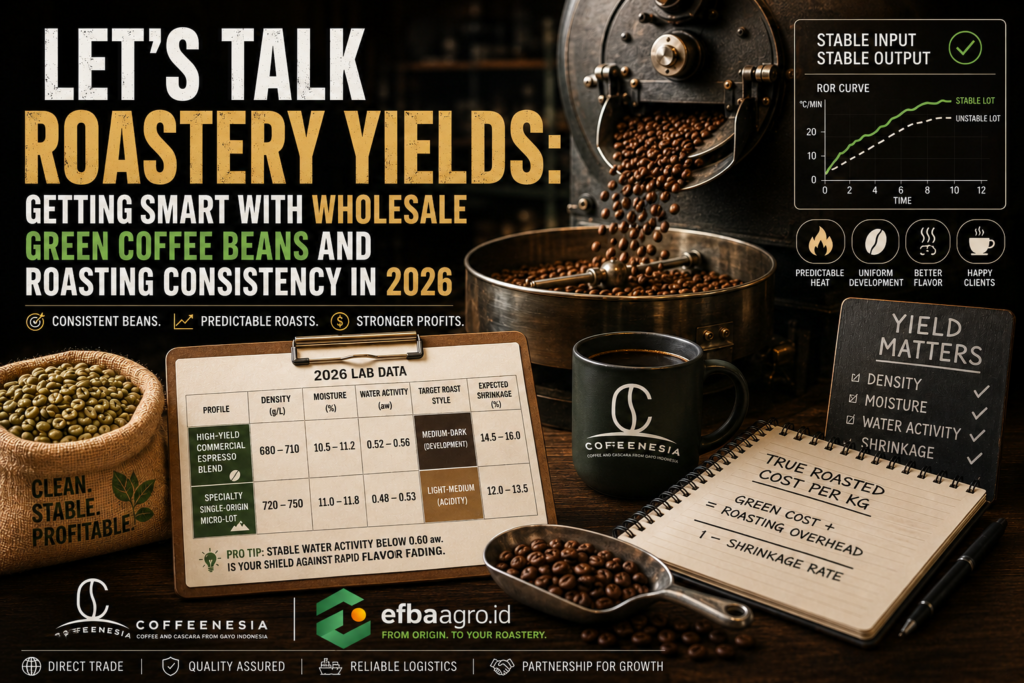
Here is a clean, easy-to-read yield comparison table based on our latest 2026 lab tests utilizing premium wholesale green coffee beans.
Technical Yield & Density Breakdown
| Bean Category / Profile | Avg Density (g/L) | Moisture Range | Water Activity (aw) | Targeted Roast Style | Expected Shrinkage |
| High-Yield Commercial Espresso Blend | 680 – 710 g/L | 10.5% – 11.2% | 0.52 – 0.56 | Medium-Dark (Development) | 14.5% – 16.0% |
| Specialty Single-Origin Micro-lot | 720 – 750 g/L | 11.0% – 11.8% | 0.48 – 0.53 | Light-Medium (Acidity) | 12.0% – 13.5% |
Pro Tip from the Cupping Lab: A stable water activity below 0.60 is your shield against rapid flavor fading. If your green stock arrives with wildly varying metrics, your carefully built roast profiles will drift within three weeks of storage.
Investing in high-grade wholesale green coffee beans gives you a predictable, rock-solid baseline. Your burners react predictably, your exhaust temperatures stay stable, and your first crack happens right when your software says it should. It transforms roasting from a stressful guessing game into a beautiful, repeatable science.
Cracking the Code on Roastery COGS and Shrinkage
Let’s talk real-world numbers because passion alone does not pay the warehouse rent or the team’s salaries. Managing your Cost of Goods Sold (COGS) requires a strict understanding of roasting shrinkage, which is the inevitable weight loss that happens when moisture goes up the chimney. If you are sourcing heavily from unverified, unroasted coffee bean wholesale channels, your shrinkage rates can jump unexpectedly.
A couple of extra percentage points lost to water vapour might not sound like much on a single batch. However, when you multiply that across hundreds of batches a month, it eats your lunch. To keep your business healthy and protect your profit margins from tanking, your production folks must calculate the true cost per roasted kilo.
We use a precise mathematical formula to ensure we never underprice our bags or lose money on commercial contracts:
True Roasted Cost per kg = Green Bean Cost per kg + Operational Roasting Overhead per kg – Shrinkage Rate
When your raw materials exhibit unpredictable shrinkage, your financial forecasting becomes completely useless. By working with reliable bulk green coffee beans, you ensure your shrinkage rate remains tightly bound and predictable. This predictability is exactly how boutique coffee chain founders scale up their operations without experiencing unexpected cash flow crunches.
Every fraction of a percent saved on shrinkage goes straight back into your working capital. Consistently clean wholesale green coffee beans mean less sorting waste, lower defect counts, and highly accurate inventory tracking. You can map out your entire financial quarter with total confidence.
Risk Management: Keeping Your Profiles Locked and Avoiding Wasted Batches
Maintaining consistency over long-term contract cycles is the ultimate challenge for independent roasteries in 2026. Working with transparent green coffee bean suppliers is your best lifesaver for matching profiles perfectly on software like Cropster or Artisan. When you can rely on the physical integrity of your green stock, you stop wasting expensive test batches trying to fix a bad lot.
Imagine the frustration of a head roaster who has to rewrite their entire roasting manual because a new shipment of wholesale green coffee beans behaves completely differently than the last one. Your B2B cafe clients will immediately notice if their signature espresso base suddenly tastes overly bitter or thin. They want the exact same flavor profile they fell in love with six months ago.
[Predictable Green Beans] -> [Consistent ROR Curve] -> [Uniform Development] -> [Happy Wholesale Clients]
We highly recommend securing your inventory through forward contracts early in the season to lock in pricing and quality. Sourcing stable wholesale green coffee beans via structured contracts shields your business from sudden market spikes and global logistics bottlenecks. It lets you focus entirely on your craft, knowing your raw material supply chain is safe and secure.
Sourcing Smart: How Coffeenesia’s Roasting Lab Pairs with Efba Agro’s Field Network

A truly successful coffee business requires two distinct skill sets working in perfect harmony: precise roasting execution in the shop and bulletproof supply chain management at the origin. We realized long ago that expecting a head roaster to also manage cross-border customs and agricultural audits is a recipe for burnout. That is why we split the heavy lifting into a seamless, cooperative ecosystem designed to protect your peace of mind and your working capital.
Our team atcoffeenesia.id operates as your dedicated roasting and product execution crew, handling all the downstream magic. We roll up our sleeves to help you dial in complex roast profiles, manage bulk roasting logistics, and share proven retail distribution tricks to ensure your bags fly off the shelves. We act as your direct line to actionable roasting data, helping you translate premium wholesale green coffee beans into highly profitable menu items.
Meanwhile, our dedicated corporate arm, efbaagro.id steps in as our agribusiness and logistics masters handling the intense upstream operations. They handle the hard work at the farm level—auditing remote micro-stations, overseeing state-of-the-art optical sorting, and managing complex maritime shipping corridors. This powerful direct-trade pipeline ensures your roastery always enjoys uninterrupted access to pristine wholesale green coffee beans, regardless of climate disruptions.
By decoupling technical roasting development from the high-risk realities of agricultural sourcing, we provide your brand with a massive competitive edge. You get the agility of a local boutique roaster backed by the institutional muscle of a global logistics network. It is the ultimate way to scale your business without losing sleep over supply chain instability.

Securing Your Roastery’s Future
As we push further into 2026, the gap between thriving roasteries and struggling ones comes down to raw material stability and data-driven precision. Chasing cheap, unverified lots is a gamble that your margins simply cannot afford in this competitive climate. Building a sustainable, scalable business requires a commitment to sourcing high-uniformity wholesale green coffee beans that honor your craft and your bottom line.
Are you ready to stop fighting your burners and start maximizing your daily production yields? Reach out to us today for a casual, no-nonsense Roastery Yield & Flavor Consistency Audit with the team here at Coffeenesia, and let’s get your profiles locked in for the year ahead.
FAQ: Practical Questions from the Roastery Floor
How does a high water activity level in green beans affect the flavor fading of my roasted coffee on the shelf?
High water activity accelerates chemical degradation and lipid oxidation within the unroasted bean structure. When you roast beans with elevated levels, the cellular matrix breaks down much faster post-roast, causing your coffee to lose its vibrant acidity and complex aromatics within weeks. Sourcing premium wholesale green coffee beans with a stable water activity below 0.60 is critical for ensuring your retail bags maintain an extended shelf life.
What’s a normal shrinkage rate to expect when roasting a commercial espresso base vs. a delicate light-roast single origin?
For a traditional medium-dark commercial espresso base, you should anticipate a shrinkage rate between 14.5% and 16.0% due to extended development time and deeper moisture loss. A delicate, light-roast single origin typically experiences a lower shrinkage rate of 12.0% to 13.5% because you pull the batch earlier to preserve organic acids. Tracking these numbers closely against your green costs prevents unexpected drops in your net profit margins.
Why do minor density differences in a green coffee lot cause some beans to face under-development while others roast perfectly?
Low-density beans absorb heat much faster than high-density beans, causing them to race ahead during the Maillard phase. If your lot lacks physical uniformity, the softer beans will end up over-roasted or scorched, while the dense beans remain underdeveloped and taste unpleasantly grassy. This is why we place such a heavy emphasis on uniform density and precise screen sizing across all our wholesale green coffee beans shipments.