
Welcome to the production front lines of 2026, my friends. We are currently navigating a fascinating yet brutal global coffee trade environment, shaped by severe climate-driven crop shortages and rapidly shifting harvest windows across major origins. For independent roasteries and commercial brand founders, managing a predictable production schedule while maintaining tight operating margins has become a daily balancing act. That is the reason why getting trusted supplier of coffee beans for roasters is the core of roastery business.
Let’s be completely honest about the classic trap of chasing cheap, unverified spot lots from fly-by-night brokers who promise unrealistic upfront savings. When you buy untraceable green stock just to clear warehouse space or patch up an inventory gap, you usually inherit an operational nightmare. You end up with uneven bags full of hidden defects and wildly inconsistent moisture levels that can ruin your entire production week.
A single container of unstable green coffee will crash your Rate of Rise (ROR) curves on your profiling software, causing your head roaster to waste valuable hours trying to save uneven batches. Instead of beautiful, repeatable flavor notes, you end up with flat, baked profiles that alienate your hard-earned clients and tank your retail sales. Introducing high-uniformity, technically audited coffee beans for roasters into your facility is the ultimate secret to keeping your sanity and making sure your production floor runs like clockwork.
We are all in this together, and we know that long-term survival in this crowded market requires absolute raw material transparency and data-driven precision. Working with a highly specialized supply line allows you to stop playing guessing games with your burner controls and airflow adjustments. Let’s break down the exact physical parameters and supply chain mechanics that will keep your roastery highly competitive, stable, and profitable this year.
The Technical Benchmarks of High-Yield Green Stock
When we load green coffee into a hot roasting drum, thermodynamics takes over completely, and understanding how to pick the right raw coffee beans for roasters determines your daily success. We cannot afford to guess how the raw materials will react to conductive and convective energy transfer, especially with operating costs at an all-time high. We need a predictable, uniform foundation to ensure our heat application yields maximum bean expansion and uniform color development.
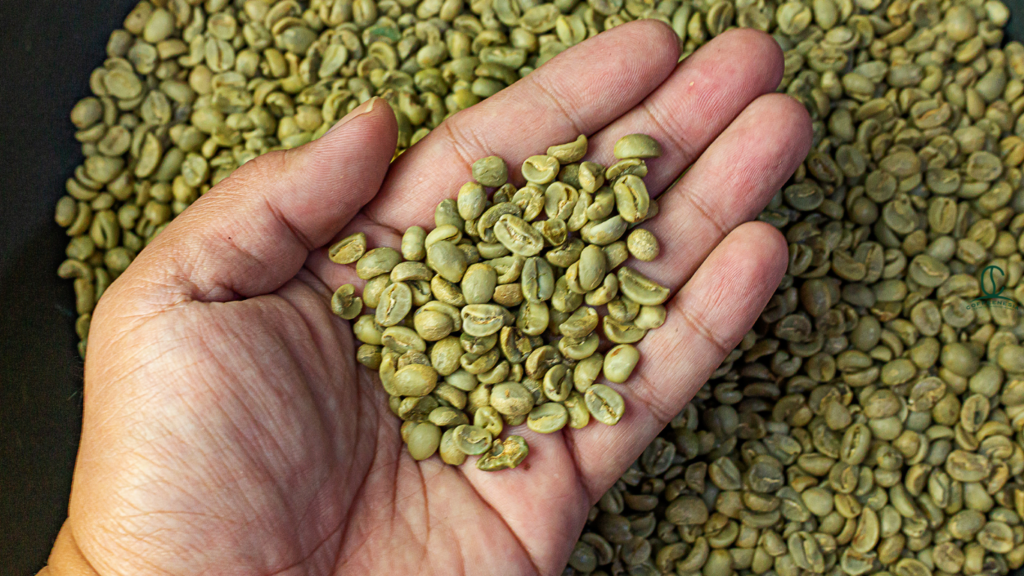
That is why we look incredibly closely at screen size distributions, bean density measured in grams per liter (g/L), and green moisture levels. Our team always aims to keep green moisture levels strictly bounded between 10% and 12%, while monitoring water activity to keep it below 0.60. When you inherit wonky water activity from an unvetted bulk lot, it forces a coffee bean roaster operator to constantly fight the burners and adjust airflow blindly, leading to baked flavors, tipping, or underdevelopment.
In 2026, advanced food-safe dehydration tech and AI optical sorting have completely replaced old, risky open-ground drying habits to ensure total purity before bagging. We look at how uniform coffee beans for roasters interact with your engineering setup to create a highly repeatable development phase. Let’s look at how an unvetted commodity lot compares to a technically audited, high-uniformity allocation.
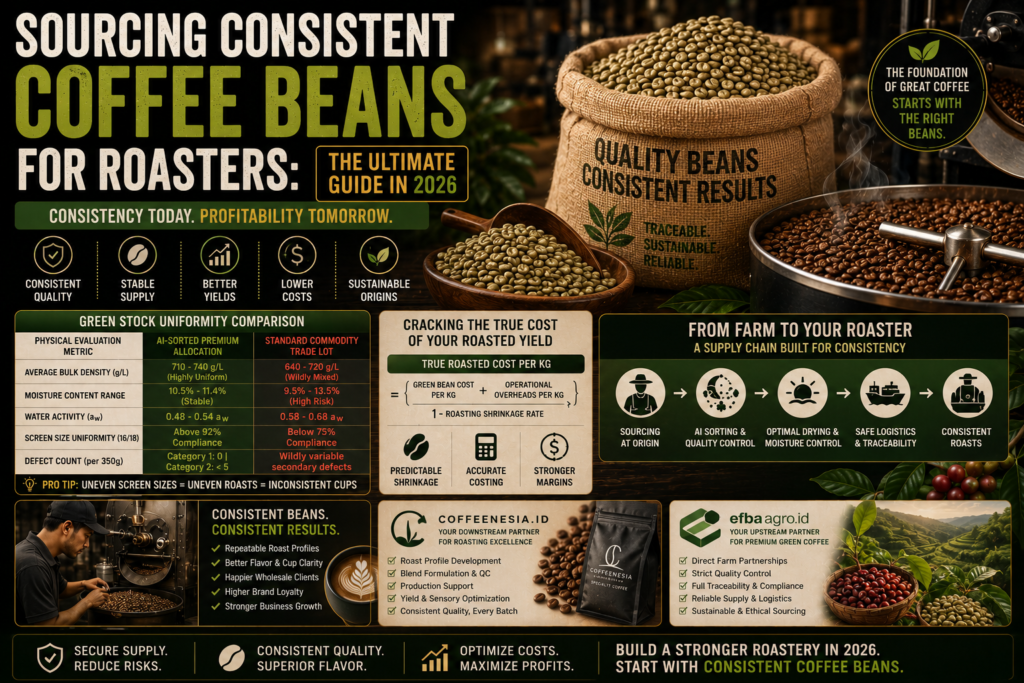
Green Stock Uniformity Table
| Physical Evaluation Metric | AI-Sorted Premium Allocation | Standard Commodity Trade Lot |
| Average Bulk Density (g/L) | 710 – 740 g/L (Highly Uniform) | 640 – 720 g/L (Wildly Mixed) |
| Moisture Content Range | 10.5% – 11.4% (Stable) | 9.5% – 13.5% (High Risk) |
| Water Activity | 0.48 – 0.54 | 0.58 – 0.68 |
| Screen Size Uniformity (16/18) | Above 92% Compliance | Below 75% Compliance |
| Defect Count (per 350g) | Category 1: 0 | Category 2: < 5 | Wildly variable secondary defects |
Pro Tip from the Warehouse Floor: If your green stock arrives with uneven screen sizes, the smaller beans will roast significantly faster than the larger ones. This results in a muddy, unbalanced cup profile that makes it impossible to replicate your signature character across consecutive production days.
Cracking the True Cost of Your Roasted Yield from Supplier of Coffee Beans for Roasters
Let’s talk pure financial logic because passion alone cannot offset the harsh reality of shrinking commercial margins in today’s crowded market. Far too many procurement managers make the mistake of calculating their raw material budget based entirely on the initial price of green coffee. When you are sorting through incoming coffee beans for roasters, consistency directly dictates your final cost of goods sold (COGS).
If your incoming green coffee exhibits an unpredictable roasting shrinkage rate (weight loss during the roast due to moisture escape), your financial forecasting becomes completely useless. To protect your business from sudden cash flow crunches, your production team must calculate the true landed cost per roasted kilo after the moisture goes up the chimney. We rely on a straightforward, clean formula to keep our operational forecasting perfectly accurate over long-term contract cycles:
True Roasted Cost per kg = [ (Green Bean Cost per kg + Operational Overheads per kg) ÷ (1 – Roasting Shrinkage Rate) ]
Sourcing predictable wholesale coffee beans keeps your shrinkage bounded, your inventory tracking accurate, and your business healthy. Every fraction of a percent saved on shrinkage and sorting waste goes straight back into your working capital. Stable batches of coffee beans for roasters keep your operations running smoothly, allowing you to map out your entire financial quarter with total confidence.
Formulating Winning Blends for Wholesale Coffee Shop Clients
Maintaining consistency over long-term contract cycles is the ultimate challenge for independent roasteries working with high-volume commercial hospitality clients. Your B2B cafe clients will immediately notice if their signature espresso base suddenly tastes overly bitter, thin, or sour. They want the exact same flavor profile and crema density they fell in love with six months ago to keep their own retail customers loyal.
Sourcing clean, reliable coffee beans for roasters allows you to design balanced house blends that perform beautifully across various commercial espresso machines. Securing the best wholesale coffee beans shields your commercial clients from seasonal flavor shifts, ensuring their retail espresso drinks taste identical all year round. This operational reliability is exactly how boutique coffee chain founders scale up their footprints without experiencing unexpected customer churn.
[Predictable Green Beans] -> [Consistent ROR Curve] -> [Uniform Development] -> [Happy Wholesale Clients]
Refining the Roast: How Coffeenesia Elevates Your Downstream Execution

Our downstream production, blend formulation, and execution lab team at coffeenesia.id operates as your direct partner on the manufacturing floor. We help you design repeatable roast curves, optimize bulk production workflows, and provide the technical parameters needed to turn large-scale green imports into high-yielding consumer favorites. We specialize in helping brands navigate the daily grind of roasting thermodynamics, translating top-tier coffee beans for roasters into retail successes that fly off the shelves.
By collaborating with our team, you gain access to experienced product developers who understand how to translate green physical data into repeatable roasting manuals. We analyze your drum dynamics, evaluate your post-roast weight loss, and help you structure highly profitable commercial blends that keep your production line efficient. Let us handle the complexities of downstream product execution so your team can focus entirely on expanding your retail presence and driving sales.
Securing the Source: How Efba Agro Powers Your Upstream Infrastructure

On the opposite side of our operational ecosystem, our agribusiness and logistics masters at efbaagro.id take complete command of your upstream supply security. They manage our extensive farm-level networks, supervise zero-emission solar drying infrastructure, and run strict compliance audits across all our origin channels. This direct control ensures that your raw materials comply with global environmental frameworks, completely shielding your business from customs border delays and inventory shortfalls.
Furthermore, because our partners at efbaagro.id maintain deep, asset-backed logistics pipelines, we can easily integrate direct-trade specialty components into your commercial supply chain. From coordinating container space in congested ports to offering premium organic palm sugar companion options for your cafe clients, they handle the heavy operational lifting at the farm level. This powerful upstream infrastructure gives your brand an unmatched competitive advantage, delivering a premium pipeline of premium coffee beans for roasters directly to your loading dock while maximizing your commercial margins.
Securing Your Roastery’s Foundations
As we look toward the future of the global coffee trade, the businesses that thrive are those that prioritize raw material stability over short-term price chasing. Trying to build a reputable brand on inconsistent, unverified spot lots is a gamble that will eventually cost you your best wholesale clients. Investing in verified coffee beans for roasters is the only way to protect your craft, secure your cash flow, and build a scalable business asset that honors your hard work.
We are right here with you, ready to help you streamline your sourcing pipeline and unlock maximum efficiency inside your roasting facility. Let’s move past the stress of erratic lot variations and build a beautiful, data-driven framework for your business. The future of your brand relies on the strength of your raw material foundation.
Are you ready to eliminate production guesswork and protect your long-term operating margins? Reach out to our team today for a casual, deep-dive Supply Chain Stability & Roastery Yield Audit with the experts here at Coffeenesia, and let’s secure your inventory for the year ahead.
FAQ: Practical Questions from the Roastery Floor
What is the safest way to evaluate and source the best coffee beans online without visiting origin farms?
The safest way to source the best coffee beans online is to partner with origin-integrated suppliers who provide verifiable physical data sheets for every available lot. Request pre-shipment samples (PSS) that include certified metrics for moisture content, density, and water activity alongside detailed crop year documentation. A transparent digital platform should allow you to evaluate these metrics and track sensory cupping scores before committing to a commercial volume.
Is it better to look for wholesale coffee beans near me or partner directly with an origin-integrated importer?
Searching for wholesale coffee beans near me is highly convenient for filling immediate inventory gaps or sourcing small spot components without paying heavy domestic freight fees. However, if your business is looking to scale its production volume, partnering directly with an origin-integrated importer like Coffeenesia is far more sustainable. It eliminates unnecessary middleman markup fees, unlocks deep custom profiling options, and protects your brand from domestic inventory shortages.
What specific parameters make a green lot the best coffee beans for coffee shop espresso programs?
The best coffee beans for coffee shop espresso programs require high physical density (above 700 g/L) and an exceptionally uniform screen size distribution to ensure balanced soluble extraction under pressure. The lot must possess a clean, low-defect count to prevent astringent off-flavors from overpowering the milk texture in commercial beverage profiles. Selecting green stock with a prominent sugar structure guarantees a heavy crema and a lingering, sweet finish that performs beautifully in high-volume settings.