
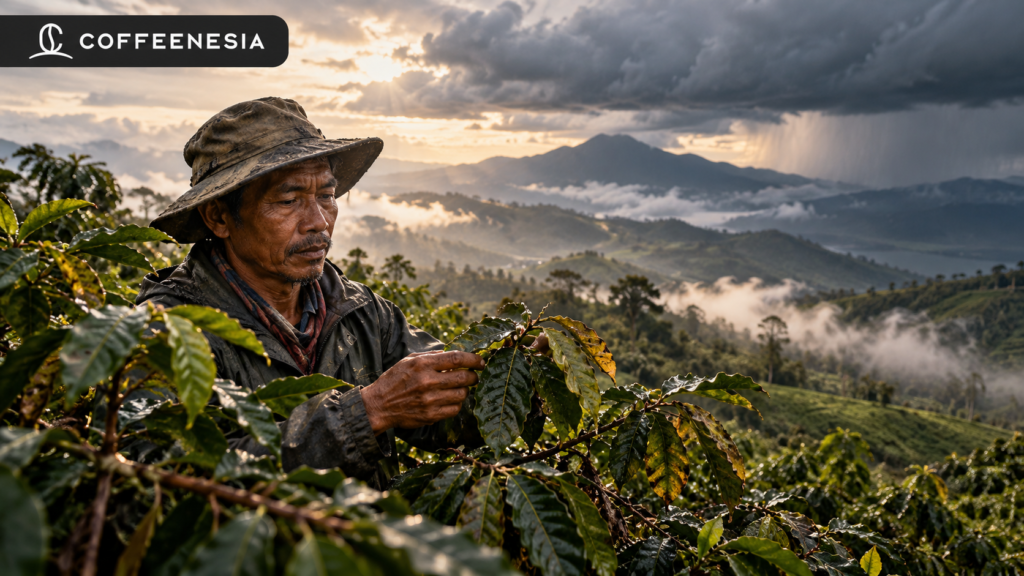
Gayo coffee climate change is becoming an increasingly important topic because Arabica coffee depends heavily on a relatively stable highland environment. Gayo coffee grows mainly across the highlands of Aceh, especially Central Aceh and Bener Meriah, where elevation, cool temperatures, volcanic soil, rainfall, shade, and careful post-harvest handling help create the flavor characteristics valued by specialty roasters and global buyers. As temperature and rainfall patterns become less predictable, the relationship between Gayo coffee climate change and farm resilience becomes increasingly important for farmers, processors, and buyers.
Climate change does not mean Gayo coffee will suddenly disappear. The more immediate concern is that changing rainfall, warmer temperatures, longer dry periods, excessive rain during flowering or harvest, and greater pressure on soil and water management can affect flowering, cherry development, farm productivity, harvesting schedules, drying, and eventually coffee quality. A 2024 study focused specifically on farmers in the Gayo Highlands found that rainfall and temperature changes already create multiple stresses for Arabica production in Central Aceh and Bener Meriah. AGRIS
The long-term challenge is more serious. Research discussing Gayo coffee climate change reports a projection that climate change could substantially reduce the amount of land suitable for Arabica coffee in Aceh by 2050, with one cited estimate reaching up to 90% loss of suitable area under the scenario examined. This should be understood as a climate-model projection rather than a prediction that 90% of Gayo coffee will definitely disappear, but it demonstrates why adaptation deserves attention now. AGRIS
For Coffeenesia, Gayo coffee climate change is relevant because the company publicly positions its Gayo coffee around direct sourcing, farm involvement, traceability, quality control, and long-term community sustainability. Coffeenesia states that its story begins in the Gayo Highlands, that it manages its own farm while working within the Gayo coffee community, and that it personally oversees coffee and cascara production to support quality and traceability. Coffeenesia
Why Is Gayo Coffee Climate Change a Growing Concern?
Gayo Arabica depends on a combination of altitude, temperature, rainfall, soil condition, shade, and seasonal patterns. Coffeenesia currently publishes Gayo coffee specifications from approximately 1,300–1,500 meters above sea level, depending on processing method and lot, with varieties such as Ateng, Bourbon, Typica, and Sigararutang. These highland conditions help slow cherry development and contribute to the sensory profiles that distinguish Gayo coffee. Coffeenesia
The relationship behind Gayo coffee climate change can be simplified as: Altitude → Temperature → Rainfall → Flowering → Cherry Development → Harvest → Processing → Cup Quality
Climate change can disrupt several stages at once. Unusual rainfall may interfere with flowering, excessive moisture may complicate drying, while prolonged heat or drought can place additional stress on coffee trees. Because coffee is a perennial crop, farmers cannot simply change planting decisions every season in the same way they might with short-cycle crops.
The question is therefore not only: “Will coffee still grow?”
It is also: “Will farmers be able to maintain productivity, quality, harvest timing, and commercial consistency under more variable conditions?”
For specialty coffee, this distinction matters because global buyers evaluate not only total production but also flavor, defects, moisture, bean density, consistency, and repeatability between lots. This is why Gayo coffee climate change is not only an environmental issue but also a quality and supply-chain issue.
What Climate Challenges Are Gayo Coffee Farmers Facing?
1. Rainfall Is Becoming More Difficult to Predict
One of the most direct Gayo coffee climate change pressures is rainfall variability. Rainfall is essential to coffee, but timing matters as much as total rainfall. Flowering, cherry formation, maturation, harvesting, and drying each benefit from different weather conditions.
If heavy rain comes at the wrong stage, farmers may face uneven flowering, delayed harvesting, slower drying, or greater difficulty maintaining post-harvest consistency. Research involving farmers and local experts in Central Aceh and Bener Meriah found that changing rainfall is one of the principal climate pressures perceived in the Gayo Highlands. The study concluded that both rainfall and temperature stresses can threaten the sustainability of Arabica production. AGRIS
For farmers, the practical Gayo coffee climate change problem may follow: Unpredictable Rainfall → Irregular Flowering → Uneven Cherry Development → Complicated Harvest → Variable Processing
The effect does not always appear in exactly the same way on every farm. Elevation, shade, drainage, soil, variety, and farm-management practices can change how strongly each plot responds.
2. Higher Temperatures Can Put Arabica under Greater Stress
Higher temperatures are another important part of Gayo coffee climate change. Arabica generally performs best in cooler highland conditions, so rising average temperatures can shift the suitable climate zone upward in elevation or make it narrower. Coffee grown close to the warmer edge of suitability may experience more stress than farms in cooler microclimates.
The 2024 Gayo-focused study warns that climate change can reduce future land suitability for Arabica in Aceh and identifies temperature as one of the key stresses already affecting farmers. AGRIS
At farm level:
Temperature ↑ → Plant Stress ↑ → Suitable Growing Conditions ↓
However, the relationship is not completely linear. Shade, elevation, soil moisture, tree health, variety, and local microclimate can moderate temperature exposure, which is why Gayo coffee climate change adaptation requires farm-specific management rather than one universal solution.
3. Longer or More Severe Dry Periods Increase Water Pressure
Water pressure is another major part of Gayo coffee climate change. Coffee trees need adequate water during important growth stages, so irregular rainfall or longer dry periods can increase plant stress on farms with weak soil-water retention. This becomes especially important on sloped land or farms where soil organic matter, shade, and water infiltration are limited.
Research specifically examining adaptation among Arabica farmers in Central Aceh identified water conservation, shade planting, and the construction of rorak or infiltration trenches as adaptation practices. The trenches help retain water and improve infiltration, while water-conservation measures can support farms during longer dry conditions. AGRIS
The Gayo coffee climate change logic is: Rainfall Variability → Water Stress → Soil Moisture Management → Farm Resilience
This is why climate resilience should not be understood only as choosing a different coffee variety. Soil and water management can be equally important.
4. Heavy Rain Can Complicate Harvest and Drying
The effects of Gayo coffee climate change continue after cherries leave the tree. Coffee quality depends heavily on post-harvest handling, fermentation, drying, moisture control, storage, and sorting. Extended rain during harvesting can slow drying or make it harder for processors to maintain consistent moisture levels.
Coffeenesia currently publishes coffee specifications with moisture typically around 11–12.5%, depending on process. Its portfolio includes natural, full wash, semi-wash, honey aerobic, honey anaerobic, and wine-process coffees, each requiring controlled post-harvest handling. Coffeenesia
For processors: Harvest → Fermentation → Drying → Moisture Control → Storage → Quality
Weather instability can add pressure to this chain. More variable drying conditions may require better drying infrastructure, closer moisture monitoring, or changes to processing schedules to maintain export-ready quality. In this sense, Gayo coffee climate change also affects processing decisions, not only farm production.
5. Pest and Disease Pressure Can Change
Pest and disease dynamics also form part of Gayo coffee climate change. Temperature, humidity, rainfall, and shade influence the ecology surrounding coffee farms, and changing climate patterns can alter conditions for certain pests or diseases. The exact effects differ by location, pest, altitude, and farm management, so climate change does not automatically mean every farm will experience the same increase in pest pressure.
Scientific reviews on shaded coffee and climate adaptation emphasize that shade can modify temperature, humidity, pest and disease conditions, coffee physiology, and yield at the same time. In other words, adaptation involves trade-offs and requires management rather than simply adding as many shade trees as possible. AGRIS
Farmers therefore need to think in terms of: Climate → Microclimate → Plant Health → Pest/Disease Pressure → Farm Management
This makes regular farm observation increasingly important as historical seasonal expectations become less reliable.
Why Is Gayo Coffee Climate Change a Major Challenge for Farmers?
1. Coffee Is a Long-Term Crop
One reason Gayo coffee climate change creates a structural challenge is the long production cycle of coffee. Coffee trees represent a long-term investment, and farmers cannot immediately relocate a mature farm or replace an entire plantation every time climate conditions shift. Establishing new trees takes time, while changing shade systems, soil management, or varieties also requires investment and technical knowledge.
This creates a structural challenge: Climate Changes Quickly → Coffee Farming Adapts Slowly
Farmers therefore need adaptation strategies before conditions become severe enough to damage productivity.
2. Many Coffee Farms Depend on Smallholder Households
The impact of Gayo coffee climate change extends beyond crop productivity because coffee cultivation in the Gayo Highlands is strongly connected to local farming communities. Coffeenesia describes Gayo coffee as more than a commodity, noting that coffee farming supports community livelihoods and forms part of the region’s agricultural identity. Coffeenesia
Climate risk is therefore not only agricultural. When productivity becomes less predictable, farmer income and household resilience may also come under pressure. The Gayo farmer-perception study explicitly warns that continued climate impacts could affect coffee sustainability and local livelihoods. AGRIS
The chain becomes: Climate Risk → Production Risk → Income Volatility → Farmer Livelihood Risk → Supply-Chain Risk
For global buyers, farmer resilience and supply resilience are increasingly connected.
3. Adaptation Requires Investment
Responding to Gayo coffee climate change also requires investment. Shade management, water conservation, replanting, drainage, soil improvement, drying infrastructure, monitoring, and training all require resources. Smallholders may understand a climate problem but still lack finance, labour, information, or infrastructure to implement adaptation quickly.
Research on climate-smart agriculture among Indonesian coffee smallholders found that adoption remains challenging and requires broader support because small farms operate within complex rural economic conditions. AGRIS
The challenge is therefore: Knowledge + Capital + Labour + Infrastructure + Market Incentive
Technical advice alone may not be enough if farmers do not have the resources to apply it.
4. Specialty Coffee Quality Must Remain Consistent
Another Gayo coffee climate change concern is the consistency of specialty-coffee quality. Gayo coffee competes not only on volume but also on origin identity and sensory quality. Coffeenesia publishes multiple processes with distinct tasting profiles, from natural coffee with tropical fruit and floral notes to semi-wash coffee with dark chocolate, cedar, spices, and heavier body. Coffeenesia
Climate variability may alter cherry maturation, harvesting windows, moisture, fermentation behaviour, and drying conditions. That does not mean Gayo’s flavor profile will automatically disappear, but it makes consistent farm and post-harvest management increasingly important.
Global specialty buyers typically want: Origin + Flavor + Consistency + Traceability + Repeat Supply
Climate resilience supports all five.
What Do Recent Studies Say About Gayo Coffee Climate Change?
A 2024 study on farmer perceptions provides direct evidence for the Gayo coffee climate change discussion. The study involved 28 coffee farmers and 10 local experts in the Gayo Highlands of Aceh through focus-group discussions and interviews. Researchers found that farmers already perceive multiple stresses related to rainfall and temperature, while overall concern among farmers remained moderate despite the potential long-term threat to Arabica production. AGRIS
The study also cites a projection that climate change could dramatically reduce future land suitability for Arabica in Aceh, potentially reaching around 90% by 2050 under the modelling scenario referenced. This figure should not be presented as a guaranteed future outcome because climate projections depend on assumptions, models, emissions pathways, and local adaptation. Nevertheless, it signals substantial long-term exposure for a coffee region that depends on relatively narrow environmental conditions. AGRIS
Earlier field research in Central Aceh found that farmers were already responding through three practical strategies: shade trees, rorak or infiltration trenches, and water conservation. That study provides useful local evidence for Gayo coffee climate change adaptation because it describes methods already practiced by Aceh coffee farmers rather than importing recommendations from other coffee origins. AGRIS
More recent global Arabica modelling published in 2025 also reinforces the wider concern. It projects potential Arabica yield declines across major producing regions under different climate scenarios and highlights the possibility that production zones may shift, although the magnitude and effectiveness of shade adaptation vary geographically. AGRIS
Official Data: Why Gayo Coffee Climate Change Matters to Indonesia and Aceh
The latest BPS publication, Indonesian Permanent Estate Crops Statistics 2025, released in August 2026 and revised in September, continues to list coffee among Indonesia’s major permanent estate crops. The publication combines plantation survey data and smallholder statistics and provides provincial information on coffee area, production, and international trade. Badan Pusat Statistik Indonesia
At local level, Bener Meriah Regency continues to report coffee as one of its dominant smallholder plantation commodities in 2025. The local BPS dataset draws from the Bener Meriah Department of Agriculture and Food, illustrating how strongly coffee remains embedded in the region’s agricultural economy. BPS Bener Meriah
These official datasets confirm why Gayo coffee climate change matters beyond specialty-coffee narratives. Gayo coffee is tied to land, farmer livelihoods, processing businesses, local trade, and export supply chains.
How Can Farmers Respond to Gayo Coffee Climate Change?
1. Improve Shade-Tree Management
Shade management is one practical Gayo coffee climate change adaptation strategy. Shade trees can help modify the coffee microclimate by reducing direct solar radiation and moderating temperature around coffee plants. Research on coffee agroforestry identifies shading as one possible nature-based adaptation strategy, although the ideal level depends on location, coffee variety, rainfall, productivity targets, and farm management. AGRIS
Central Aceh farmers have already used species such as avocado, banana, durian, lamtoro, mahogany, and other trees within adaptation strategies documented by agricultural research. AGRIS
The principle is:
Shade Tree → Microclimate → Reduced Heat Exposure → Greater Farm Resilience
However, excessive shade can create trade-offs with yield, humidity, and disease, so farmers need managed agroforestry rather than unmanaged tree density.
2. Strengthen Water Conservation
Water conservation directly addresses one of the major Gayo coffee climate change risks. When rainfall becomes more variable, capturing and retaining water becomes more important. Central Aceh research documents farmers using rorak and infiltration structures to slow runoff and hold water in the farm landscape. AGRIS
The objective is:
Rainfall → Capture → Infiltration → Soil Moisture → Coffee Tree
Better water retention can make farms less vulnerable during dry periods while also helping reduce erosion on sloped land.
3. Protect Soil Health
Soil health is another important element of Gayo coffee climate change resilience. Healthy soil improves water retention, root development, and long-term farm productivity. Organic matter, ground cover, erosion control, and careful nutrient management can strengthen the ability of coffee trees to tolerate environmental stress.
Although climate resilience often receives attention through temperature, soil remains the foundation of the farm. A climate-adaptation programme that ignores soil quality may address symptoms without improving long-term resilience.
A useful framework is:
Soil Organic Matter → Water Retention → Root Health → Plant Resilience
This is particularly relevant in highland landscapes where rainfall intensity and slopes can accelerate erosion.
4. Improve Farm Monitoring
Closer monitoring can help farmers respond more effectively to Gayo coffee climate change. Historical knowledge remains valuable, but changing seasons mean farmers increasingly need to combine experience with closer observation. Rainfall timing, flowering dates, pest pressure, harvest windows, soil moisture, and tree health can help farmers recognize changes before losses become larger.
Use:
Observe → Record → Compare → Adjust
Farm-level monitoring also helps cooperatives and supply-chain partners understand whether quality or production changes are linked to weather, farm management, or post-harvest processes.
5. Diversify Farm Income and Cropping Systems
Diversification can strengthen household resilience to Gayo coffee climate change. Research on climate-smart agriculture for Indonesian coffee smallholders found diversification to be one of the adaptation strategies farmers value. AGRIS
Agroforestry may provide fruits, timber, shade, or other farm outputs alongside coffee, helping households reduce dependence on one harvest. This does not mean replacing coffee.
Rather:
Coffee + Shade Crops + Additional Farm Value → Greater Household Resilience
Diversification can strengthen farmers financially when coffee yields fluctuate, although crop selection still needs to fit local agronomy and farm economics.
6. Strengthen Post-Harvest Infrastructure
Post-harvest infrastructure is also part of Gayo coffee climate change adaptation. More unpredictable rain creates a need for stronger drying management, moisture monitoring, storage, raised drying beds, covered drying areas, and disciplined processing protocols. These measures can help maintain consistency even when harvest weather becomes less favourable.
For specialty supply:
Cherry Quality → Processing Control → Drying Control → Moisture → Storage → Cup Quality
Coffeenesia currently manages multiple Gayo processing styles and publishes moisture targets for its green coffee lots, reinforcing why post-harvest control forms part of commercial climate resilience. Coffeenesia
Can Shade Trees Solve the Climate Problem?
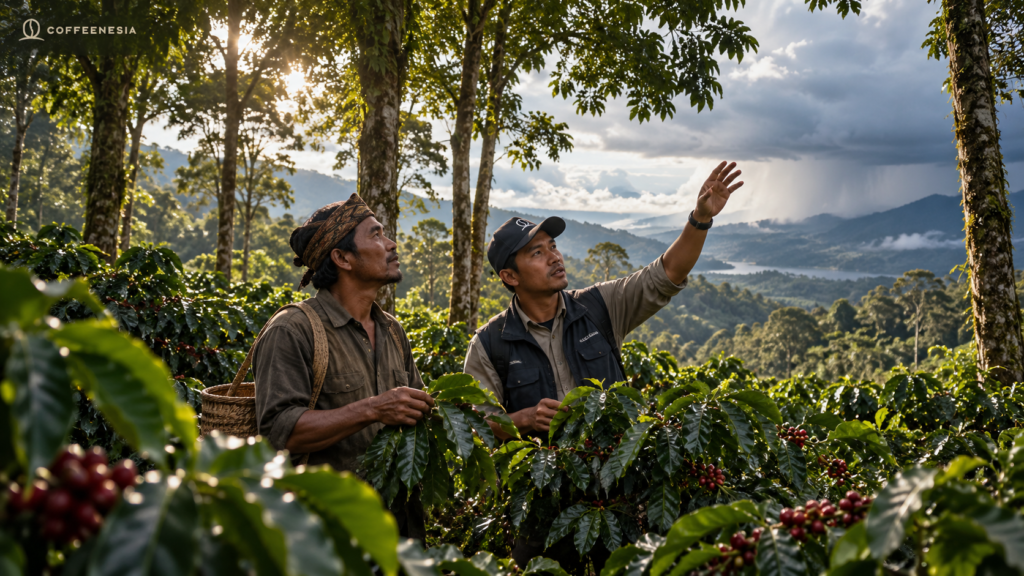
Not by themselves. Shade trees are one important adaptation tool for Gayo coffee climate change, but research consistently shows trade-offs. Shade can reduce heat and radiation and improve microclimate conditions, yet excessive shade may reduce productivity, modify humidity, or influence pest and disease dynamics. AGRIS
The better approach is integrated farm management:
Shade + Soil + Water + Variety + Monitoring + Post-Harvest Management
This is especially important in Gayo because farms differ in elevation, slope, tree age, variety, shade density, and local rainfall. A practice that works well at one elevation may not deliver exactly the same result elsewhere. For that reason, Gayo coffee climate change adaptation should remain site-specific rather than formulaic.
Will Gayo Coffee Climate Change Push Production to Higher Elevations?
Possibly in some locations over the long term, because warming can change where Arabica finds suitable temperatures. Global coffee-climate studies increasingly identify potential shifts toward cooler, higher-elevation production zones. AGRIS
However, moving production uphill is not a simple solution to Gayo coffee climate change. Higher land may involve forests, conservation areas, competing land uses, different soil conditions, infrastructure constraints, or community ownership issues. Expanding production upward without careful land-use planning could create new environmental problems.
A responsible response should therefore prioritize:
Improve Existing Farms → Adapt Management → Protect Ecosystems → Evaluate Future Suitability
rather than assuming the industry can endlessly move coffee plantations to higher ground.
How Could Gayo Coffee Climate Change Affect Global Buyers?
Gayo coffee climate change can affect global buyers through supply reliability, lot consistency, harvest timing, price volatility, and quality variation. A buyer may not see the climate event directly, but the effects can appear later in procurement through changing availability, processing conditions, or sensory consistency.
The chain can be:
Climate Variability → Farm Yield → Cherry Quality → Processing → Export Volume → Buyer Supply
For specialty roasters, another concern is repeatability. A lot purchased one year may be difficult to replicate exactly when flowering, harvest timing, or processing weather changes. This is why strong origin relationships, traceability, quality control, and multi-season communication become increasingly important when managing Gayo coffee climate change risk.
Global buyers should therefore evaluate suppliers not only on:
Price + Cup Score
but also:
Traceability + Farmer Relationships + Processing Capacity + Quality Control + Supply Resilience
Climate resilience is gradually becoming a procurement issue as well as an environmental one.
What Should Coffee Buyers Ask Suppliers About Gayo Coffee Climate Change?
International buyers do not need to become climate scientists, but they can ask practical questions about the supply chain. These questions help distinguish a transparent origin partner from a supplier that only provides a commodity price. For buyers concerned about Gayo coffee climate change, the goal is to understand how suppliers identify and manage variability rather than expecting them to eliminate climate risk entirely.
Buyers can ask about:
Origin → Elevation → Farm / Cooperative → Variety → Harvest → Processing → Moisture → Climate Challenges → Adaptation → Traceability
Relevant questions include whether coffee comes from one origin or multiple areas, how drying is handled during wet conditions, how moisture is monitored, whether farms use shade systems, and how suppliers manage lot variation. These questions help buyers understand how Gayo coffee climate change may influence supply quality and consistency over time.
The objective is not to demand that farmers eliminate climate risk. No agricultural supplier can guarantee that. The goal is to understand how the supply chain identifies changing conditions and responds to them.
Coffeenesia Expertise in Gayo Coffee Climate Change and Origin Supply
Coffeenesia describes itself as a direct source of specialty coffee and cascara from the Gayo Highlands of Aceh. Its official website states that the company established its farm in Gayo, directly oversees production, provides traceability regarding origin, variety, and processing, and works as part of the wider Gayo coffee community. Coffeenesia
Coffeenesia currently publishes Gayo coffees using Natural, Full Wash, Semi Wash, Honey Aerobic, Honey Anaerobic, and Wine processes. Depending on the lot, the published origin is Takengon, Aceh, generally around 1,300–1,500 masl, with moisture specifications near 11–12.5% and varieties that include Ateng, Bourbon, Typica, and Sigararutang. Coffeenesia
Its website also states that Coffeenesia personally oversees coffee and cascara production, promotes direct sourcing and full traceability, and connects purchases with farmer welfare, community development, and environmental preservation in Gayo. Coffeenesia
For buyers, this expertise can be summarized as:
Gayo Origin → Farm Connection → Processing → Quality Control → Traceability → Wholesale Supply
Coffeenesia should not claim to solve Gayo coffee climate change for Aceh’s coffee sector. Its verifiable role is narrower and more credible: maintaining origin relationships, overseeing coffee production, supporting traceability, working with the Gayo coffee community, and supplying coffee and cascara to buyers who value quality and origin transparency. Pasted markdown
Why Does Cascara Matter in a Gayo Coffee Climate Change Context?
Cascara uses the dried outer fruit of the coffee cherry, turning a coffee-processing by-product into a separate beverage ingredient. Coffeenesia explicitly positions cascara as part of its sustainability approach and states that using more of the coffee cherry supports zero-waste harvesting. Coffeenesia
For farmers and processors, value creation beyond the bean may help diversify revenue from the coffee harvest. Cascara will not compensate for large production losses on its own, but it illustrates a broader Gayo coffee climate change resilience principle:
Use More Value from Each Harvest
instead of relying only on green-bean volume.
This becomes increasingly relevant when farms face higher production uncertainty and need stronger economics per unit of harvested coffee.
Framework for Gayo Coffee Climate Change Resilience
A practical Gayo coffee climate change resilience framework can be structured as:
1. CLIMATE MONITORING
How are temperature and rainfall patterns changing?
2. FARM OBSERVATION
How are flowering, cherry development, and tree health responding?
3. SHADE MANAGEMENT
Does the farm have the right level and diversity of shade?
4. WATER MANAGEMENT
Can the farm retain water and reduce runoff during variable rainfall?
5. SOIL HEALTH
Is the soil able to retain moisture and support healthy roots?
6. DIVERSIFICATION
Can farmers reduce income dependence on one crop or one product?
7. HARVEST MANAGEMENT
Are cherries picked and handled consistently despite changing seasons?
8. PROCESSING CONTROL
Can drying and fermentation remain stable during wet weather?
9. QUALITY CONTROL
Are moisture, defects, density, and sensory characteristics monitored?
10. TRACEABILITY & BUYER COMMUNICATION
Can changing crop conditions be communicated transparently to buyers?
In short:
Climate → Farm → Harvest → Processing → Quality → Traceability → Market
This framework helps explain why Gayo coffee climate change is not only an environmental issue. It extends through the entire specialty-coffee value chain, from farm management to buyer communication. Pasted markdown
FAQ About Gayo Coffee Climate Change
How is Gayo coffee climate change affecting production?
Gayo coffee climate change can affect production through changing rainfall, higher temperatures, drought stress, harvest timing, drying conditions, and shifts in Arabica suitability. Research involving farmers in Central Aceh and Bener Meriah has already identified temperature and rainfall as major climate pressures on production. The exact impact differs between farms depending on altitude, shade, soil, water availability, variety, and management. Climate change therefore creates greater variability rather than one identical outcome everywhere. AGRIS
Will Gayo coffee disappear because of climate change?
There is no basis for saying Gayo coffee will definitely disappear. A Gayo-focused study cites modelling suggesting that suitable Arabica-growing land in Aceh could decline dramatically by 2050 under certain climate scenarios, but this is a projection rather than a guaranteed outcome. Farmer adaptation, future emissions, technology, varieties, land management, and local microclimates will influence actual outcomes.
For Gayo coffee climate change, the data should therefore be treated as a warning about long-term risk rather than a prediction of inevitable disappearance. AGRIS
What are Gayo farmers doing to adapt to climate change?
Research from Central Aceh documents farmers using shade trees, rorak or infiltration trenches, and water-conservation techniques as Gayo coffee climate change adaptation measures. These practices can help regulate microclimate, improve water infiltration, and reduce vulnerability to dry periods. Adaptation still needs to match the conditions of each farm because elevation, rainfall, soil, and shade differ across the Gayo Highlands. AGRIS
Can shade trees protect Arabica coffee from higher temperatures?
Shade trees can reduce direct radiation and moderate farm microclimate, making agroforestry an important Gayo coffee climate change adaptation option. However, shade must be managed because excessive density can create competition, affect productivity, or change humidity and pest conditions. Research therefore supports managed shade rather than assuming more shade is always better. AGRIS
Does Gayo coffee climate change affect the taste of coffee?
Climate can influence coffee indirectly through cherry maturation, harvest timing, plant stress, and post-harvest conditions, all of which can influence bean characteristics and cup quality. However, a specific flavor change cannot be attributed to Gayo coffee climate change alone because variety, soil, processing, fermentation, roasting, and farm management also matter. Buyers should therefore evaluate climate impact through actual lot specifications and cupping rather than assuming every warmer season produces the same sensory result.
Why should global buyers care about Gayo coffee climate change?
Global buyers may experience Gayo coffee climate change risk through supply availability, lot consistency, harvest timing, quality variation, or higher procurement uncertainty. Understanding origin conditions helps roasters and importers build better long-term sourcing relationships. Traceability and direct communication become increasingly valuable when seasonal conditions vary.
Climate resilience is therefore both an environmental concern and a supply-chain issue.
How does Coffeenesia support Gayo coffee sourcing?
Coffeenesia states that it operates directly within the Gayo coffee ecosystem, has established farming activities in the highlands, oversees coffee and cascara production, and provides traceability around origin, variety, and processing. The company supplies several Gayo processing profiles and works with wholesale buyers seeking direct-origin coffee. Coffeenesia
This role becomes increasingly relevant in a Gayo coffee climate change context because direct origin relationships, processing oversight, and traceability can help buyers better understand seasonal variation and lot-level quality.
Protecting Gayo Coffee from Climate Change Requires More Than One Solution
Gayo coffee climate change is not a distant issue limited to environmental reports. Research involving Gayo farmers already identifies rainfall and temperature variability as production pressures, while longer-term modelling raises serious questions about future Arabica suitability in Aceh. The challenge affects farm productivity, farmer livelihoods, post-harvest processing, specialty quality, and the reliability of international supply. AGRIS
There is no single adaptation technique that can eliminate Gayo coffee climate change risk. Shade management, water conservation, soil health, farm monitoring, diversification, post-harvest infrastructure, quality control, and long-term buyer relationships need to work together. Just as importantly, adaptation needs to fit the conditions and capabilities of individual farmers rather than applying a single formula across every Gayo farm.
Coffeenesia’s role within this ecosystem is to maintain close connection with Gayo origin, oversee coffee and cascara production, provide traceability, manage quality, and connect specialty coffee with global buyers. Buyers interested in Gayo coffee can explore Coffeenesia’s available origins, processing methods, wholesale tiers, and direct-sourcing approach through its official platform. Coffeenesia

For wider Indonesian agricultural commodity sourcing, EFBA Agro also works with Indonesian coffee and agricultural supply chains, while PT EFBA Digital Mulia provides the broader corporate ecosystem behind related business activities.
The future of Gayo coffee will depend not only on protecting its traditional flavor, but on helping the farms, processing systems, and supply relationships behind that flavor become more resilient to a changing climate.