
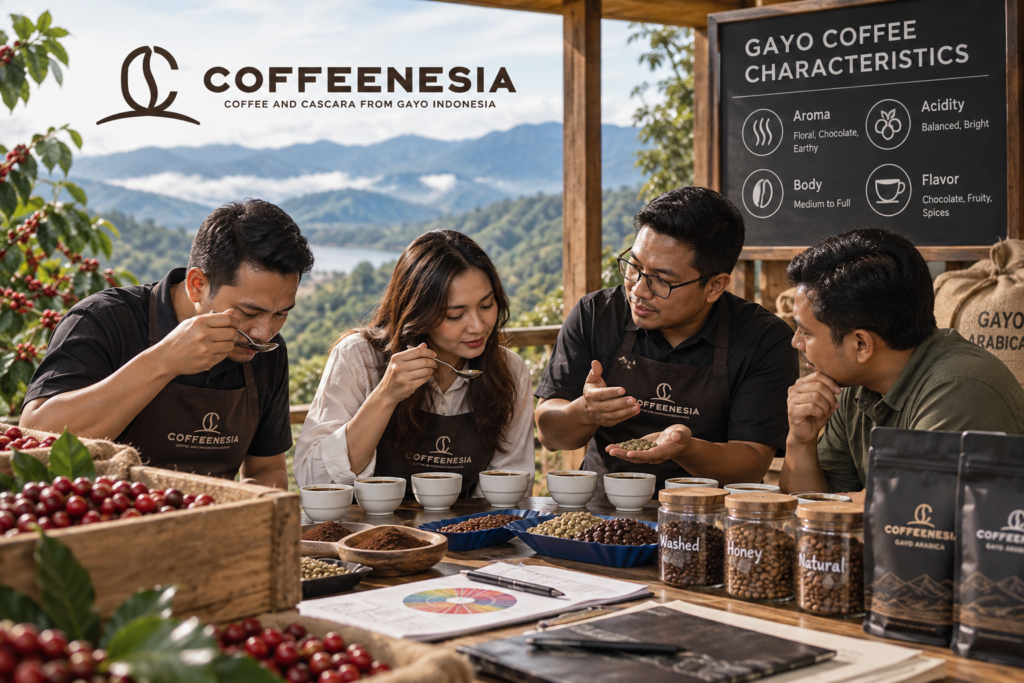
Gayo Coffee is one of Indonesia’s distinctive Arabica origins, grown in the highlands of Aceh. Understanding Gayo coffee characteristics requires more than identifying a single flavor note. Origin, altitude, variety, harvesting, post-harvest processing, roasting, and brewing can all influence what consumers ultimately experience in the cup.
For buyers, roasters, cafés, and coffee businesses, understanding Gayo coffee characteristics is useful before choosing green beans or developing a roast profile. Aroma, acidity, body, sweetness, aftertaste, and processing method should be considered together rather than treating “Gayo” as one fixed flavor profile.
The origin itself has formal recognition in Indonesia. The Directorate General of Intellectual Property lists Kopi Arabika Gayo as a registered Geographical Indication from Aceh under registration number IG.00.2009.000003.
Therefore, buyers should evaluate Gayo coffee characteristics through both origin information and the actual sensory profile of the coffee lot.
What Are the Main Gayo Coffee Characteristics?
The main Gayo coffee characteristics commonly include a fragrant aroma, balanced acidity, noticeable body, natural sweetness, and a complex flavor profile. However, the sensory experience can vary depending on the growing area, altitude, coffee variety, post-harvest process, roast level, and brewing method.
Research from Indonesia’s Ministry of Agriculture repository evaluated Gayo Arabica from Aceh Tengah and Bener Meriah at elevations of 1,000–1,500 and 1,500–1,750 meters above sea level. The samples received total cup scores ranging from 82.75 to 85.25, placing them within the specialty coffee category evaluated in the study.
These findings show that Gayo coffee characteristics should not be represented by one fixed tasting note. Instead, buyers can assess the coffee through a broader framework:
Origin → Altitude → Variety → Processing → Roasting → Brewing → Aroma → Acidity → Body → Flavor → Aftertaste
Each stage can influence the final cup. As a result, two coffees from the Gayo Highlands may share the same geographical identity while offering different sensory experiences.
Research Data on Gayo Arabica Coffee Quality
Scientific research provides useful context when evaluating Gayo coffee characteristics. One study on Geographical Indication Gayo Arabica examined coffee from Aceh Tengah and Bener Meriah, including samples grown at elevations between 1,000–1,500 meters and 1,500–1,750 meters above sea level.
The researchers assessed both physical bean quality and sensory attributes. The sensory evaluation covered fragrance, flavor, aftertaste, acidity, body, balance, uniformity, clean cup, sweetness, and overall quality.
The study reported scores between 82.75 and 85.25 points. Within the research conditions, the higher-altitude samples generally showed stronger physical and cup-quality results.
This research is useful because it demonstrates that Gayo coffee characteristics involve multiple measurable attributes. Therefore, buyers should evaluate the complete sensory profile instead of relying on a single description such as “strong,” “smooth,” or “fruity.”
1. Gayo Coffee Aroma: An Important Sensory Attribute
Aroma is one of the first Gayo coffee characteristics that consumers may notice during preparation and tasting. In professional coffee evaluation, fragrance and aroma help describe the volatile compounds perceived from dry grounds and brewed coffee.
Gayo Arabica can produce a complex aromatic profile, although the exact expression depends on the coffee lot. Coffeenesia’s published materials describe some Gayo offerings with rich aromatic qualities and list different processing methods, including Washed, Honey, and Natural.
Processing can influence how aroma develops because the coffee cherry undergoes different treatments after harvesting. Therefore, buyers should look beyond the general question, “What does Gayo coffee smell like?” and consider the specific origin, process, lot, and roast profile being evaluated.
For commercial sourcing, aroma should consequently be assessed together with the other sensory attributes rather than treated as a standalone indicator of quality.
2. Gayo Coffee Acidity: Understanding Balance
Acidity is another important element when evaluating Gayo coffee characteristics. In coffee tasting, acidity does not simply refer to an unpleasant sour taste. Instead, it describes a lively sensation that can contribute brightness, structure, and complexity to the cup.
Gayo Arabica is often described commercially as having mild, balanced, or lower perceived acidity, depending on the product and processing method. Coffeenesia also describes some of its Gayo offerings with smooth profiles and balanced or low acidity.
However, these descriptions should be treated as characteristics of particular products rather than a universal specification for every Gayo coffee. Growing conditions, processing, roasting, and brewing can all influence how acidity is perceived.
A practical way to assess the cup is:
Acidity + Sweetness + Body + Flavor + Aftertaste = Overall Cup Balance
This approach gives buyers a clearer understanding of how acidity contributes to the complete sensory profile.
3. Gayo Coffee Body: Understanding Mouthfeel
Body describes the physical sensation or weight of coffee in the mouth and is another relevant part of Gayo coffee characteristics. Depending on the coffee and preparation method, the mouthfeel can range from light and delicate to smooth, rich, or full.
Gayo Coffee is frequently associated commercially with medium-to-full or full-bodied profiles. Coffeenesia’s published product materials also describe several Indonesian Gayo Arabica offerings using full-bodied or balanced-body characteristics.
Nevertheless, body is not determined by origin alone. Roast development, grind size, extraction, and brewing method can change the perceived mouthfeel considerably. The same green coffee may therefore produce different results when prepared as espresso, French press, pour-over, or through another brewing method.
For roasters and cafés, this distinction is important because body can influence how a coffee performs in different menu applications. Buyers should therefore evaluate the green coffee profile together with the intended roasting and brewing application.
4. Gayo Coffee Flavor: Chocolate, Earthy, Spice, and Fruity Notes
Flavor is among the most recognizable Gayo coffee characteristics, yet Gayo Coffee should not be reduced to one universal flavor profile. Different lots can display different combinations of sweetness, chocolate-like notes, earthy depth, spice, fruit-related characteristics, and other sensory impressions.
Coffeenesia’s published product information illustrates this variation by presenting different Gayo offerings with profiles that include chocolate, earthy, fruity, smooth, and other sensory directions.
Such variation is expected because coffee flavor results from multiple factors. Genetics, elevation, climate, agricultural practices, harvesting, post-harvest processing, roasting, and brewing can all contribute to the final cup.
Research on Gayo Arabica also identified differences between samples from different growing elevations. Therefore, buyers looking for particular Gayo coffee characteristics should evaluate the actual lot and sample rather than relying solely on the geographical name.
5. Sweetness, Aftertaste, and Clean Cup Also Matter
Aroma, acidity, body, and flavor are important when assessing Gayo coffee characteristics, but they do not provide a complete sensory evaluation. Professional coffee assessment also considers sweetness, aftertaste, balance, uniformity, clean cup, and overall impression.
The Ministry of Agriculture research on Gayo Arabica included these attributes when evaluating samples from Aceh Tengah and Bener Meriah. This provides a useful reminder that coffee quality involves the interaction of several sensory characteristics rather than one dominant tasting note.
For specialty buyers, a coffee with an intense aroma may still perform differently from a lot with better balance between aroma, acidity, sweetness, body, and aftertaste. Consequently, sample evaluation and cupping can provide more useful information before selecting coffee for a specific commercial application.
Buyers can use the following sequence when evaluating a sample:
Aroma → Flavor → Aftertaste → Acidity → Body → Sweetness → Balance → Clean Cup → Overall
By reviewing these attributes together, buyers can develop a more complete picture of Gayo coffee characteristics and compare individual lots according to their target market, roast profile, and brewing application.
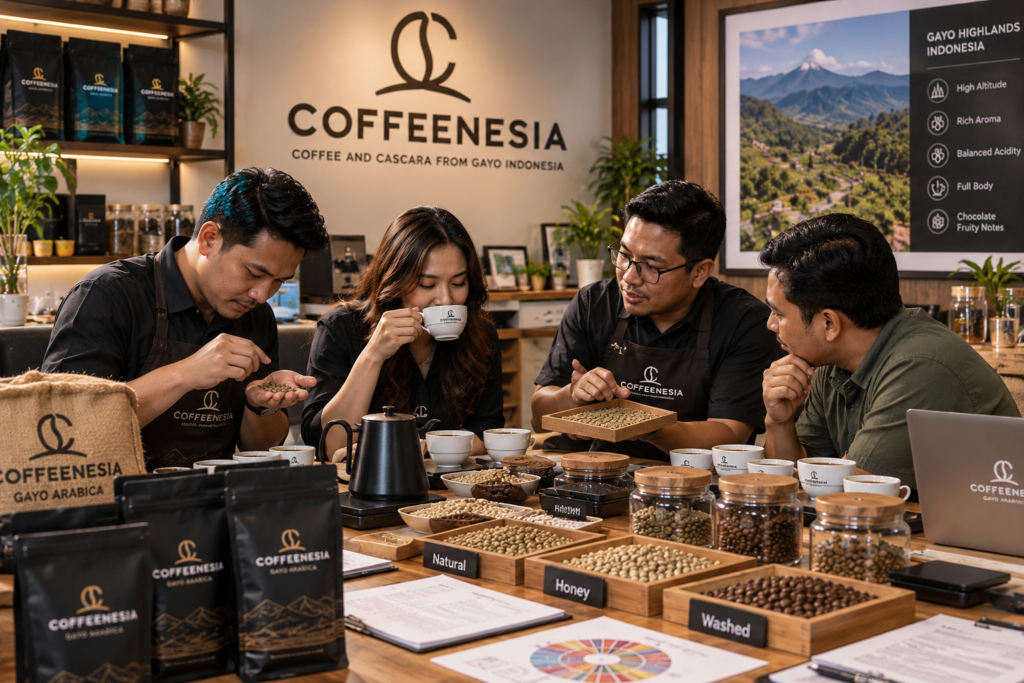
6. Altitude Helps Shape Gayo Coffee Characteristics
The Gayo Highlands provide the environmental context behind the coffee’s origin, but altitude deserves particular attention. Higher elevation can affect cherry development and ultimately influence physical and sensory quality, although altitude is only one of several interacting factors.
The Indonesian agricultural study compared Gayo Arabica grown at 1,000–1,500 meters with coffee grown at 1,500–1,750 meters above sea level. Within that study, the higher-elevation group generally produced better physical bean quality and sensory results.
This does not mean altitude alone guarantees better coffee. Harvest maturity, variety, farm management, processing, drying, storage, roasting, and preparation remain important.
For buyers, origin information becomes more useful when accompanied by traceability:
Origin → Farm/Cooperative → Elevation → Variety → Process → Lot → Quality Evaluation
7. Processing Can Change the Expression of Gayo Coffee
Post-harvest processing is one of the most important variables affecting how coffee characteristics appear in the cup. Coffeenesia publishes Gayo Arabica offerings using multiple processing approaches, including Washed, Honey, and Natural, allowing buyers to explore different expressions from the same broader origin.
Natural processing can emphasize different sensory characteristics from washed coffee, while honey processing creates another processing pathway. The final result still depends on the specific lot, drying control, roasting, and brewing, so these categories should not be treated as guarantees of particular tasting notes.
Coffeenesia also describes a production method based on selective red-cherry picking, processing after harvest, and slow drying on raised beds. According to its website, the company uses these steps to support quality and aromatic complexity in its coffee and cascara products.
Therefore:
Coffee Cherry → Selection → Processing → Drying → Green Bean → Roasting → Brewing → Cup Profile
8. What Does Gayo Coffee Contain?
Coffee naturally contains many chemical compounds that contribute to flavor and physiological effects. Relevant components studied in Arabica coffee include caffeine, chlorogenic acids, trigonelline, sucrose, and lipids, although their levels vary according to genetics, environment, processing, and roasting.
These compounds should not be confused with fixed nutritional specifications for every Gayo Coffee lot. Without laboratory analysis of a specific Coffeenesia batch, it would be inaccurate to claim that all Gayo beans contain an exact amount of caffeine, chlorogenic acid, or other compounds.
Caffeine is the most familiar example. The U.S. FDA states that caffeine can be part of a healthy diet for most people and cites 400 mg per day for most adults as an amount not generally associated with negative effects, while also noting that sensitivity varies between individuals.
Therefore, health claims about Gayo Coffee should remain careful. Its strongest differentiators for buyers are its origin, sensory quality, processing, traceability, and application, rather than unsupported medical claims.
9. What Can Gayo Coffee Be Used For?
Gayo Coffee can serve several commercial purposes depending on bean form, roast profile, and target market. Green beans can supply specialty roasters, while roasted beans can support cafés, retail coffee brands, hospitality businesses, offices, and other beverage channels.
Roasters can develop the coffee as a single-origin offering, incorporate suitable lots into blends, or adjust roast profiles for espresso and filter applications. Cafés can then explore espresso, Americano, long black, manual brew, milk-based drinks, cold brew, or other coffee beverages according to the roast and extraction design.
Coffeenesia also develops another product from the coffee fruit: cascara. The company describes its Gayo cascara as the sun-dried fruit surrounding Arabica coffee beans, creating an additional beverage product while supporting its approach to using more of the coffee cherry.
This creates a broader product pathway:
Gayo Coffee Cherry → Green Coffee → Roasted Coffee → Brewed Coffee
and
Coffee Fruit → Cascara → Infusion / Beverage Ingredient
10. What Should Buyers Check Before Purchasing Gayo Coffee?
For commercial buyers, flavor description should be the beginning of evaluation rather than the final decision. Ask for information about origin, processing method, lot specifications, physical quality, sample availability, packaging, minimum order quantity, and traceability.
Coffeenesia’s official website states that the company manages its own farms in the Gayo Highlands and oversees production stages while providing transparency regarding origin, variety, and processing. It also publishes partnership MOQ options of 25 kg for Merchant Tier, 100 kg for Wholesale Tier, and above 250 kg for Distributor Tier.
For businesses that rely heavily on cup quality, requesting a sample before a larger purchase is a practical step. Coffeenesia’s published ordering information also describes a process where buyers can request samples for cupping and confirm specifications such as process and packaging before shipment.
A practical buying sequence is:
Define Cup Profile → Select Origin → Select Process → Review Specification → Request Sample → Cup the Coffee → Confirm Volume → Confirm Packaging → Order
Understanding Gayo Coffee Characteristics
If the discussion is simplified, the character of Gayo Coffee can be understood through several connected elements:
Gayo Highlands → Growing Environment → Coffee Cherry → Processing → Green Bean Quality → Roasting → Brewing → Aroma → Acidity → Body → Flavor → Aftertaste
These factors do not operate independently. Processing can influence sensory expression, roasting changes aromatic and flavor development, while brewing determines how those characteristics are extracted into the final cup.
Before choosing a Gayo Coffee lot, buyers should therefore answer three questions:
1. What flavor profile does the business need?
2. Will the coffee be used for roasting, retail, café service, or another product?
3. Do the origin, process, quality specification, volume, and packaging fit that commercial requirement?
This approach is especially useful for importers, distributors, roasters, and cafés that need consistency rather than simply an attractive origin story.
Coffeenesia Expertise in Gayo Coffee Supply
Coffeenesia’s relevance to Gayo Coffee is directly supported by its published operations. The company’s official website describes Coffeenesia as a direct source for single-origin Indonesian coffee and cascara, with its farm operations based in the Gayo Highlands of Aceh. It also states that the company oversees stages of coffee and cascara production and provides information on origin, variety, and processing methods.
Its production information describes selective red-picking, rapid hygienic processing, and slow drying, while its product offering includes single-origin specialty coffee and Gayo cascara. Coffeenesia also publishes flexible packaging options and different MOQ levels for merchant, wholesale, and distributor buyers.
For Gayo Arabica specifically, Coffeenesia publishes products and sourcing information aimed at roasters, cafés, distributors, and international buyers. Its coffee pages describe options such as green beans, roasted beans, different processing methods, samples for quality evaluation, and wholesale supply.
This makes the supplier discussion directly relevant to the characteristics covered above. A buyer is not simply purchasing “Gayo Coffee”; the commercial decision should connect:
Origin + Process + Cup Profile + Quality + Traceability + Volume + Packaging + Supply
For broader Indonesian agricultural sourcing, buyers can also explore EFBA Agro, while the wider EFBA ecosystem provides information about business development and related commercial activities. The role of Coffeenesia in this article, however, remains focused on its verifiable expertise in Gayo Coffee and cascara sourcing and supply.
FAQ About Gayo Coffee Characteristics
What are the main characteristics of Gayo Coffee?
Gayo Arabica is associated with aromatic complexity, balanced acidity, noticeable body, sweetness, and varied flavor characteristics. However, the exact profile depends on origin within the Gayo Highlands, elevation, variety, post-harvest processing, roasting, and brewing. Research on Gayo Arabica from Aceh Tengah and Bener Meriah recorded specialty-category scores of 82.75–85.25 in the samples studied.
Is Gayo Coffee acidic?
Gayo Coffee contains acidity as part of its sensory structure, but acidity should not automatically be interpreted as unpleasant sourness. Its perceived acidity can range depending on the lot, processing, roast, and brewing method, and should be evaluated alongside sweetness, body, flavor, and balance.
Is Gayo Coffee strong-bodied?
Gayo Arabica is often associated with medium-to-full or fuller body, and Coffeenesia describes several of its Gayo offerings in this direction. However, the final mouthfeel also changes according to roast profile and brewing method.
What does Gayo Coffee taste like?
There is no single flavor that describes every Gayo lot. Depending on the coffee and processing, profiles can include chocolate-like, earthy, spice, fruity, sweet, and other sensory characteristics. Buyers should evaluate actual lot specifications and samples instead of assuming that every Gayo Coffee tastes identical.
Is Gayo Coffee specialty coffee?
Gayo Arabica can qualify as specialty coffee when a particular lot meets the relevant quality criteria. In one Ministry of Agriculture study, Gayo Arabica samples from Aceh Tengah and Bener Meriah scored 82.75–85.25 points and were classified as specialty coffee in that evaluation.
What can Gayo Coffee be processed into?
Gayo Coffee can be supplied as green beans for roasting or roasted for applications such as espresso, filter coffee, manual brew, cold brew, and other café or retail products. The coffee fruit can also provide cascara, which Coffeenesia markets as a dried coffee-fruit infusion product.
Can Coffeenesia supply Gayo Coffee in bulk?
Yes. Coffeenesia’s official website publishes Gayo specialty coffee sourcing and wholesale options, with MOQ tiers starting at 25 kg and larger tiers for wholesale and distributor partnerships. Buyers should confirm current lot availability, specifications, pricing, packaging, and shipment requirements directly before ordering.
Source Authentic Gayo Coffee with Coffeenesia
Understanding Gayo coffee characteristics means looking beyond a simple list of tasting notes. Aroma, acidity, body, sweetness, flavor, and aftertaste result from the interaction between origin, altitude, processing, roasting, and brewing.
For commercial buyers, the next step is to translate those characteristics into specifications. Decide the desired cup profile, application, processing method, volume, packaging, and quality requirements before choosing a lot.

Coffeenesia provides Gayo single-origin specialty coffee and cascara with published information on direct sourcing, processing, traceability, packaging, and wholesale quantities. Buyers looking for authentic Gayo Coffee can use those specifications as the starting point for samples, cupping, and supply discussions.
The goal is not simply to buy coffee from Gayo, but to select the Gayo Coffee profile that fits your market, roasting strategy, and customers.