
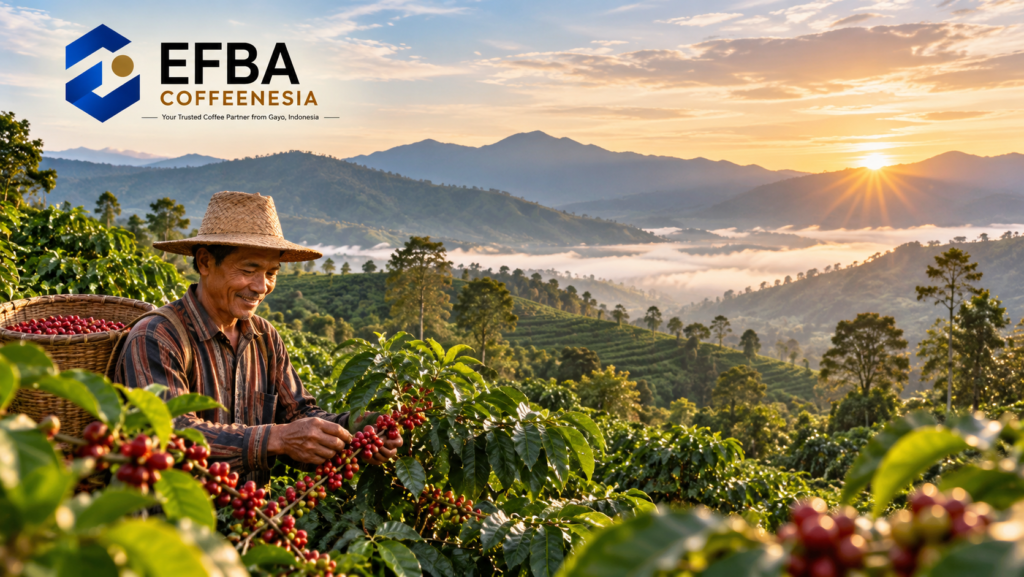
The story of Gayo coffee origin begins in the mountainous highlands of Aceh, Indonesia, where coffee cultivation has become closely connected with the landscape, farming communities, and regional identity. Located on the northern part of Sumatra, the Gayo Highlands have earned recognition as one of Indonesia’s important Arabica coffee-producing areas.
For coffee buyers, roasters, importers, distributors, and specialty coffee businesses, understanding where coffee comes from provides valuable context. Origin can help explain differences in growing conditions, processing traditions, flavor potential, traceability, and even how a coffee can be positioned in the market.
However, origin should never become the only factor when evaluating coffee. Two lots from the same region may still have different characteristics because farmers and processors use different varieties, harvesting practices, processing methods, drying techniques, sorting standards, and storage conditions.
Therefore, exploring the Gayo coffee origin means understanding not only a location on the map but also the wider ecosystem behind coffee production in the highlands of Aceh.
Table of Contents
ToggleWhat Is the Gayo Coffee Origin?
The Gayo coffee origin refers to coffee associated with the Gayo Highlands of Aceh, Indonesia. The region has become particularly recognized for Arabica coffee cultivation and has developed a distinctive identity within Indonesia’s diverse coffee landscape.
Indonesia itself has many coffee-producing regions. Sumatra, Java, Sulawesi, Bali, Flores, and other areas offer different environments and coffee traditions. Within this diversity, Gayo has established a strong reputation through its connection with highland Arabica production.
One important indication of this regional identity is the recognition of Kopi Arabika Gayo as an Indonesian Geographical Indication. Indonesia’s Directorate General of Intellectual Property lists Kopi Arabika Gayo among registered geographical indications originating from Aceh.
This connection between coffee and geography is particularly important for buyers who want to understand the origin behind the product they purchase.
For additional information about coffee and cascara from the region, explore Gayo Coffee & Cascara: 7 Amazing Insights You Should Know.
Where Is Gayo Coffee Grown?
Gayo coffee is associated with the highland areas of Aceh on the island of Sumatra. This mountainous environment forms an important part of the identity behind the Gayo coffee origin.
Coffee farms throughout the region operate within landscapes where elevation, local climate, soil conditions, rainfall patterns, farming practices, and surrounding vegetation can influence coffee cultivation.
These conditions create an environment suitable for Arabica production. Nevertheless, environmental advantages alone do not automatically produce high-quality coffee.
Farm management remains essential.
Farmers must manage coffee trees, monitor cherry development, determine appropriate harvesting periods, and separate mature cherries whenever possible. After harvesting, processors must also control several stages before coffee reaches buyers.
As a result, quality comes from the interaction between place, people, agricultural practices, and post-harvest management.
This relationship is one of the most interesting aspects of Gayo coffee.
The Gayo Highlands and Their Coffee-Growing Environment
The highland environment plays a significant role in the identity of Gayo coffee.
Coffee cultivation at higher elevations can allow cherries to develop differently compared with coffee grown under warmer conditions at lower elevations. Temperature, sunlight, rainfall, shade, soil characteristics, and farm management all interact throughout the growing cycle.
However, buyers should avoid assuming that altitude automatically guarantees superior quality.
Elevation represents only one variable.
A coffee grown in a favorable environment can still lose quality through poor harvesting, uncontrolled fermentation, inadequate drying, improper storage, or inconsistent sorting. Conversely, careful processing and quality control can help producers preserve the potential developed on the farm.
This is why understanding Gayo coffee origin should include both environmental conditions and the human decisions that occur throughout production.
Why Gayo Coffee Origin Matters
Origin provides context.
When buyers understand where their coffee comes from, they gain a clearer foundation for discussing product identity, traceability, processing, quality expectations, and sourcing requirements.
For specialty coffee businesses, origin may also become part of the customer experience. Consumers increasingly encounter coffees identified not simply as “Indonesian coffee” but by specific regions, processing methods, varieties, farms, cooperatives, or lots.
For commercial buyers, meanwhile, origin information can support procurement decisions and product differentiation.
A clearly communicated Gayo coffee origin can therefore contribute to:
- stronger product identity;
- better traceability discussions;
- clearer supplier communication;
- more informed sample evaluation;
- regional differentiation;
- more meaningful product storytelling; and
- better sourcing decisions.
Still, professional buyers should combine origin information with objective product specifications.
The History and Identity Behind Gayo Coffee
Coffee is more than an agricultural product in many producing regions. Over time, cultivation can become part of local economic activity, knowledge, and community life.
The Gayo Highlands represent an example of how a coffee-growing area can develop an identity that extends beyond the beans themselves.
Farming communities contribute practical knowledge about cultivation, harvesting, processing, and handling. Producers adapt their methods to local conditions, market requirements, available infrastructure, and changing buyer expectations.
At the same time, international demand encourages greater attention to consistency, traceability, processing transparency, and quality evaluation.
This interaction between traditional production knowledge and modern market requirements continues to shape the way Gayo coffee reaches buyers.
Consequently, the story of Gayo coffee origin is also a story about the people and supply chains behind the product.
Arabica Coffee and the Gayo Highlands
Gayo is particularly associated with Arabica coffee.
Arabica generally performs well in suitable highland environments, which makes the mountainous areas of Aceh relevant for its cultivation. Yet the final characteristics of Gayo Arabica depend on considerably more than the coffee species.
Variety, farm conditions, cherry maturity, processing, fermentation, drying, sorting, storage, and roasting can all influence the result.
For this reason, professional buyers should avoid purchasing coffee based solely on the word “Gayo.”
Instead, they should request detailed information about the actual coffee lot.
A strong sourcing process combines regional identity with measurable specifications and sample evaluation.
How Geography Can Influence Coffee Character
Geography creates the environmental framework in which coffee develops.
Temperature patterns influence plant development. Rainfall affects growing and harvesting cycles. Soil conditions influence plant nutrition. Elevation changes the environment in which cherries mature.
However, these elements work together rather than independently.
The same region can contain different microenvironments, which means farms located within the broader Gayo area may produce coffees with different characteristics.
Processing adds another layer of variation.
That is why Gayo coffee origin should be viewed as the starting point for understanding a coffee rather than a guarantee of one exact flavor profile.
For buyers, this distinction is important. Regional reputation can help identify promising sourcing areas, but samples and specifications remain essential before making purchasing decisions.
Harvesting and Cherry Selection
Quality management starts before processing.
Coffee cherries do not all mature at exactly the same time. Careful harvesting practices can help increase the proportion of mature cherries entering the processing stage.
Cherry selection matters because fruit maturity can influence sweetness, fermentation behavior, and overall cup quality.
After harvest, producers may conduct additional sorting before processing. Removing unsuitable cherries and foreign material can help improve consistency.
For buyers researching Gayo coffee origin, understanding harvesting practices provides useful insight into how producers manage quality at an early stage.
Quality control should continue throughout processing, drying, storage, grading, and preparation for shipment.
Processing Methods Used for Gayo Coffee
Processing represents one of the most influential stages after harvesting.
Once producers collect ripe coffee cherries, they must separate and dry the coffee using a chosen processing approach. Different methods can influence body, acidity, sweetness, aroma, clarity, and other sensory characteristics.
Indonesia is widely associated with distinctive coffee processing traditions, while producers also increasingly explore different processing approaches for specialty markets.
Regardless of method, control matters.
Fermentation time, water quality where relevant, drying conditions, moisture management, cleanliness, storage, and sorting can all affect the final product.
Therefore, international buyers should ask suppliers about the processing method rather than assuming all Gayo coffee follows exactly the same process.
How Processing Shapes Gayo Coffee Flavor
Origin establishes the environment. Processing helps shape how that potential appears in the cup.
For example, differences in fermentation and drying can create noticeable differences between coffee lots, even when the cherries originate from the same general production area.
Some coffees may emphasize sweetness and body. Others may offer greater clarity or different aromatic characteristics.
Roasting then transforms the green coffee again.
This means a coffee’s final sensory experience represents the result of multiple stages:
Origin → Farming → Harvesting → Processing → Drying → Storage → Roasting → Brewing
Each stage matters.
Understanding this chain allows buyers to evaluate Gayo coffee more accurately instead of attributing every characteristic exclusively to geography.
What Does Gayo Coffee Taste Like?
There is no single flavor description that applies to every Gayo coffee.
Depending on the specific lot, variety, processing method, roast profile, and brewing approach, buyers may encounter different combinations of aroma, sweetness, acidity, body, and flavor complexity.
This variation is normal.
Rather than expecting every Gayo coffee to match one fixed profile, professional buyers should evaluate samples and cupping results from the actual lots under consideration.
A roaster looking for specialty coffee may prioritize distinctive sensory characteristics. A distributor may emphasize consistency across shipments. Another buyer may require a particular grade, screen size, processing method, or volume.
Therefore, Gayo coffee origin provides valuable regional context, while actual lot evaluation determines whether the coffee matches a buyer’s specific requirements.
Gayo Coffee and Indonesia’s Coffee Diversity
Indonesia offers extraordinary coffee diversity.
Different islands and regions have their own climates, landscapes, farming systems, processing practices, and supply structures. This diversity gives international buyers opportunities to build coffee portfolios around multiple Indonesian origins.
Gayo represents one important part of this wider ecosystem.
Its highland identity and association with Arabica make it particularly relevant to buyers exploring Sumatran and Indonesian coffee.
For a wider perspective on Indonesia’s international coffee potential, read 7 Powerful Reasons Indonesian Coffee for Export Is Winning Global Markets.
Understanding multiple origins also helps buyers avoid treating “Indonesian coffee” as a single uniform product. Coffee from different areas can present significantly different characteristics.
Gayo Coffee Origin and Geographical Indication
Geographical identity has particular importance for Gayo Arabica.
Indonesia’s Directorate General of Intellectual Property recognizes Kopi Arabika Gayo as a registered Geographical Indication from Aceh.
A geographical indication identifies products connected to a particular geographic area where geographic origin contributes to the product’s reputation, quality, or characteristics.
For international buyers, this provides useful context when researching Gayo coffee.
Those who want to verify information about Indonesian geographical indications can consult the official Geographical Indication database of Indonesia’s Directorate General of Intellectual Property.
Official geographical recognition does not eliminate the need for quality evaluation. Buyers should still assess individual lots, specifications, samples, supplier capabilities, and documentation.
Traceability in Gayo Coffee Sourcing
Traceability has become increasingly relevant for coffee businesses.
Buyers may want to know not only the country of origin but also the region, processing method, production group, harvest information, lot identity, and other available sourcing details.
The amount of information available can vary between suppliers and supply chains.
Nevertheless, buyers should communicate their traceability requirements before placing large orders.
Useful information may include:
- country and region of origin;
- production area;
- coffee type or variety when available;
- processing method;
- harvest information;
- lot or batch identification;
- quality specifications;
- moisture information;
- packaging details; and
- shipment information.
A transparent supplier should clearly communicate which information it can provide.
Quality Control from Origin to Export
Coffee quality does not stop at the farm.
After harvesting and processing, green coffee still needs appropriate drying, storage, sorting, grading, packaging, and handling.
Each stage creates potential quality risks.
Excess moisture may affect storage stability. Poor packaging can expose coffee to unfavorable conditions. Inconsistent sorting can create unwanted variation. Long or poorly managed storage can influence freshness.
Consequently, buyers evaluating Gayo coffee origin should ask suppliers about their broader quality management process.
Questions might include:
How does the supplier evaluate green coffee?
What specifications can the supplier provide?
How does the supplier manage moisture?
What packaging options are available?
Can buyers request samples before ordering?
How does the supplier manage consistency between lots?
These questions help buyers move from an attractive origin story toward a practical sourcing decision.
What International Buyers Should Check Before Buying Gayo Coffee
International coffee sourcing requires more than finding a supplier online.
Buyers should establish clear requirements before requesting quotations. Doing so helps suppliers recommend appropriate products and reduces unnecessary misunderstandings.
Important factors include the required coffee type, processing method, quality expectations, quantity, packaging, destination market, and shipment requirements.
Buyers should also request samples whenever possible.
Sample evaluation provides an opportunity to assess the actual product before making a larger commercial commitment.
For more practical sourcing guidance, read Wholesale Coffee Beans Indonesia: 7 Powerful Sourcing Tips.
The guide explains important considerations when evaluating coffee for wholesale purchasing.
Choosing a Reliable Indonesian Coffee Exporter
Origin quality alone cannot guarantee a successful transaction.
The supplier or exporter also plays an important role.
International buyers need partners who can communicate clearly, understand product specifications, prepare suitable documentation, coordinate packaging, and manage export requirements.
Before selecting a supplier, buyers should examine several factors:
Product knowledge – Does the supplier understand the coffee it offers?
Specification clarity – Can the supplier provide relevant product information?
Communication – Does the supplier respond clearly to technical and commercial questions?
Sampling – Can buyers evaluate products before larger purchases?
Supply capability – Can the supplier handle the required volume?
Export readiness – Can the supplier coordinate international orders appropriately?
Our guide Indonesian Coffee Exporter: 7 Proven Tips for Successful Coffee Sourcing discusses these considerations in greater detail.
How to Source Premium Coffee Beans from Indonesia
Sourcing premium coffee requires a structured approach.
Start by defining what you need.
Determine your preferred origin, processing method, quality level, approximate volume, packaging, and destination. Then identify suppliers capable of meeting those requirements.
Next, request specifications and samples.
Evaluate the coffee before moving toward larger commercial discussions. If the sample meets expectations, buyers can discuss pricing, volume, packaging, lead time, logistics, and other terms.
This structured approach reduces the risk of selecting coffee based solely on marketing descriptions.
For a complete overview, see How to Source Premium Coffee Beans from Indonesia: 7 Powerful Tips.
Bulk and Wholesale Gayo Coffee Considerations
Wholesale buyers face different requirements from individual coffee consumers.
Consistency becomes particularly important.
A roaster purchasing larger quantities may need predictable specifications across multiple deliveries. Distributors may need stable supply and suitable packaging. Importers may focus heavily on documentation and logistics.
Therefore, buyers considering bulk Gayo coffee should discuss:
- expected order volume;
- product specifications;
- available grades;
- processing method;
- sample approval;
- packaging;
- production or preparation lead time;
- shipment schedule; and
- documentation requirements.
Clear communication before ordering can help both parties establish realistic expectations.
Packaging and Storage Considerations
Packaging protects coffee throughout storage and transportation.
The appropriate packaging format depends on the type of product, order size, buyer requirements, transportation conditions, and destination.
Green coffee buyers should discuss available packaging specifications directly with suppliers.
Storage conditions also matter.
Coffee should remain protected from excessive moisture, strong odors, contamination, and other conditions that may affect quality.
For international shipments, the journey between origin and destination can take time. Appropriate packaging and handling therefore become part of quality preservation.
Gayo Coffee for Roasters
For roasters, understanding Gayo coffee origin can support both product development and communication.
Origin information gives roasters context before sample evaluation. They can then assess how the coffee responds to different roast profiles and determine whether it suits espresso, filter, blends, or other applications.
However, roasting decisions should remain based on the actual coffee.
Density, moisture, processing, bean size, and sensory objectives can all influence roast development.
A strong origin story can attract attention, but consistent roasting and cup quality ultimately determine the consumer experience.
Gayo Coffee for Importers and Distributors
Importers and distributors often evaluate coffee from a broader commercial perspective.
They may need to balance quality with volume, price, supply continuity, logistics, documentation, and customer requirements.
For these businesses, Gayo coffee can provide a recognizable regional identity within an Indonesian coffee portfolio.
Nevertheless, reliable sourcing requires more than a recognizable name.
Importers should verify specifications, evaluate samples, clarify shipment requirements, and communicate expected volumes before finalizing orders.
Understanding Gayo coffee origin helps establish product context, while disciplined procurement helps build a sustainable supply relationship.
Gayo Coffee for Specialty Coffee Businesses
Specialty coffee businesses often place greater emphasis on transparency, sensory quality, processing, and origin differentiation.
Gayo coffee can offer opportunities for roasters and cafés looking to introduce Indonesian coffee with a strong regional identity.
Businesses can communicate information about Aceh, the Gayo Highlands, processing methods, and coffee characteristics to help customers better understand what they are drinking.
Still, storytelling should remain accurate.
Specific claims about farms, producers, varieties, processing, certifications, or sustainability should correspond to the actual coffee being sold.
Transparency builds stronger credibility than exaggerated marketing language.
From Coffee Cherry to Cascara
The coffee cherry contains more than the seed that eventually becomes a roasted coffee bean.
During processing, the fruit surrounding the seed can also become relevant for other products. One example is cascara, which comes from the dried coffee fruit.
This creates an interesting connection between coffee and other potential products within the coffee ecosystem.
For Coffeenesia, exploring Gayo means looking not only at coffee beans but also at the wider value that coffee fruit can offer.
You can learn more about this connection through Gayo Coffee & Cascara: 7 Amazing Insights You Should Know.
Sustainability and Responsible Coffee Sourcing
Sustainability has become an important discussion throughout global coffee supply chains.
However, the word “sustainable” can refer to many different practices. Buyers should therefore avoid assuming that every product from a particular origin automatically meets the same sustainability standards.
Instead, buyers can ask suppliers specific questions about farming practices, traceability, waste utilization, community relationships, certifications where applicable, and supply-chain transparency.
Specific information provides more value than broad claims.
The relationship between coffee production and local communities also deserves attention. Coffee sourcing can create economic activity across farming, processing, transportation, trading, quality control, and export services.
Understanding this ecosystem gives buyers a more complete perspective on the Gayo coffee origin.
Why Buyers Continue to Explore Indonesian Coffee
Indonesia remains an attractive sourcing destination because of its diversity.
Buyers can explore multiple coffee origins, processing approaches, flavor possibilities, and supply options within one country.
For international businesses, this diversity can support different product strategies.
A specialty roaster may seek distinctive single-origin lots. A larger roaster may require dependable supply for blends. A distributor may want multiple Indonesian origins in its portfolio.
Gayo can play a role in each of these strategies depending on the actual coffee and supplier capabilities.
Read 7 Powerful Reasons Indonesian Coffee for Export Is Winning Global Markets for additional insight into Indonesia’s position as a coffee sourcing destination.
Coffeenesia and the Story of Gayo Coffee
Coffeenesia connects the story of Indonesian coffee with the needs of buyers who want to understand origin, quality, processing, and sourcing.
Gayo represents an important part of that story.
Rather than viewing coffee only as a finished beverage, understanding its origin allows buyers to see the entire journey behind the product—from highland farms and coffee cherries to processing, quality control, green beans, roasting, and international markets.
This perspective is particularly valuable for businesses that want to communicate authentic product stories while maintaining a practical focus on quality and sourcing.
Our Gayo Coffee & Cascara Insights provides additional information for readers who want to explore coffee, cascara, sourcing, and product characteristics in greater detail.
Frequently Asked Questions About Gayo Coffee Origin
What is Gayo coffee origin?
Gayo coffee origin refers to coffee associated with the Gayo Highlands of Aceh, Indonesia. The region is particularly known for Arabica coffee and has developed a strong identity within Indonesia’s coffee sector.
Where does Gayo coffee come from?
Gayo coffee comes from the highland areas of Aceh on the island of Sumatra, Indonesia.
Is Gayo coffee Arabica or Robusta?
The Gayo name is strongly associated with Arabica coffee grown in the highlands of Aceh. Buyers should nevertheless confirm the product specifications of the particular coffee they intend to purchase.
Is Gayo coffee recognized as a geographical indication?
Yes. Indonesia’s Directorate General of Intellectual Property lists Kopi Arabika Gayo as a registered Geographical Indication from Aceh.
What makes the Gayo Highlands suitable for coffee?
The region offers a highland growing environment associated with Arabica cultivation. Elevation, climate, soil, farm management, harvesting, and processing collectively influence coffee development.
What does Gayo coffee taste like?
There is no single flavor profile for every Gayo coffee. Characteristics vary according to farm conditions, variety, processing, drying, storage, roasting, and brewing. Buyers should evaluate samples from individual lots.
Why is origin important when buying coffee?
Origin provides context regarding geography, production environment, regional identity, and traceability. However, buyers should combine origin information with samples and measurable product specifications.
How should buyers evaluate Gayo coffee?
Buyers should evaluate samples, processing methods, quality specifications, moisture, defects where applicable, packaging, consistency, available quantity, and supplier capabilities.
Can international buyers purchase Gayo coffee in bulk?
Availability depends on the supplier, product, season, quantity, and specifications required. Buyers should discuss their needs directly with a supplier before ordering.
How can buyers source Indonesian coffee?
Start by defining product specifications and expected volume. Then identify suitable suppliers, request product information and samples, evaluate quality, and discuss packaging, pricing, logistics, and export requirements.
For more guidance, read Wholesale Coffee Beans Indonesia: 7 Powerful Sourcing Tips.
Explore Gayo Coffee Origin with Coffeenesia
Understanding Gayo coffee origin means looking beyond the name printed on a coffee bag. The highlands of Aceh provide the geographical foundation, while farmers, processors, suppliers, exporters, roasters, and buyers all contribute to the coffee’s journey.
Origin creates identity. Farming develops the raw potential. Processing shapes the coffee further. Quality control protects consistency. Finally, roasting and brewing reveal the characteristics experienced by consumers.
For buyers, this complete perspective makes sourcing more informed.
Rather than choosing coffee based solely on regional reputation, evaluate the origin together with processing information, specifications, samples, supplier capability, packaging, and traceability.
If you are exploring Gayo coffee or other Indonesian coffee products, visit Coffeenesia: 7 Premium Gayo Coffee & Cascara Products to learn more about our products and sourcing approach.
You can also explore Gayo Coffee & Cascara: 7 Amazing Insights You Should Know for additional information about Gayo coffee and cascara.
For sourcing preparation, continue with How to Source Premium Coffee Beans from Indonesia: 7 Powerful Tips or learn what to evaluate when choosing an Indonesian coffee exporter.
If you are ready to discuss Gayo coffee, product specifications, samples, bulk requirements, or international supply, contact the Coffeenesia team to discuss your requirements.