
Welcome to the production front lines of 2026, my friends. We are currently navigating a highly volatile global market shaped by severe weather anomalies that are actively shifting historical harvest calendars across Indonesia. For independent roasteries and commercial brand founders, managing a predictable production schedule has become a daily balancing act.
Let’s be completely honest about the classic trap of chasing cheap, unverified spot lots from fly-by-night brokers who promise unrealistic upfront savings. When you buy untraceable green stock just to patch up an inventory gap, you usually inherit a massive operational headache. You end up with uneven bags full of hidden defects and wildly inconsistent moisture levels that can ruin your entire production week.
An unpredictable container of poorly dried green coffee will crash your Rate of Rise (ROR) curves on your profiling software, causing your head roaster to waste valuable hours trying to save uneven batches. Instead of beautiful, repeatable flavor notes, you end up with flat, baked profiles that alienate your hard-earned clients and tank your retail sales. Securing clean, physically stable arabica gayo coffee is the ultimate secret to keeping your sanity and making sure your signature blends or single-origin offerings taste incredible every single time.
We are all in this together, and we know that long-term survival in this crowded market requires absolute raw material transparency and data-driven precision. Working with a highly specialized supply line allows you to stop playing guessing games with your burner controls and airflow adjustments. Let’s break down the exact physical parameters and supply chain mechanics that will keep your roastery highly competitive, stable, and profitable this year.
Terroir meets Tech: Processing Physics in the Gayo Highlands That Creates Arabica Gayo Coffee
When we load green coffee into a hot roasting drum, thermodynamics takes over completely, and understanding how to pick the right arabica gayo coffee determines your daily success. We cannot afford to guess how the raw materials will react to conductive and convective energy transfer, especially with operating costs at an all-time high. We need a predictable, uniform foundation to ensure our heat application yields maximum bean expansion and uniform color development.
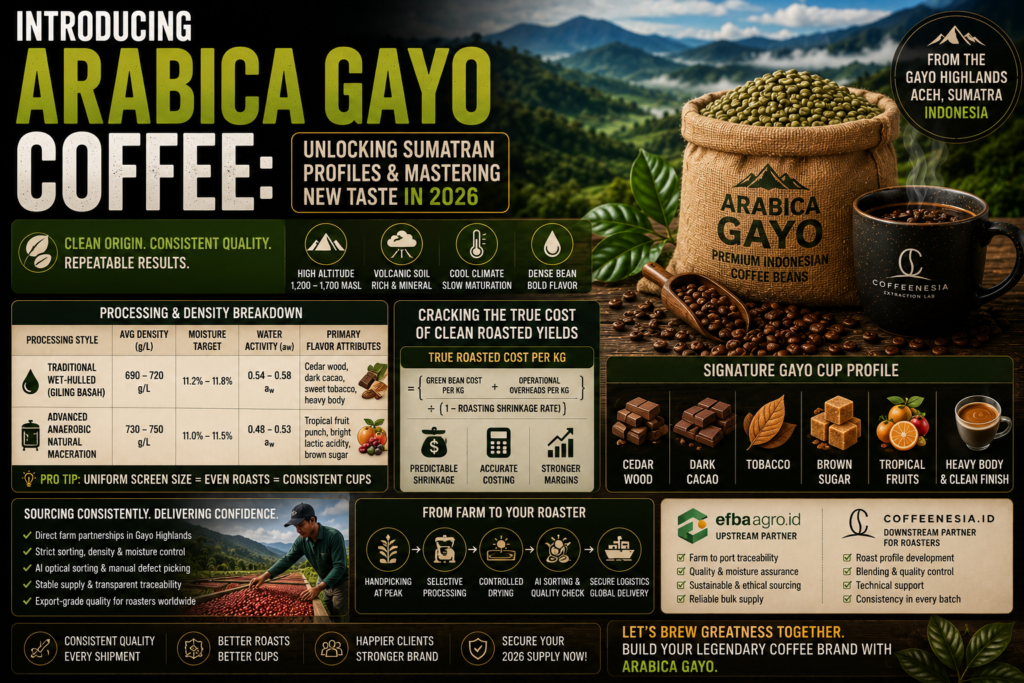
That is why we look incredibly closely at screen size distributions, bean density measured in grams per liter (g/L), and green moisture levels. Our team always aims to keep green moisture levels strictly bounded between 11% and 12%, while monitoring water activity to keep it below 0.60 despite Aceh’s crazy humidity. When you inherit wonky water activity from an unvetted bulk lot, it forces your operator to constantly fight the burners and adjust airflow blindly, leading to baked flavors, tipping, or underdevelopment.
We look closely at how pristine arabica gayo coffee behaves under intense thermal conduction depending on the way it was processed at origin. Experimental processing, like extended anaerobic maceration, completely alters bean density and cellular structure compared to traditional wet-hulled (Giling Basah) processing. In 2026, advanced food-safe dehydration tech and AI optical sorting have completely replaced old, risky drying habits to ensure total purity before bagging.
Let’s look at how different processing methods alter the physical metrics of your green stock before it hits your production floor.
Processing & Density Breakdown Table From Arabica Gayo Coffee
| Processing Style Evaluation | Avg Density (g/L) | Moisture Target | Water Activity (aw) | Primary Flavor Attributes |
| Traditional Wet-Hulled (Giling Basah) | 690 – 720 g/L | 11.2% – 11.8% | 0.54 – 0.58 | Cedar wood, dark cacao, sweet tobacco, heavy body |
| Advanced Anaerobic Natural Maceration | 730 – 750 g/L | 11.0% – 11.5% | 0.48 – 0.53 | Tropical fruit punch, bright lactic acidity, brown sugar |
Pro Tip from the Warehouse Floor: If your green stock arrives with uneven screen sizes or mixed processing lots, the smaller beans will roast significantly faster than the larger ones. This results in a muddy, unbalanced cup profile that makes it impossible to replicate your signature character across consecutive production days.
Cracking the True Cost of Clean Roasted Yields From Arabica Gayo Coffee
Let’s talk pure financial logic because passion alone cannot offset the harsh reality of shrinking commercial margins in today’s crowded market. Far too many procurement managers make the mistake of calculating their raw material budget based of coffee beans for roasters entirely on the initial price of green coffee. When you are sorting through incoming lots, consistency directly dictates your final cost of goods sold (COGS), especially when sourcing high-quality arabica gayo coffee.
If your incoming green coffee exhibits an unpredictable roasting shrinkage rate (weight loss during the roast due to moisture escape) or high sorting defects, your financial forecasting becomes completely useless. Traditional wet-hulled lots often contain high counts of crushed beans from local hulling machines, which char easily and must be sorted out. To protect your business from sudden cash flow crunches, your production team must calculate the true landed cost per roasted kilo after the moisture goes up the chimney.
We rely on a straightforward, clean formula to keep our operational forecasting perfectly accurate over long-term contract cycles. You can paste this simple calculation directly into your company’s internal accounting documents:
True Roasted Cost per kg = [ (Green Bean Cost per kg + Operational Overheads per kg) ÷ (1 – Roasting Shrinkage Rate) ]
Predictable arabica gayo coffee bounds your shrinkage rate, keeping your inventory tracking accurate and your business financially healthy. Every fraction of a percent saved on shrinkage and sorting waste goes straight back into your working capital. Stable batches mean your operations run smoothly, allowing you to map out your entire financial quarter with total confidence.
Strategy on the Cupping Table: Heavy Blenders vs. Exotic Single-Origins Arabica Gayo Coffee
Maintaining consistency over long-term contract cycles is the ultimate challenge for independent roasteries working with high-volume commercial hospitality clients. Your B2B cafe clients will immediately notice if their signature espresso base suddenly tastes overly bitter, thin, or sour. Integrating clean arabica gayo coffee into your product lineup acts as an incredible shield against seasonal profile drift.
We love using traditional wet-hulled Gayo lots to anchor heavy, milk-base espresso blenders because they bring an unmatched structural foundation to the cup. The deep, massive body, distinct cedar tones, and complex herbal spice characteristics of these lots give your espresso blends a rich crema and a velvety mouthfeel. It cuts through milk beautifully, providing a bold, classic flavor profile that wholesale cafe clients and retail customers crave in 2026’s crowded market.
Conversely, our modern experimental anaerobic micro-lots shine brilliantly as standalone, exotic single-origin offerings on your brew bar menu. These coffees showcase the incredible adaptability of the terroir, shifting the classic earthy reputation into a vibrant explosion of tropical fruits and clean, complex acidity. It gives your brand a powerful storytelling tool that proves you are operating at the absolute cutting edge of specialty coffee sourcing.
Refining the Roast: How Coffeenesia Supply Fresh Arabica Gayo Coffee

Our downstream production, blend formulation, and execution lab team at coffeenesia.id operates as your direct partner on the manufacturing floor. We help you design repeatable roast curves, optimize bulk production workflows, and provide the technical parameters needed to turn large-scale green imports into high-yielding consumer favorites. We specialize in helping brands navigate the daily grind of roasting thermodynamics, transforming raw arabica gayo coffee into a consistent favorite that flies off the shelves.
By collaborating with our team, you gain access to experienced product developers who understand how to translate green physical data into repeatable roasting manuals. We analyze your drum dynamics, evaluate your post-roast weight loss, and help you structure highly profitable commercial blends that keep your production line efficient. Let us handle the complexities of downstream product execution so your team can focus entirely on expanding your retail presence and driving sales.
Securing the Source: How Efba Agro Powers Your Upstream Infrastructure

On the opposite side of our operational ecosystem, our agribusiness and logistics masters at efbaagro.id take complete command of your upstream supply security. They manage our extensive farm-level networks in Central Aceh, supervise zero-emission solar drying infrastructure, and run strict compliance audits across all our local collection stations. This direct control ensures that our teams are supplying clean arabica gayo coffee directly to your facility, fully complying with modern environmental frameworks and shielding your business from customs border delays.
Furthermore, because our partners at efbaagro.id maintain deep, asset-backed logistics pipelines, we can easily integrate direct-trade specialty components into your commercial supply chain. From coordinating container space in congested ports to offering premium organic palm sugar companion options for your cafe clients, they handle the heavy operational lifting at the farm level. This powerful upstream infrastructure gives your brand an unmatched competitive advantage, delivering a premium pipeline of green coffee directly to your loading dock while maximizing your commercial margins.
Securing Your Roastery’s Foundations
As we look toward the future of the global coffee trade, the businesses that thrive are those that prioritize raw material stability over short-term price chasing. Trying to build a reputable brand on inconsistent, unverified spot lots is a gamble that will eventually cost you your best wholesale clients. Sourcing physically stable arabica gayo coffee is the only way to protect your craft, secure your cash flow, and build a scalable business asset that honors your hard work.
We are right here with you, ready to help you streamline your sourcing pipeline and unlock maximum efficiency inside your roasting facility. Let’s move past the stress of erratic lot variations and build a beautiful, data-driven framework for your business. The future of your brand relies on the strength of your raw material foundation.
Are you ready to eliminate production guesswork and protect your long-term operating margins? Reach out to our team today for a casual, deep-dive Supply Chain Stability & Roastery Yield Audit with the experts here at Coffeenesia, and let’s secure your inventory for the year ahead.
How do we adjust our initial charge temperature when switching from standard processed lots to an experimental arabica gayo wine profile?
When handling an experimental arabica gayo wine profile, you must lower your initial charge temperature by roughly 5°C to 10°C compared to standard fully washed or wet-hulled lots. The extensive fruit-skin contact during extended fermentation loads the bean structure with volatile fructose and glucose compounds that caramelize much faster under intense heat. Dropping your charge temperature and lengthening the drying phase gently prevents these surface sugars from scorching or causing tipping early in the roast cycle.
Why does traditional wet-hulled gayo arabica coffee exhibit a different roasting shrinkage rate than fully washed coffees?
Traditional wet-hulled gayo arabica coffee exhibits a highly unique shrinkage rate because the protective parchment is stripped off at a very high moisture level (around 30-35%) before final drying. This direct exposure to the elements alters the outer cell wall density and structural porosity of the green bean, causing it to release its bound water much more rapidly during the first phase of the roast. Your head roaster must track this rapid moisture release on their ROR curves to ensure the bean core develops fully without stalling before the first crack.
How can we prevent moisture migration and condensation damage during maritime shipping of green stock from Sumatra?
Moisture migration during long ocean voyages occurs when containers pass through dramatic climate zones, causing humidity to collect inside standard jute bags and leading to mold growth. To eliminate this risk, we mandate the use of high-barrier, multi-layer interior liners like GrainPro or Ecotact inside every single sack before loading. Enclosing your green stock in these specialized hermetic environments preserves the original water activity.