
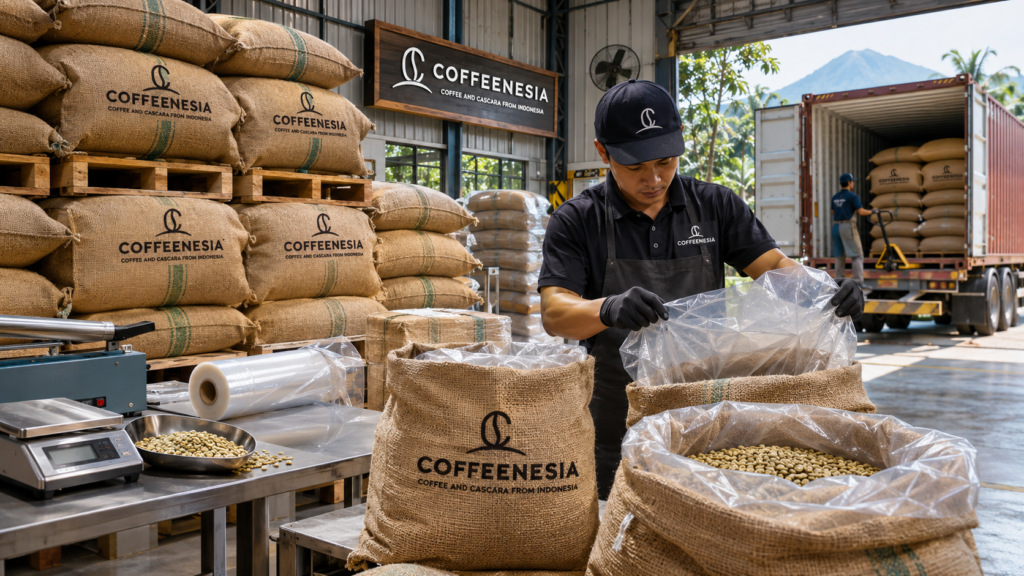
Coffee Packaging for Export: Bags, Liners, and Moisture Protection
Coffee packaging for export protects green coffee beans from moisture fluctuations, contamination, physical damage, and quality deterioration during international transportation. Exporters commonly use jute bags, woven polypropylene sacks, polyethylene (PE) inner liners, or specialized hermetic barriers depending on the coffee grade, buyer requirements, and shipping conditions.
Choosing the right coffee packaging for export is particularly important for shipments from Indonesia to international markets. Changes in temperature and humidity can affect green bean stability during transportation. Therefore, exporters must check coffee moisture, packaging integrity, warehouse conditions, and container cleanliness before loading to help preserve product quality.
What Is Coffee Packaging for Export?
Coffee packaging for export refers to the materials and handling methods exporters use to protect coffee during storage, container loading, sea freight, and delivery to international buyers. For green coffee, packaging typically consists of an outer transport bag and, when necessary, an inner moisture-protection barrier.
The outer bag supports handling, identification, and transportation, while the inner liner offers additional protection against environmental moisture and contamination. However, the appropriate combination depends on bean condition, shipping duration, storage conditions, and buyer requirements.
For example, commercial green coffee may use conventional jute sacks, while specialty Arabica may benefit from a high-barrier liner during extended transportation. Therefore, exporters should choose packaging based on specific shipment risks rather than assuming one material works for every coffee lot.
What Types of Bags Are Used for Coffee Export?
Exporters use several types of coffee packaging for export depending on product value, logistics requirements, and transportation conditions. Each material provides different levels of physical strength, breathability, and moisture protection.
Understanding these differences helps exporters select materials that meet the buyer’s quality specifications while supporting practical international transportation.
1. Jute Bags for Green Coffee
Jute bags are common in international green coffee trading because they offer durability, practical handling, and suitability for bulk transportation. Commercial capacities often include 25 kg, 50 kg, 60 kg, and 70 kg, depending on the supplier and purchasing agreement.
However, jute does not provide a moisture barrier. Its woven fibers allow interaction with surrounding air, which means coffee may absorb moisture or unwanted odors when storage conditions are unfavorable.
Therefore, exporters should inspect bag cleanliness, strength, and dryness before packing. Additional inner protection may be appropriate when coffee will travel through changing humidity conditions.
2. Polypropylene Woven Bags
Polypropylene (PP) woven bags provide lightweight and durable packaging for agricultural commodities. They can withstand ordinary handling stress and offer practical advantages for certain bulk logistics operations.
Nevertheless, conventional woven PP bags are not automatically airtight or moisture-proof. Their protective performance depends on construction, coating, closure methods, and the use of additional liners.
When choosing coffee packaging for export, exporters should verify whether the selected PP bags meet buyer requirements and provide suitable protection for the planned shipment.
3. Jute Bags with PE Inner Liners
A common export arrangement combines durable jute sacks with polyethylene inner liners. The outer bag supports physical handling, while the inner layer provides additional separation between the green coffee and its surroundings.
However, PE liner performance depends on material thickness, permeability, closure quality, and overall construction. Standard PE liners do not necessarily offer the same moisture and oxygen barrier properties as specialized hermetic packaging.
Therefore, buyers should request the liner’s technical specifications instead of assuming every plastic-lined coffee bag provides identical protection.
4. Hermetic Coffee Bags
Hermetic coffee bags use specialized barrier materials and suitable closures to reduce moisture and gas exchange between coffee beans and the surrounding environment. This type of coffee packaging for export can be particularly relevant for specialty green coffee that requires additional protection during transportation and storage.
Commercial examples include specialized GrainPro products and other high-barrier packaging systems. However, actual performance varies by manufacturer, product specification, and sealing method.
Importantly, hermetic packaging works best when exporters pack coffee at a suitable and uniform moisture level. Sealing excessively moist coffee does not correct its condition or eliminate the risk of mold development.
5. Bulk Container Liners
Some larger commercial shipments use container-sized liners instead of individual coffee sacks. These systems support bulk transportation while providing a protective barrier between the coffee and the container environment.
However, bulk loading requires suitable equipment, documented procedures, and careful management of moisture, cleanliness, and unloading arrangements.
Therefore, exporters should select this option only when the buyer and logistics providers have the appropriate facilities to handle bulk green coffee.
Coffee Packaging for Export: Jute Bags vs. PE Liners vs. Hermetic Bags
Selecting coffee packaging for export requires balancing packaging costs, physical protection, moisture resistance, expected transit conditions, and buyer requirements.
The following comparison explains the main characteristics of common green coffee packaging materials.
| Packaging Type | Main Function | Moisture Protection | Typical Application |
|---|---|---|---|
| Jute bag | Bulk handling and transportation | Limited | Conventional green coffee shipments |
| Woven PP bag | Durable outer packaging | Depends on construction | Selected bulk shipments |
| Jute + standard PE liner | Physical handling with added inner protection | Variable | Green coffee requiring additional protection |
| High-barrier hermetic liner | Reduce moisture exchange | Higher when properly sealed | Specialty coffee or extended shipping |
| Bulk container liner | Protect coffee transported loose | Depends on liner design | Large-volume commercial shipments |
No packaging material guarantees coffee quality by itself. Therefore, exporters must combine suitable packaging with proper drying, physical inspection, moisture monitoring, and appropriate transportation conditions.
How Does Moisture Affect Coffee During Export?
Moisture control plays an important role in coffee packaging for export because green coffee can exchange water with its surrounding environment. Excessive moisture may increase the risk of mold, discoloration, sensory deterioration, and storage problems.
Many commercial green coffee specifications use moisture targets around 10–12%, although exact acceptance ranges depend on the contract and relevant quality standards.
Therefore, exporters should verify the buyer’s moisture requirements instead of applying the same percentage to every coffee shipment.
1. Green Coffee Moisture Content
Moisture content measures the amount of water present in green coffee beans relative to their total weight. Exporters commonly assess this parameter before packing and may repeat measurements during warehouse storage or pre-shipment quality control.
However, an average moisture reading may not reveal uneven drying across a large coffee lot. Therefore, exporters should collect representative samples from different bags or sections of the batch to obtain more reliable results.
2. Water Activity and Storage Stability
Water activity describes the availability of water within a product rather than simply its total moisture content. Two green coffee samples may have similar moisture percentages but different water activity measurements.
Monitoring both parameters can provide additional information about storage stability, particularly for longer international shipments or demanding quality specifications.
Nevertheless, water activity testing should complement moisture testing, visual inspection, and relevant sensory evaluation rather than replace these quality checks.
3. Condensation Inside Shipping Containers
Container condensation can occur when temperature differences cause water vapor to accumulate on cooler surfaces. During sea freight, changing temperatures may create moisture on container roofs or walls and expose coffee packaging to rewetting.
This risk becomes especially relevant when containers travel between tropical and cooler climates. Therefore, exporters should inspect container conditions, avoid wet loading materials, and select appropriate protective arrangements.
How to Protect Green Coffee from Moisture During Shipping
Effective coffee packaging for export begins with proper moisture management before the beans enter a shipping container. Suitable packaging materials alone cannot compensate for poor drying, unsuitable storage, or water exposure.
Exporters should follow seven practical steps to reduce avoidable moisture-related risks during international coffee transportation.
1. Verify Coffee Moisture Before Packing
Measure coffee moisture using an appropriate testing method and confirm that the lot meets the agreed purchasing specification. In addition, take representative samples from different bags rather than relying on a single reading.
If the coffee exceeds the acceptable moisture limit, exporters should address the quality issue before shipment. Stronger packaging cannot compensate for unsuitable bean moisture.
2. Choose the Appropriate Inner Liner
Select an inner liner based on the required moisture protection, shipment conditions, and buyer preferences. For example, specialty coffee or longer transit routes may justify specialized barrier materials when their performance meets the purchasing requirements.
Moreover, exporters should inspect liner integrity and closure quality before loading. Punctures, tears, and improper sealing can reduce the intended protective performance.
3. Keep Bags Away from Wet Surfaces
Coffee bags should not come into direct contact with wet floors, leaking walls, or water-damaged pallets. Therefore, warehouses should maintain suitable cleanliness, drainage, and protection against rainfall.
During loading, workers should also move packed coffee through sheltered areas. This precaution helps prevent avoidable water exposure before transportation begins.
4. Inspect the Shipping Container
Container inspection is essential when preparing coffee packaging for export. Before loading, exporters should examine the container floor, ceiling, walls, doors, and seals for damage or contamination.
Check for water leaks, structural openings, unusual odors, moisture from previous cargo, and other conditions that may affect product quality.
If a container cannot provide suitable transportation conditions, exporters should request repairs or replacement before loading green coffee.
5. Manage Container Condensation Risk
Appropriate container lining, protective materials, and loading arrangements can help reduce condensation-related risks. For example, suitable kraft-paper protection may help limit direct exposure to water collecting on container surfaces.
In addition, appropriately selected desiccants may support a broader moisture-management plan. However, their effectiveness depends on shipment conditions, product specifications, and proper installation.
Desiccants should complement suitable coffee packaging for export rather than replace proper drying, liner selection, or container inspection.
6. Arrange Bags for Safe Transportation
Stack coffee bags securely to reduce movement and physical damage during international shipping. Avoid unstable arrangements, excessive pressure, and direct exposure to vulnerable container surfaces.
Furthermore, exporters should plan the loading pattern to support safe unloading at the destination. Proper handling helps maintain bag integrity and reduces the risk of packaging damage.
7. Document Packaging and Shipment Conditions
Record the packing date, coffee lot identification, moisture results, packaging materials, bag count, net weight, and container condition. When appropriate, maintain loading photographs and inspection records.
These documents support traceability and help exporters verify compliance with purchasing specifications. Moreover, complete records make it easier to investigate quality concerns if the receiving buyer identifies inconsistencies.
Recommended Coffee Export Packaging Workflow:
Green Coffee Inspection → Moisture Testing → Bag and Liner Selection → Packing → Container Inspection → Protected Loading → Shipment Documentation
What Should Exporters Check Before Loading a Coffee Container?
A pre-shipment inspection helps identify avoidable problems before coffee leaves the warehouse. In particular, exporters should verify green coffee quality, packaging integrity, and container suitability.
The following checklist supports quality control when preparing coffee packaging for export.
| Inspection Item | What to Verify |
|---|---|
| Coffee moisture | Meets agreed lot specification |
| Water activity | Tested when relevant to the buyer’s quality plan |
| Bean condition | No unacceptable mold, foreign matter, or defects |
| Outer bags | Clean, dry, and structurally sound |
| Inner liners | Correct type, intact, and properly closed |
| Lot labeling | Matches packing list and product identification |
| Container floor | Dry and free from contamination |
| Container walls and roof | No leaks or significant structural damage |
| Door seals | Intact and suitable for shipment |
| Loading records | Bag count, weight, and container details documented |
Exporters should resolve discrepancies before loading. Furthermore, when buyers require third-party inspection or specific testing, both parties should agree on inspection procedures and acceptance criteria before shipment.
What Information Should Appear on Coffee Export Bags?
Coffee export bag markings help identify the product during storage, transportation, and receiving operations. However, labeling requirements vary according to destination regulations, purchasing contracts, and buyer specifications.
Common shipping marks may include:
- Product description and coffee origin.
- Exporter or shipper identification.
- Lot or batch reference.
- Bag number and total bag count.
- Net weight.
- Relevant grade or processing information.
- Other contractually required shipping marks.
These markings support product identification but do not replace commercial invoices, packing lists, shipping documents, certificates, or other required export paperwork.
For specialty coffee, accurate lot references are particularly useful because they help connect the evaluated sample with the delivered commercial shipment.
What Do International Standards Say About Coffee Packaging for Export?
International standards provide technical guidance for maintaining green coffee quality during storage and transportation. Therefore, exporters should consider recognized references when selecting packaging materials and preparing international shipments.
The International Organization for Standardization publishes ISO 8455:2011, Green Coffee — Guidelines for Storage and Transport. This standard addresses conditions intended to reduce contamination, infestation, and quality deterioration during green coffee storage and international transportation.
In addition, the International Coffee Organization (ICO) provides guidance on preventing mold formation in coffee. Its recommendations emphasize uniform drying, container inspection, protection against rewetting, and careful loading practices.
ICO guidance also explains how condensation and unfavorable transport conditions can contribute to localized quality problems. Therefore, coffee packaging for export should form part of a broader quality-control system rather than function as the only protective measure.
Scientific research published in Applied Food Research in 2026 also examined different packaging materials. Under the study conditions, high-barrier polymer systems demonstrated potential advantages for moisture and quality stability compared with traditional fiber packaging.
Together, these references emphasize that suitable packaging supports green coffee quality when exporters combine it with proper drying, monitoring, and storage procedures.
What Coffee Packaging for Export Is Best for Specialty Coffee?
The best coffee packaging for export depends on coffee value, transit duration, moisture requirements, and buyer expectations. Specialty roasters may prioritize protection against environmental changes, while commercial buyers may also emphasize handling efficiency and transportation costs.
For specialty green coffee, a high-barrier liner inside a durable outer bag may provide useful additional protection. However, exporters should confirm whether the packaging specifications and additional costs match the product’s requirements.
Meanwhile, conventional jute sacks or bags with standard inner liners may be appropriate for commercial shipments when they meet the purchasing contract and relevant quality standards.
Therefore, buyers should request clear technical specifications from packaging suppliers instead of assuming every bag or liner provides identical performance.
How Does Coffeenesia Approach Coffee Quality and Export Packaging?
Coffeenesia publishes sourcing and export-related information for Indonesian coffee and cascara, particularly products originating from the Gayo Highlands of Aceh. Its website describes direct coffee sourcing, post-harvest processing, quality control, and wholesale supply for international buyers.
The company’s Gayo coffee export materials mention moisture analysis, density evaluation, cupping, and export packaging as part of its described quality approach.
These activities are relevant because coffee packaging for export should reflect the physical condition and quality requirements of the selected coffee. Therefore, buyers should discuss packaging requirements together with product specifications rather than treating the two decisions separately.
Gayo Coffee Sourcing and Quality Evaluation
Coffeenesia focuses on Gayo Arabica coffee, including green coffee beans for roasters and wholesale purchasers. Its published information discusses origin characteristics, processing methods, and evaluation practices before commercial purchasing.
Buyers can learn more through Coffee Sample Evaluation. Sample testing helps establish whether a coffee lot meets the intended quality requirements before packaging and bulk shipment.
Moreover, evaluating representative samples can support more informed decisions about product specifications, moisture requirements, and transportation protection.
Coffee Packaging and Wholesale Requirements
Coffeenesia’s website discusses conventional export bags, hermetic liners, and bulk purchasing arrangements. However, these publications do not independently establish that every packaging option is available for every order.
Therefore, international buyers should confirm bag capacity, liner type, product grade, shipment quantity, and packaging costs directly with the supplier.
Discussing coffee packaging for export before finalizing an order helps both parties clarify expectations and select suitable transportation arrangements.
Traceability and Shipment Identification
Coffeenesia emphasizes origin transparency and product identification in its sourcing information. Packaging labels and shipment records can support this approach when they consistently connect the commercial coffee lot with the agreed purchasing documents.
In addition, lot identification can help buyers review sourcing records and evaluate product consistency across repeat orders.
For related information, read Specialty Coffee Sourcing and Traceable Coffee Supplier.
Coffee Packaging for Export in the EFBA Agro International Supply Network
EFBA Agro International publishes agricultural commodity sourcing and export services, including Gayo Arabica green coffee. Its product information contains reference specifications for grading, moisture, bag capacity, and shipment preparation.
These details provide relevant examples of how exporters can describe coffee packaging for export alongside product quality specifications.
The company’s published Gayo Arabica product page lists the following packaging-related information.
| Parameter | Published EFBA Agro Reference |
|---|---|
| Coffee origin | Gayo Highlands, Aceh |
| Product | Green Arabica coffee |
| Processing | Semi-washed |
| Moisture | 12.0–12.5% |
| Packaging | 25 kg or 50 kg jute sacks |
| Inner protection | PE inner liners |
| Listed loading port | Belawan, Medan |
These specifications represent published commercial references, not independent laboratory findings for every shipment. Therefore, buyers should confirm the applicable lot specification, packaging availability, and final purchasing terms before ordering.
For international buyers, the important consideration is whether coffee packaging for export matches the selected bean grade, moisture condition, shipping environment, and purchasing contract.
Source Indonesian Green Coffee with Suitable Export Packaging
Choosing coffee packaging for export requires more than selecting a strong outer bag. Exporters must also consider green coffee moisture, inner liner performance, container cleanliness, shipment duration, and buyer requirements.
Jute bags support conventional bulk transportation, while PE liners and specialized hermetic materials can provide additional protection when their specifications match the shipment. However, proper drying, quality inspection, and careful loading remain essential for maintaining green coffee condition.
Coffeenesia provides sourcing and export-related information for Indonesian coffee, particularly Gayo Arabica from Aceh. International buyers can discuss product specifications, wholesale requirements, and available packaging arrangements before finalizing their purchases.
For more information, visit Gayo Coffee Export – Coffeenesia or explore Coffeenesia to discuss green coffee sourcing and shipment requirements.
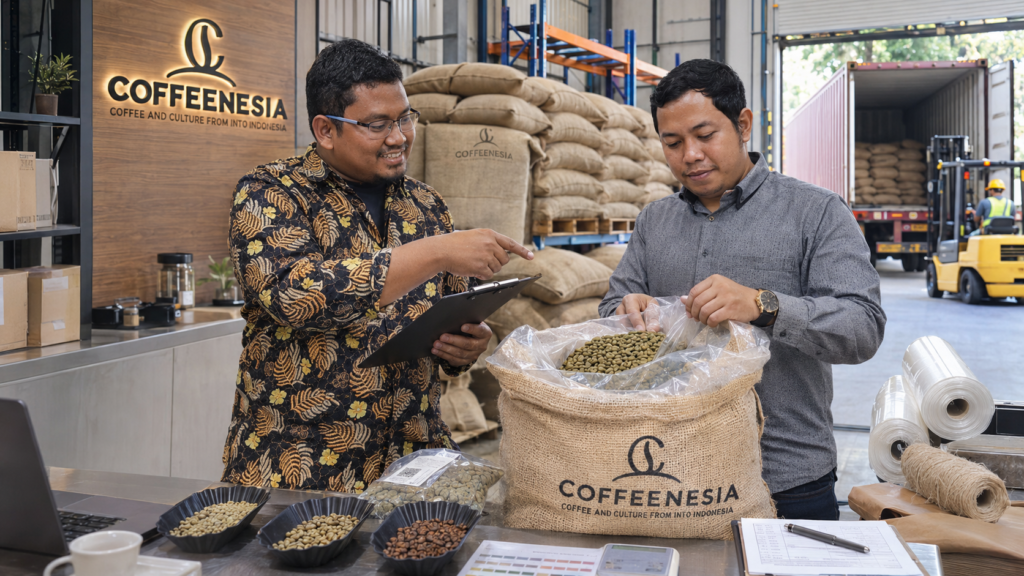
The broader PT EFBA Digital Mulia ecosystem provides additional business development and commercial context. Meanwhile, Coffeenesia and EFBA Agro focus on their respective agricultural sourcing and supply activities.
For international buyers, these businesses provide relevant information about Indonesian commodity sourcing, product quality, and export requirements. However, buyers should confirm specific product availability and packaging arrangements with the appropriate supplier.
How to Request Coffee Packaging for Export from Coffeenesia
International buyers should provide complete product and transportation requirements when requesting a coffee quotation. Choosing suitable coffee packaging for export becomes easier when suppliers understand the required quantity, destination, shipping conditions, and quality expectations.
In addition, importers should consider the expected transit duration, packaging materials, and moisture-protection requirements. These factors help determine whether conventional jute sacks, PE inner liners, or specialized hermetic barriers are appropriate for the shipment.
Before placing an order, buyers should specify:
- Coffee origin: Preferred growing region, processing method, and grade.
- Wholesale quantity: Estimated order volume and purchasing requirements.
- Packaging materials: Desired bag capacity, outer bag type, and inner liner specifications.
- Quality requirements: Moisture content, physical grading, and inspection criteria.
- Shipping destination: Destination country and receiving port.
- Shipment schedule: Expected purchasing date and transportation timeline.
- Documentation: Labeling, quality inspection, traceability, and export paperwork requirements.
Once buyers provide these details, Coffeenesia can discuss relevant product and packaging requirements according to available supply and agreed commercial conditions.
Therefore, international importers should confirm the final packaging specifications before approving their wholesale purchases. This approach helps reduce misunderstandings regarding bag capacity, liner selection, quality expectations, and shipment preparation.
FAQ About Coffee Packaging for Export
1. What is the best packaging for green coffee export?
The best coffee packaging for export depends on coffee quality, shipment duration, moisture conditions, and buyer requirements. Exporters commonly use jute sacks with suitable inner liners, while specialized hermetic materials may provide additional protection against environmental moisture exchange.
However, no packaging system guarantees quality by itself. Exporters must also maintain appropriate bean moisture, inspect packaging integrity, and prepare shipping containers properly.
2. Why are jute bags used for coffee export?
Jute bags are durable, practical for bulk handling, and widely used in international green coffee trading. Their construction supports warehouse storage and transportation, especially for conventional commercial shipments.
However, jute is not moisture-proof because its woven fibers allow environmental moisture exchange. Therefore, exporters may add inner liners when the shipment requires additional protection.
3. What is the difference between PE liners and hermetic coffee bags?
Standard polyethylene (PE) liners provide an additional protective layer between green coffee beans and their surroundings. However, their effectiveness depends on material thickness, permeability, and closure quality.
Meanwhile, specialized hermetic coffee bags use high-barrier materials designed to reduce moisture and gas exchange more effectively when properly sealed. Buyers should therefore compare technical specifications before choosing a liner.
4. What moisture level is suitable for exporting green coffee?
Many commercial green coffee contracts specify moisture levels around 10–12%, although acceptable ranges depend on buyer requirements and applicable standards. Therefore, exporters should follow the agreed specification rather than applying the same moisture target to every shipment.
In addition, representative testing helps identify uneven moisture across coffee lots. Excessive moisture can increase the risk of quality deterioration, mold development, and storage problems during transportation.
5. Can green coffee develop mold during shipment?
Yes. Excess moisture, container condensation, inadequate drying, and water exposure may create conditions that support mold growth. These risks can become more significant during extended shipping periods with changing temperatures and humidity.
Therefore, exporters should combine suitable packaging with proper drying, moisture testing, clean storage, and container inspection. Although these precautions help reduce risk, they cannot guarantee that mold will never develop.
6. Are desiccants necessary for coffee export containers?
Desiccants are not necessary for every coffee shipment. Their usefulness depends on the packaging system, transportation environment, condensation risk, and container conditions.
However, appropriately selected desiccants may support moisture management when exporters use them correctly. They should complement suitable liners and proper container preparation rather than replace effective drying practices.
7. What bag sizes are used for exporting coffee?
Common green coffee export bag capacities include 25 kg, 50 kg, 60 kg, and 70 kg, although other sizes may also be available. The appropriate capacity depends on supplier options, handling requirements, and purchasing agreements.
Therefore, buyers should confirm the bag size and packaging materials before placing a wholesale order. Specialty coffee buyers may also need to specify the inner liner and closure requirements.
8. What should exporters inspect before loading coffee?
Exporters should inspect coffee moisture, physical defects, bag condition, liner integrity, container cleanliness, water leaks, floor dryness, and shipment labeling. In addition, they should verify lot identification, bag counts, net weight, and relevant inspection records.
A pre-shipment inspection helps identify avoidable problems before international transportation begins. Therefore, exporters should resolve discrepancies and document the agreed quality checks before loading.
9. Does Coffeenesia provide coffee export packaging?
Coffeenesia publishes Indonesian coffee wholesale and export-related services, including information about packaging requirements and quality control. Its website also discusses Gayo Arabica coffee sourcing and international purchasing arrangements.
However, available packaging options may depend on product specifications, order quantity, and supplier arrangements. Buyers should contact Coffeenesia directly to confirm bag types, liner availability, packaging costs, and shipment requirements.
10. How can international buyers order Gayo coffee from Coffeenesia?
International buyers can contact Coffeenesia with their preferred coffee origin, grade, order quantity, packaging specifications, destination, and expected shipment schedule. Providing complete information helps clarify product requirements before discussing commercial terms.
Next, buyers can request product information, discuss representative samples, and confirm the applicable quotation. In addition, they should verify coffee packaging for export specifications, quality requirements, and shipping documentation before finalizing a wholesale purchase.
Source Indonesian Coffee with Suitable Export Packaging from Coffeenesia
Coffee packaging for export plays an important role in protecting green coffee beans during storage, international transportation, and delivery. Choosing suitable jute bags, PE liners, or specialized hermetic materials helps reduce moisture-related risks while supporting the physical condition and sensory quality of the coffee.
However, packaging alone cannot compensate for poor drying, excessive moisture, or unsuitable transportation conditions. Therefore, exporters need a complete quality-control approach that includes representative testing, careful handling, proper packaging, container inspection, and shipment documentation.
Coffeenesia publishes Indonesian coffee sourcing and export-related services, particularly for Gayo Arabica coffee from Aceh. International buyers can explore its coffee products, discuss wholesale requirements, and confirm available packaging arrangements before placing an order.
Looking for Indonesian Gayo Arabica coffee with suitable export packaging?
Explore Gayo Coffee Export from Indonesia or visit Coffeenesia to discuss green coffee sourcing, wholesale quantities, packaging preferences, and international shipping requirements.
Share your preferred coffee grade, bag size, liner type, destination port, and estimated order volume so the Coffeenesia team can clarify available products and commercial arrangements.

Coffeenesia supplies Indonesian coffee and cascara sourced from the Gayo Highlands of Aceh, with published services related to wholesale procurement, product evaluation, and export coordination.
Looking for Gayo Arabica green coffee with packaging suitable for your international order?
Visit Coffeenesia’s Gayo Coffee Export or Coffeenesia’s official website to discuss green coffee specifications, available packaging, wholesale quantities, and export requirements.
Share your preferred bag size, liner type, destination country, expected purchase volume, and quality requirements so the Coffeenesia team can clarify the available options and prepare an appropriate sourcing discussion.