
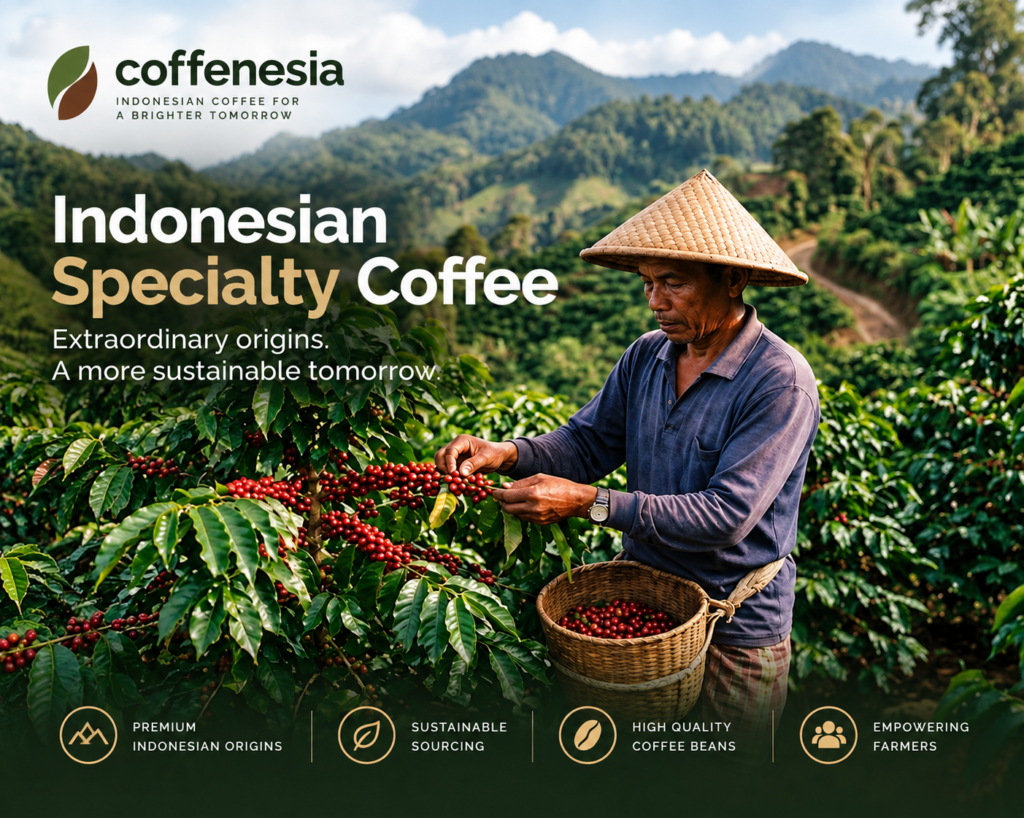
Indonesian specialty coffee offers global coffee buyers an extraordinary combination of diverse origins, distinctive sensory characteristics, regional processing traditions, and strong traceability stories. From the highlands of Gayo in Aceh to Toraja in South Sulawesi, Kintamani in Bali, Java, and Flores Bajawa, Indonesia provides a broad spectrum of coffee origins for roasters, importers, distributors, cafés, and specialty coffee businesses.
For international buyers, however, sourcing coffee from Indonesia requires more than choosing a famous origin.
The same region can produce coffees with different sensory characteristics depending on variety, elevation, harvest conditions, processing method, producer practices, storage, and lot preparation. Therefore, professional buyers should evaluate the actual coffee rather than relying solely on an origin name or generalized flavor description.
This guide explores some of the most important Indonesian specialty coffee origins, explains how processing and regional differences influence coffee, and provides practical guidance for businesses looking to source Indonesian coffee.
Whether you are a specialty roaster searching for your next single-origin release or an importer looking for reliable Indonesian green coffee, understanding these factors can help you make better sourcing decisions.
Table of Contents
ToggleWhat Is Indonesian Specialty Coffee?
Indonesian specialty coffee refers broadly to coffee from Indonesia recognized for distinctive attributes that create additional value in the marketplace.
Importantly, the modern concept of specialty coffee extends beyond simply assigning a numerical cupping score.
The Specialty Coffee Association defines specialty coffee as coffee or a coffee experience recognized for distinctive attributes that give it significant extra value in the marketplace. Those attributes can include intrinsic qualities such as flavor, aroma, and mouthfeel as well as informational attributes such as origin, producer, growing practices, and processing methods.
Specialty Coffee Association – What Is Specialty Coffee?
This approach is particularly relevant to Indonesia because the country has extraordinary diversity across its coffee-producing regions.
Coffee grown in Aceh can differ substantially from coffee produced in Bali, Java, Sulawesi, or Flores.
Differences can come from:
- Geography
- Elevation
- Variety
- Microclimate
- Agricultural practices
- Harvesting
- Cherry selection
- Processing
- Drying
- Storage
- Lot preparation
Therefore, describing all Indonesian coffee with a single flavor profile would oversimplify its diversity.
For businesses exploring Indonesian coffee more broadly, our Gayo Coffee & Cascara Insights provide additional information about Gayo coffee, cascara, processing, sourcing, and the Indonesian coffee industry.
Why Indonesian Specialty Coffee Attracts Global Buyers
Indonesia has long participated in international coffee trade, but its value for specialty buyers goes beyond production volume.
One of its strongest advantages is origin diversity.
A roaster can potentially create multiple Indonesian single-origin offerings while providing customers with noticeably different coffee experiences.
For example, an Indonesian portfolio could contain:
Gayo → Toraja → Kintamani → Flores Bajawa → Java
Each origin provides a different geographical story and can offer different sensory characteristics depending on the individual lot.
Indonesia also has numerous coffee geographical indications. The Directorate General of Intellectual Property lists registered geographical indications including Kopi Arabika Gayo, Kopi Arabika Kintamani Bali, Kopi Arabika Flores Bajawa, Kopi Arabika Kalosi Enrekang, Kopi Arabika Java Preanger, Kopi Arabika Java Ijen-Raung, Kopi Arabika Toraja, and others.
Indonesian Geographical Indication Database – DJKI
For buyers, these regional identities can create value beyond the physical product.
Origin information can support:
- Product differentiation
- Retail storytelling
- Traceability programs
- Single-origin collections
- Seasonal releases
- Premium positioning
- Coffee education
- Café menus
Nevertheless, geographical reputation alone does not guarantee that every lot will meet a buyer’s quality requirements.
Sampling and specification evaluation remain essential.
7 Best Indonesian Specialty Coffee Origins to Explore
Indonesia contains many coffee-producing regions. However, the following origins provide a strong starting point for buyers exploring Indonesian specialty coffee.
1. Gayo Coffee – Aceh
The Gayo highlands in Aceh are among Indonesia’s most recognized Arabica coffee-producing areas.
For Coffeenesia, this origin is particularly important because our sourcing activities focus on coffee and cascara connected to the Gayo highlands.
Kopi Arabika Gayo is also registered as an Indonesian geographical indication.
The region offers opportunities for buyers seeking coffee for:
- Single-origin programs
- Specialty roasting
- Espresso
- Filter coffee
- Wholesale distribution
- Green coffee importing
- Private-label coffee programs
However, buyers should avoid assuming that every Gayo coffee tastes identical.
One lot may differ from another because of variety, location, elevation, producer, harvest, processing, drying, storage, and preparation.
Therefore, when evaluating Gayo coffee, request information such as:
Origin: Gayo, Aceh, Indonesia
Subregion: if available
Variety: according to the lot
Elevation: according to production area
Process: wet-hulled, washed, natural, honey, or another method
Harvest: current crop information
Moisture: actual lot specification
Screen size: where applicable
Defect specification: according to buyer requirements
Packaging: commercial/export specification
Available volume: current availability
The goal is to understand the actual lot, rather than buying simply because the bag says “Gayo”.
International buyers interested in this process can also read our Indonesian Coffee Exporter sourcing guide.
2. Toraja Coffee – South Sulawesi
Toraja is another Indonesian origin widely associated with specialty coffee.
Located in South Sulawesi, the region has developed strong recognition among international coffee professionals and consumers.
Kopi Arabika Toraja appears in Indonesia’s geographical indication database alongside Kalosi Enrekang from the same province.
For buyers, Toraja can be explored for several applications, including:
- Premium single origin
- Espresso
- Specialty blends
- Filter coffee
- Seasonal offerings
- Retail coffee
Again, sensory expectations should remain flexible.
A buyer should never assume every Toraja lot will present exactly the same flavor characteristics.
Instead, compare:
Producer → Variety → Process → Harvest → Physical Quality → Sample → Cup Profile
This approach produces a more reliable sourcing decision than choosing coffee based only on origin reputation.
3. Kintamani Coffee – Bali
Bali is globally recognized as a tourism destination, but its highland areas also produce coffee.
Kopi Arabika Kintamani Bali is registered as an Indonesian geographical indication.
For specialty coffee businesses, Kintamani can provide an interesting regional story and portfolio contrast to Sumatran or Sulawesi coffee.
Buyers evaluating Bali coffee should request information about:
- Farm or producer
- Production area
- Variety
- Elevation
- Processing method
- Harvest
- Moisture
- Physical grading
- Sensory evaluation
- Lot size
For consumer-facing brands, origin storytelling can also add value.
However, product storytelling should remain accurate and connected to traceable information rather than generic marketing claims.
4. Flores Bajawa Coffee – East Nusa Tenggara
Flores provides another distinctive Indonesian Arabica origin.
The Flores Bajawa Arabica geographical indication is officially listed by Indonesia’s Directorate General of Intellectual Property.
For specialty roasters, Flores can help expand an Indonesian origin portfolio beyond the more familiar Sumatran coffees.
A roaster could potentially structure a seasonal Indonesian program such as:
Gayo → Java → Flores → Toraja
Such a strategy gives customers an opportunity to explore Indonesia through different coffees while giving the roaster more storytelling possibilities.
Still, the purchasing decision should always return to the actual sample.
5. Java Specialty Coffee
The word Java has a historical connection with coffee, but today’s specialty buyers should be more specific when discussing Java coffee.
Indonesia has several registered coffee geographical indications on the island, including:
- Java Preanger Arabica
- Java Ijen-Raung Arabica
- Java Sindoro-Sumbing Arabica
These listings demonstrate why “Java coffee” should not automatically be treated as one homogeneous product.
For buyers, greater geographical specificity can improve both sourcing and product positioning.
Instead of:
Indonesian Java Coffee
A more informative description may include:
Java Preanger Arabica – West Java, Indonesia
provided the coffee genuinely comes from that origin and the supplier can substantiate the information.
This level of specificity can be especially useful for specialty roasters selling origin-focused products.
6. Kalosi Enrekang Coffee – South Sulawesi
Toraja is not the only important coffee identity from South Sulawesi.
Kopi Arabika Kalosi Enrekang is also registered as a geographical indication in Indonesia.
For buyers exploring Sulawesi, this creates an opportunity to compare different regional coffees rather than treating the entire island as a single origin.
A buyer could compare:
Toraja vs. Kalosi Enrekang
and evaluate differences based on actual samples, processing methods, availability, and commercial requirements.
7. Mandailing and Other Sumatran Coffees
Sumatra contains several coffee-producing areas beyond Gayo.
This makes the island particularly interesting for buyers seeking deeper origin segmentation.
Instead of purchasing a generic “Sumatra coffee,” professional buyers may ask for more detailed information regarding:
- Province
- Region
- Producer group
- Processing
- Variety
- Harvest
- Physical specifications
This approach improves traceability and makes it easier to compare suppliers.
For international buyers, clearer origin information also improves product communication once the coffee reaches the final market.
Indonesian Specialty Coffee Origins Comparison
The table below can serve as an initial orientation.
Coffee Origin | Region | Potential B2B Application |
Gayo | Aceh | Single origin, filter, espresso, wholesale |
Toraja | South Sulawesi | Single origin, espresso, premium retail |
Kintamani | Bali | Single origin, specialty retail |
Flores Bajawa | East Nusa Tenggara | Filter, seasonal origin, premium retail |
Java Preanger | West Java | Single origin, espresso, specialty roasting |
Java Ijen-Raung | East Java | Specialty roasting and origin programs |
Kalosi Enrekang | South Sulawesi | Specialty origin and roasting programs |
Mandailing | Sumatra | Espresso, blends, origin-focused retail |
These are not fixed flavor classifications.
Actual characteristics depend on the specific lot.
That distinction matters because specialty buyers purchase coffee, not just origin names.
Arabica vs. Robusta in Indonesian Coffee
International buyers should also distinguish between Arabica and Robusta.
Indonesia produces both.
Indonesian Arabica Coffee
Arabica is strongly associated with many Indonesian specialty origins, including Gayo, Toraja, Kintamani, Flores Bajawa, and several Java origins.
Specialty roasters often evaluate Arabica for:
- Single-origin programs
- Premium espresso
- Filter coffee
- Micro-lots
- Seasonal releases
- High-end blends
However, “Arabica” alone is not a quality guarantee.
The actual value still depends on farming, harvest selection, processing, drying, storage, grading, and sensory characteristics.
Indonesian Robusta Coffee
Robusta also plays an important role in Indonesia’s coffee industry.
In fact, Kopi Robusta Lampung appears in Indonesia’s registered geographical indication database.
Robusta can be relevant for buyers looking for:
- Espresso blends
- Commercial roasting
- Instant coffee applications
- Specialty or fine Robusta programs
- Products requiring different sensory or functional characteristics
Therefore, buyers should define their intended application before requesting quotations.
How Processing Shapes Indonesian Specialty Coffee
Origin tells only part of the story.
Processing can substantially influence the characteristics of Indonesian specialty coffee.
Indonesia uses several processing approaches, and buyers should identify the method for each lot.
Wet-Hulled / Giling Basah
Wet-hulling, commonly known as giling basah, is strongly associated with Indonesian coffee, particularly parts of Sumatra.
However, it is important not to assume that all Indonesian coffee uses this method.
Buyers may encounter different processing methods even within the same region.
Fully Washed Coffee
Fully washed coffees provide another processing option.
Roasters seeking specific cup characteristics may compare washed lots against wet-hulled or natural coffees from similar origins.
Natural Coffee
Natural processing dries the coffee with the fruit around the seed.
Depending on variety, cherry quality, fermentation, drying management, and storage, natural processing can create a very different sensory expression.
Honey Process
Honey processing leaves varying amounts of mucilage during drying.
Availability depends on producer and region.
Experimental Processing
Some producers are also exploring more controlled or experimental approaches, including fermentation-based techniques.
These coffees may appeal to specialty roasters looking for distinctive limited releases.
However, buyers should evaluate experimental coffees carefully.
A fashionable processing name should never replace quality evaluation.
Processing Method vs. Origin: Which Matters More?
The answer is: both matter.
Consider two coffees from the same region.
Coffee A may be wet-hulled.
Coffee B may be natural.
Even if both come from the same geographical area, they can provide substantially different sensory experiences.
Likewise, two natural coffees from different producers can perform differently.
Therefore, professional sourcing should consider several layers:
Country → Region → Producer → Variety → Process → Harvest → Lot → Sample
This gives buyers a much more complete picture of the coffee.
How Indonesian Specialty Coffee Is Evaluated
For years, specialty coffee purchasing discussions often focused heavily on a single cupping score.
The industry is increasingly moving toward a broader evaluation framework.
The Specialty Coffee Association’s Coffee Value Assessment (CVA) evaluates coffee through four complementary dimensions: physical, descriptive, affective, and extrinsic assessments.
Physical Assessment
This examines physical characteristics such as:
- Color
- Defects
- Moisture
- Size
Descriptive Assessment
This records sensory characteristics such as:
- Aroma
- Flavor
- Texture
- Aftertaste
Affective Assessment
This captures an evaluator’s impression of coffee quality relative to personal or market preferences.
Extrinsic Assessment
This examines information beyond the cup that may contribute to value, including:
- Origin
- Traceability
- Processing information
- Certifications
This broader framework is highly relevant for international specialty coffee sourcing because buyers often evaluate far more than flavor alone.
Indonesia and the Coffee Value Assessment
There is another development particularly relevant to Indonesian specialty coffee.
In May 2025, the Specialty Coffee Association and Specialty Coffee Association of Indonesia announced an agreement to implement the Coffee Value Assessment as an official protocol for evaluating Indonesian specialty coffees.
SCA and SCAI Coffee Value Assessment Collaboration
According to the SCA, the collaboration aims to support greater transparency, education, quality evaluation, and international market access.
For international buyers, developments like this matter because clearer evaluation frameworks can improve communication between:
Producer → Processor → Exporter → Importer → Roaster → Consumer
Better communication can reduce ambiguity when discussing coffee quality and value.
Understanding Flavor Profiles in Indonesian Specialty Coffee
Buyers frequently search for phrases such as:
- Indonesian coffee flavor profile
- Gayo coffee flavor
- Toraja coffee tasting notes
- Sumatra coffee characteristics
- Bali coffee flavor
These searches are useful, but generalized tasting notes should be treated as orientation rather than guarantees.
Coffee flavor can change depending on:
Variety + Terroir + Harvest + Processing + Drying + Storage + Roasting + Brewing
Even two samples from the same region can perform differently.
Therefore, rather than asking:
“What does Indonesian coffee taste like?”
A more useful sourcing question is:
“What are the sensory characteristics of this specific lot?”
That question leads to better purchasing decisions.
Why Gayo Coffee Deserves Attention from Specialty Buyers
Among Indonesia’s many origins, Gayo is especially relevant to Coffeenesia.
Our coffee sourcing connects with the highlands of Gayo, Aceh, Indonesia.
For international buyers, Gayo offers several potential advantages.
Recognized Origin
Gayo Arabica has an established regional identity and registered geographical indication in Indonesia.
Specialty Coffee Potential
Different producers and processing methods create opportunities for roasters to explore different Gayo coffee profiles.
B2B Applications
Depending on lot specifications, Gayo coffee may be considered for:
- Specialty roasting
- Single origin
- Espresso
- Filter
- Wholesale programs
- Importing
- Distribution
Origin Story
Clear geographical identity can support traceability and consumer communication.
To explore our sourcing focus in more detail, visit Coffeenesia – Premium Gayo Coffee & Cascara.
Indonesian Specialty Coffee for Specialty Roasters
Roasters are among the most important commercial buyers of specialty green coffee.
However, not every coffee fits every roasting business.
A roaster should first define the intended product.
Single-Origin Program
For single-origin products, buyers may prioritize:
- Distinctive sensory characteristics
- Traceability
- Producer information
- Regional identity
- Storytelling
- Seasonal availability
Espresso
For espresso, buyers may consider:
- Body
- Sweetness
- Acidity balance
- Solubility
- Roast development
- Performance with milk
- Consistency
Filter Coffee
Filter-oriented specialty roasters may look for coffees with clear sensory differentiation.
Again, actual sample evaluation should guide the decision.
House Blend
Indonesian coffee can also become part of a broader blend strategy.
In this situation, buyers should determine what role the coffee needs to play in the final blend.
Indonesian Specialty Coffee for Importers
Importers have different requirements from small specialty roasters.
They may need to purchase larger quantities and manage:
- International logistics
- Documentation
- Quality control
- Warehousing
- Customer distribution
- Contract terms
- Shipment schedules
- Inventory
Consequently, cup quality alone is insufficient.
Importers should evaluate supplier reliability as carefully as coffee quality.
Important questions include:
Can the supplier provide the required volume?
Can specifications remain reasonably consistent?
Is the coffee export-ready?
What packaging is available?
What documentation is provided?
What is the production or preparation lead time?
Can representative samples be provided?
How is lot traceability maintained?
Our guide to Indonesian Coffee for Export provides additional information for buyers exploring international sourcing.
Indonesian Specialty Coffee for Distributors
Distributors often need coffee that can serve several customer segments.
Their customers may include:
- Roasters
- Cafés
- Restaurants
- Hotels
- Retailers
- Specialty stores
- Private-label businesses
Therefore, distributors need to consider not only cup quality but also commercial flexibility.
Questions may include:
Can the supplier support repeat orders?
Are different grades or origins available?
Can the coffee be supplied in suitable packaging?
Is the documentation clear?
Can the origin story be communicated accurately?
These factors can influence whether a supplier relationship is suitable for long-term distribution.
Indonesian Specialty Coffee for Cafés
Cafés can also benefit from origin-focused Indonesian coffee.
Possible applications include:
- Espresso
- House blend
- Pour-over
- Seasonal menu
- Signature coffee
- Retail beans
For specialty cafés, origin can become part of customer education.
A menu might present information such as:
Origin: Gayo, Aceh, Indonesia
Process: according to lot
Roast: according to roaster
Tasting Notes: based on actual sensory evaluation
This creates a more informative experience than simply listing “Indonesian Coffee”.
Green Coffee Beans vs. Roasted Coffee
Before requesting quotations, buyers should clarify whether they need green or roasted coffee.
Green Indonesian Specialty Coffee
Green coffee is commonly relevant to:
- Importers
- Specialty roasters
- Distributors
- Private-label roasters
- Coffee manufacturers
Purchasing green coffee gives the buyer more control over roast development.
Roasted Indonesian Coffee
Roasted coffee may be more suitable for:
- Cafés without roasting facilities
- Retailers
- Hospitality businesses
- Corporate buyers
- Private-label programs
For roasted products, buyers should pay particular attention to:
- Roast date
- Roast profile
- Packaging
- Degassing valve
- Storage
- Shipping duration
- Shelf-life strategy
Product format should therefore be clarified before discussing price.
How to Evaluate Green Indonesian Specialty Coffee
For green coffee buyers, evaluation should include several layers.
1. Origin
Ask exactly where the coffee comes from.
2. Processing
Identify whether it is wet-hulled, washed, natural, honey, or another process.
3. Harvest
Ask for crop or harvest information.
4. Moisture
Request actual moisture specifications.
5. Defects
Understand the grading or defect specification being offered.
6. Bean Size
Screen size may matter depending on buyer requirements.
7. Sensory Evaluation
Cup a representative sample.
8. Packaging
Ask whether coffee is packed in jute bags, inner liners, vacuum packaging, or another agreed format.
9. Volume
Confirm available quantity.
10. Traceability
Determine how much information can be traced back through the supply chain.
Together, these factors create a more complete sourcing picture.
Why Samples Are Essential Before Wholesale Orders
One of the biggest mistakes in international coffee sourcing is committing to volume before properly evaluating a representative sample.
Photos cannot tell you how coffee cups.
Origin names cannot guarantee quality.
Tasting notes from another person cannot guarantee that a coffee fits your market.
Therefore, samples are an essential commercial tool.
A buyer can use samples to evaluate:
- Physical quality
- Roast behavior
- Aroma
- Flavor
- Acidity
- Sweetness
- Mouthfeel
- Aftertaste
- Balance
- Overall suitability
After evaluation, the buyer can determine whether the coffee fits the intended program.
For larger commercial purchases, read our Wholesale Coffee Beans Indonesia: 7 Powerful Sourcing Tips.
How Much Indonesian Specialty Coffee Should You Order?
There is no universal quantity suitable for every buyer.
Required volume depends on:
- Business size
- Sales forecast
- Roasting capacity
- Storage capacity
- Customer demand
- Product format
- Shipment economics
- Supplier MOQ
A small specialty roaster may begin with a smaller lot.
An importer or distributor may require significantly larger quantities.
Before requesting a quotation, provide an estimated quantity.
For example:
Product: Green Arabica Coffee
Origin: Gayo, Aceh
Estimated volume: 1,000 kg
Destination: Singapore
Intended use: Specialty roasting
Sample: Required
This inquiry is much more actionable than:
“How much is Indonesian coffee?”
Understanding Indonesian Specialty Coffee Pricing
Another common buyer question is:
“What is the price of Indonesian specialty coffee?”
There is no single price.
Pricing can vary according to:
- Origin
- Quality
- Processing
- Grade
- Defect tolerance
- Harvest
- Lot size
- Traceability
- Certifications
- Packaging
- Available volume
- Market conditions
- Logistics
- Incoterms
Specialty lots may also carry additional value because of distinctive sensory characteristics, scarcity, processing, producer identity, or traceability.
Therefore, professional buyers should compare quotations using equivalent specifications.
Comparing a traceable specialty lot against an unspecified commercial coffee solely by price per kilogram would not provide a meaningful comparison.
What Buyers Should Include in a Coffee Inquiry
A clear inquiry helps suppliers respond faster.
Include:
- Company name
- Country
- Business type
- Coffee required
- Arabica or Robusta
- Origin preference
- Green or roasted
- Processing preference
- Required specifications
- Estimated quantity
- Packaging requirement
- Destination
- Shipment period
- Sample requirement
For example:
We are a specialty roaster based in South Korea and are looking for Gayo Arabica green coffee for our single-origin program. Our initial requirement is approximately 1–2 tons. Please provide available lot specifications, processing information, harvest details, packaging options, indicative pricing, and sample availability.
This gives the supplier enough context to provide a useful commercial response.
For a more detailed sourcing process, see How to Source Premium Coffee Beans from Indonesia: 7 Powerful Tips.
How to Choose an Indonesian Specialty Coffee Supplier
Finding coffee is relatively easy.
Finding the right supplier requires more evaluation.
Origin Transparency
Can the supplier explain where the coffee comes from?
Clear Specifications
Can they provide meaningful specifications instead of only promotional descriptions?
Sample Availability
Can the buyer evaluate coffee before placing a commercial order?
Traceability
Can the supplier provide relevant origin and processing information?
Quality Control
How does the supplier evaluate coffee before shipment?
Communication
Can they respond clearly to technical and commercial questions?
Packaging
Can they support packaging appropriate for the agreed shipment?
Export Capability
Can they prepare the required commercial and shipment documentation?
Consistency
Can they support future orders when the buyer requires continuity?
Long-Term Cooperation
Does the supplier approach the relationship as a one-time sale or an ongoing partnership?
For additional supplier evaluation guidance, read Indonesian Coffee Exporter: 7 Proven Tips for Successful Coffee Sourcing.
Traceability and Indonesian Specialty Coffee
Traceability has become increasingly important in specialty coffee.
A useful traceability chain might include:
Indonesia → Aceh → Gayo → Producer/Cooperative → Process → Harvest → Lot
The exact depth depends on the supply chain.
For buyers, traceability can support:
- Quality management
- Supplier verification
- Product differentiation
- Consumer communication
- Sustainability programs
- Origin storytelling
It also aligns with the SCA’s broader recognition that informational attributes such as origin, producer, growing practices, and processing can contribute to specialty coffee value.
Therefore, traceability should not be treated solely as a marketing tool.
It can also be part of a more structured sourcing system.
Packaging for Indonesian Green Coffee Export
Packaging plays an important role in preserving green coffee during storage and transportation.
Common considerations include:
- Bag material
- Inner liner
- Bag weight
- Palletization
- Container loading
- Humidity protection
- Storage conditions
- Shipping duration
Buyers should communicate packaging requirements before finalizing the order.
For premium coffee, maintaining product condition during logistics is particularly important because quality can deteriorate if coffee experiences unsuitable storage or excessive moisture exposure.
Export Readiness Matters
A coffee may cup beautifully but still create commercial problems if the supplier cannot prepare it reliably for international shipment.
Export readiness includes more than putting coffee into bags.
Depending on transaction structure and destination requirements, buyers and suppliers may need to coordinate:
- Commercial documentation
- Packing information
- Shipping arrangements
- Product specifications
- Export documentation
- Destination requirements
Indonesia maintains an established international export system. BPS publishes annual foreign trade statistics using sources including Goods Export Declaration documents from Indonesia’s Directorate General of Customs and Excise. Its 2025 publication reports export data by commodity, destination, loading port, and province of origin.
BPS – Indonesia Foreign Trade Statistics Exports 2025
For coffee-specific commercial sourcing considerations, see 7 Powerful Reasons Indonesian Coffee for Export Is Winning Global Markets.
Common Mistakes When Buying Indonesian Specialty Coffee
Understanding common mistakes can reduce sourcing risk.
Choosing Coffee Only by Origin Name
“Gayo,” “Toraja,” or “Java” does not tell you everything about an individual lot.
Skipping Samples
Never assume a commercial shipment will fit your program without proper evaluation.
Ignoring Processing
Processing can strongly influence coffee characteristics.
Comparing Only Price
Different specifications cannot be compared meaningfully using price alone.
Not Defining Volume
Suppliers need approximate quantities to provide relevant commercial information.
Ignoring Packaging
Poor storage and logistics can reduce coffee quality.
Assuming All Indonesian Coffee Is Wet-Hulled
Indonesia produces coffee through multiple processing methods.
Treating Tasting Notes as Guarantees
Sensory characteristics vary by lot and evaluation conditions.
Ignoring Traceability
Origin information adds commercial and quality-management value.
Choosing a Supplier Without Assessing Communication
Clear communication becomes increasingly important once sampling, contracting, production preparation, documentation, and shipping begin.
Building a Long-Term Indonesian Coffee Supply Relationship
For many buyers, the best sourcing strategy is not simply finding the cheapest available coffee each season.
Long-term supplier relationships can create advantages.
Over time, buyer and supplier can better understand:
- Required quality
- Preferred processing
- Volume
- Packaging
- Shipment schedules
- Documentation
- Sample approval
- Market preferences
This reduces repeated negotiation and improves communication.
A buyer may begin with:
Sample → Trial Order → Evaluation → Repeat Order → Long-Term Supply
This approach allows both parties to learn before scaling volume.
Why Indonesian Specialty Coffee Has Strong B2B Potential
Indonesia combines several characteristics that make it commercially interesting for international specialty coffee buyers.
First, the country has multiple recognized coffee origins.
Second, processing diversity allows buyers to explore different product profiles.
Third, Indonesian coffee can serve different business models—from micro-lot specialty roasting to wholesale and distribution.
Fourth, stronger evaluation and traceability frameworks can improve communication between producers and buyers.
The SCA and SCAI collaboration around Coffee Value Assessment further reflects Indonesia’s engagement with evolving specialty coffee quality evaluation.
For buyers, this means Indonesia should not be viewed simply as a source of “Sumatra coffee”.
It is a diverse coffee-producing country with multiple regional identities.
Why Choose Coffeenesia for Gayo Coffee Sourcing?
Coffeenesia focuses on coffee and cascara connected to the highlands of Gayo, Aceh, Indonesia.
Our approach is built around four key principles.
Direct Sourcing
A closer connection to origin helps create clearer communication about the coffee being supplied.
Meticulous Quality Control
Quality evaluation matters throughout sourcing and preparation.
Full Traceability
We aim to provide buyers with useful information regarding origin, variety, processing, and product specifications where available.
Sustainable and Innovative Approach
Our focus includes both coffee and cascara, creating opportunities to utilize more value from the coffee cherry.
This approach is designed for international buyers seeking more than an anonymous commodity.
Learn more about Coffeenesia and our premium Gayo Coffee & Cascara products.
For educational resources, explore Gayo Coffee & Cascara: 7 Amazing Insights You Should Know.
Who Should Source Indonesian Specialty Coffee from Coffeenesia?
Our B2B focus can be relevant to:
- Specialty coffee roasters
- Coffee importers
- Green coffee distributors
- Café groups
- Hospitality businesses
- Coffee retailers
- Private-label businesses
- International wholesalers
- Beverage companies
- Buyers exploring Indonesian origins
The ideal coffee depends on the buyer’s specifications.
Therefore, providing a clear inquiry helps us understand whether available products match your business needs.
FAQ About Indonesian Specialty Coffee
What is Indonesian specialty coffee?
Indonesian specialty coffee is coffee from Indonesia recognized for distinctive attributes that provide additional marketplace value. These can include sensory characteristics as well as origin, processing, producer information, traceability, and other attributes.
What are the best Indonesian specialty coffee origins?
Notable origins include Gayo, Toraja, Kintamani, Flores Bajawa, Java Preanger, Java Ijen-Raung, Kalosi Enrekang, Mandailing, and other regional coffees. Several are officially registered geographical indications in Indonesia.
Is Gayo coffee considered specialty coffee?
Gayo is an established Indonesian Arabica origin, and Kopi Arabika Gayo is a registered geographical indication. Whether an individual lot meets a buyer’s specialty requirements still depends on its actual characteristics, quality, traceability, and evaluation.
Is Indonesian specialty coffee always Arabica?
No. Indonesia produces Arabica and Robusta. While many well-known specialty origins are associated with Arabica, Robusta also plays an important role in the Indonesian coffee industry.
Does all Indonesian coffee use wet-hulled processing?
No. Although wet-hulling or giling basah has a strong association with Indonesia, buyers may also find washed, natural, honey, and other processing approaches.
Can I buy Indonesian specialty coffee wholesale?
Yes. Commercial availability depends on supplier capability, lot availability, specifications, quantity, packaging, and destination. Read our Wholesale Coffee Beans Indonesia guide for more information.
Can international buyers request samples?
Sample policies depend on individual suppliers and lots. For professional purchasing, evaluating a representative sample before committing to a larger order is strongly recommended.
What should I ask an Indonesian coffee supplier?
Ask about origin, variety, processing, harvest, physical specifications, sensory profile, available quantity, packaging, sample availability, lead time, and export terms.
How do I choose an Indonesian coffee exporter?
Evaluate product quality together with traceability, specifications, sample availability, communication, quality control, packaging, export readiness, and supply consistency. Our Indonesian Coffee Exporter guide provides a detailed checklist.
Is Indonesian specialty coffee suitable for espresso?
Potentially, yes. Suitability depends on the individual coffee, roast profile, intended beverage, and target sensory characteristics rather than origin alone.
Is Indonesian coffee suitable for filter brewing?
Many Indonesian specialty coffees can be evaluated for filter programs. Roasters should select lots according to actual sensory characteristics and desired roast style.
Can Indonesian specialty coffee be used for private label products?
Yes, depending on the supplier, product format, roasting arrangements, packaging requirements, and commercial agreement.
Why is traceability important when buying specialty coffee?
Traceability gives buyers clearer information about origin, processing, producer or supply-chain context, and lot identity. It can support quality management, sourcing transparency, and product storytelling.
How can I start sourcing coffee from Indonesia?
Start by defining the product, origin, quality requirements, process, quantity, packaging, destination, and shipment schedule. Then request supplier information and representative samples before moving toward a commercial order.
For a step-by-step guide, read How to Source Premium Coffee Beans from Indonesia: 7 Powerful Tips.
Source Indonesian Specialty Coffee with Coffeenesia
Indonesia offers international coffee buyers much more than a single origin or flavor profile.
From Gayo in Aceh to Java, Bali, Flores, and Sulawesi, the country’s diverse coffee landscape creates opportunities for specialty roasters, importers, distributors, cafés, and other B2B buyers.
However, successful sourcing requires more than choosing a famous region.
Professional buyers should evaluate:
Origin → Producer → Variety → Processing → Harvest → Physical Specifications → Sample → Sensory Quality → Traceability → Volume → Packaging → Logistics
This process helps transform sourcing from guesswork into a structured purchasing decision.
If you are currently looking for Indonesian specialty coffee, particularly coffee connected to the Gayo highlands of Aceh, explore Coffeenesia’s premium Gayo Coffee & Cascara products.
You can also continue your research through our guides:
Wholesale Coffee Beans Indonesia: 7 Powerful Sourcing Tips
Indonesian Coffee Exporter: 7 Proven Tips for Successful Coffee Sourcing
7 Powerful Reasons Indonesian Coffee for Export Is Winning Global Markets
How to Source Premium Coffee Beans from Indonesia: 7 Powerful Tips
With the right specifications, representative samples, transparent communication, and reliable sourcing relationships, Indonesian specialty coffee can become a valuable and distinctive part of your coffee portfolio.