
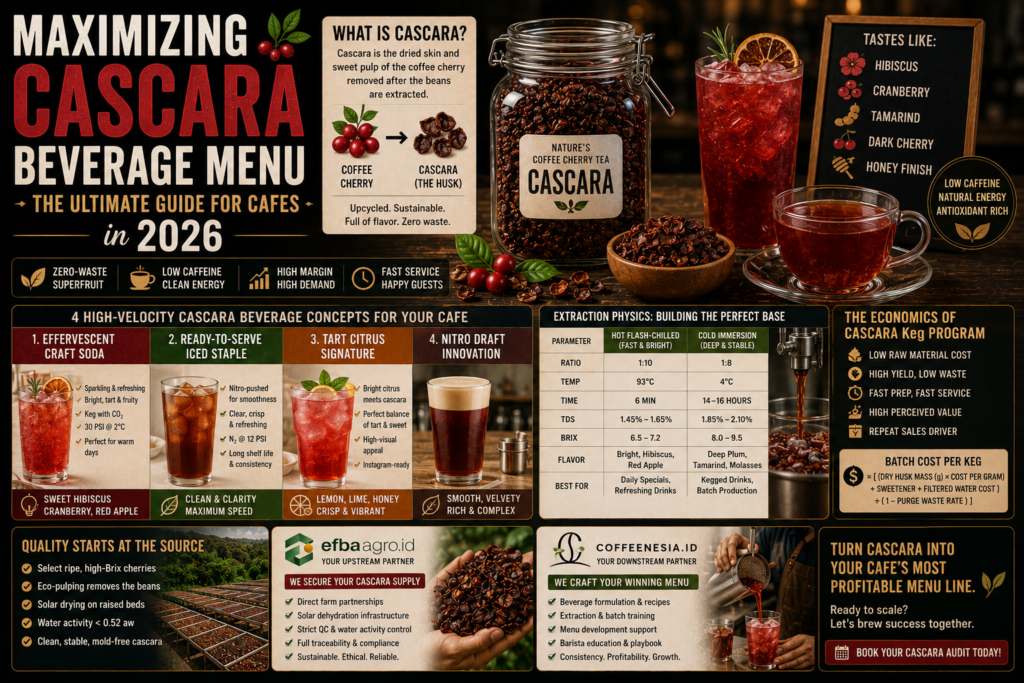
It is 3:00 PM on a sweltering Tuesday afternoon inside your high-volume cafe right now in 2026. The manic morning espresso rush has completely wrapped up, and your grinders are finally quiet. Suddenly, a new wave of afternoon customers walks through your doors, looking for cold, effervescent, botanical refreshments that offer a clean, functional energy lift without the heavy, late-night jittery crash of a double espresso.
This exact scenario represents the single biggest growth market for modern beverage programs this year. As consumer demand for zero-waste circular menus and functional low-caffeine options reaches an all-time high, building a high-volume cold program or an innovative cascara beverage program requires moving past old-school, slow-steeping methods. If your baristas are still individually steeping loose husks in individual teapots during a heavy afternoon rush, your speed-of-service metrics will completely tank, creating a massive operational bottleneck that destroys your daily throughput.
Worse yet, far too many beverage directors attempt to build their draft systems using unstable, poorly dried husks sourced from unverified spot brokers. These low-tier lots carry a volatile water activity profile that triggers rapid micro-biological decay during storage. When you run an unstable batch through your prep tanks, it creates a muddy, vinegary extraction that clogs your tap lines, slows down your ticket times, and ruins your commercial consistency.
Mastering the batch physics, extraction metrics, and production flow of a premium cascara beverage line is your ultimate shortcut to driving up afternoon ticket sales while keeping your operational workflows entirely efficient. We are all in this together, and we know that real profitability is built on speed, precision, and uncompromised raw materials. Let’s throw out the generic online recipe blogs and look directly at the real-world mixology architectures, kegging logistics, and backend unit economics required to dominate the functional drink space this year.
Extraction Physics: Formulating the Perfect Botanical Liquid Base
Every successful commercial cascara beverage formula depends on creating a flawless, shelf-stable liquid base that maintains total flavor clarity over a long service week. To execute this properly, your production team must treat the dehydrated fruit skins with the exact same scientific discipline that your head roaster applies to checking total dissolved solids (TDS) and extraction yields on a digital refractometer. We must carefully monitor our target Brix balance and contact times to extract the pristine malic and citric acids without pulling out heavy, astringent wood tannins.
To prevent wild yeast or bacterial fermentation from ruining your prep tanks, you must verify that your raw green inventory has been stabilized below a clean 0.52 aw water activity baseline at origin. High water activity acts as a destructive catalyst, breaking down natural fructose compounds into volatile acetic acids that ruin your cup quality. When you source clean, technical purity, you secure a highly dense, uniform material that releases its stone-fruit sugars predictably across every commercial batch. Let’s analyze the exact operational metrics that separate a high-velocity hot flash-chilled extraction from a long-term cold immersion setup inside a commercial preparation kitchen.
Batch Extraction Performance Blueprint
| Operational Parameters | Hot Flash-Chilled Batch Extraction | Long-Term Cold Immersion Pre-Batch |
| Target Brew Ratio | 1:10 (100g Husk to 1000g Water) | 1:8 (125g Husk to 1000g Water) |
| Water Temperature | 93 Degree Celsius Purified Water | 4 Degree Celsius Cold Storage Room |
| Contact Steep Time | Exactly 6 Minutes (Timed Infusion) | 14 to 16 Hours (Overnight Steep) |
| Target Finished TDS | 1.45% – 1.65% Soluble Solids | 1.85% – 2.10% Soluble Solids |
| Brix Density Scale | 6.5 – 7.2 Brix Balance | 8.0 – 9.5 Brix Balance |
| Flavor Profile Clarity | Vibrant hibiscus, crisp red apple, bright malic pop | Deep plum, tamarind, heavy molasses sweetness |
| Operating Throughput | Fast turnaround, ideal for daily signature specials | Exceptional stability, engineered for bulk kegging |
By evaluating these extraction parameters, your team can design a highly reliable cascara beverage concentrate that acts as the foundational ingredient for your entire cold drink lineup. If you prioritize maximum operational throughput and long-term shelf stability inside a multi-unit cafe ecosystem, the long-term cold immersion pre-batch method delivers an uncompromised structural baseline. It yields a dense, intensely sweet concentrate that responds beautifully to carbonation, nitrogen displacement, and creative acid blending without showing signs of flavor fading over a 14-day storage cycle.
Menu Architecture: Scaling Four Blockbuster Beverage Concepts
Once your production team has successfully prepared a clean, uniform liquid base, the next step is deploying that base into high-velocity menu items. To keep your speed of service lightning-fast during a heavy afternoon rush, your menu architecture must rely on pre-batched components that require minimal assembly time at the barista station. Let’s break down how to transform your base extraction into four distinct commercial drink formats that target different consumer preferences while maximizing your operational throughput for every single cascara beverage variant you place on tap.
H3: Concept 1: The Effervescent Craft Soda
The first pillar of your craft menu should be a refreshing, highly effervescent cascara soda. To execute this high-velocity concept, take your cold-immersed base liquid, blend it with a light natural sweetener to hit a target of 10 Brix, and transfer the batch into a clean, stainless steel Cornelius keg. Purge the headspace with carbon dioxide and set your pressure regulator to an intense 30 PSI at 2 degrees Celsius for 48 hours to lock in a tight, sparkling carbonation volume that mimics a premium champagne mouthfeel. When serving, a barista simply pulls the tap handle directly into an ice-filled glass and finishes the drink with a fresh rosemary sprig, turning a simple infusion into a premium cascara beverage that commands a high retail price. This effervescent presentation looks beautiful in a premium glass and helps consumers understand the natural origin of the cascara coffee cherry husk through an approachable, familiar craft format.
H3: Concept 2: The Ready-To-Serve Iced Staple
Building a dedicated, kegged volume of cascara iced tea serves as your ultimate speed-of-service tool to handle long lines of thirsty consumers without slowing down your espresso station. For this setup, dilute your cold immersion base with purified water until your digital refractometer reads a clean, refreshing 1.20% TDS, and push the liquid through your tap lines using pure nitrogen gas at 12 PSI. This nitrogen displacement technique completely shields the delicate liquid from oxygen contact, preventing oxidation and preserving the vibrant red apple and cranberry flavor attributes for weeks. It enables your team to serve a high-velocity cascara beverage during peak afternoon temperature spikes, offering a beautifully clear variant of classic cascara coffee tea that baristas can pour in under three seconds.
H3: Concept 3: The Tart Citrus Signature
Our absolute favorite high-velocity drink for the summer season is a crisp, bright cascara lemonade. To structure this drink for maximum workflow efficiency, pre-batch a concentrated citrus modifier by blending fresh lemon juice with an unrefined sweetener at a 2:1 ratio. At the service bar, the barista fills a cup with dense ice, pours in 60ml of the citrus modifier, and tops the cup with 200ml of your nitro-pushed base liquid straight from the tap. For guests who are used to drinking a hot, slow-steeped tea from coffee cherry, this iced citrus twist completely redefines their expectations of what an upcycled menu item can achieve. The intense citric pop of the lemon perfectly cuts through the natural malic acidity of the fruit husk, producing a deep layered pink aesthetic that drives immense organic traction on social media platforms.
H3: Concept 4: The Nitro Draft Innovation
To capture the premium wellness crowd that completely avoids added sugars and dairy products, you can run a pure, nitrogen-infused draft line. Load your undiluted cold-brew base directly into a dedicated keg, completely purge the remaining atmospheric oxygen, and hook up a pure nitrogen line set to a heavy 45 PSI through a specialized stout faucet containing a restrictor disc. By injecting pure nitrogen to displace residual oxygen, you transform traditional coffee cascara into an ultra-smooth, cascading draft elixir that pours with a thick, creamy head. The micro-bubbles alter the consumer’s sensory perception, making the drink taste incredibly sweet and velvety without adding a single gram of sugar or artificial syrups.
[Base Extractions]
├── + CO2 Gas @ 30 PSI –> Sparkling Craft Soda Line
├── + Pure N2 @ 12 PSI –> Ready-To-Serve Clear Iced Staple
├── + Citrus Modifier –> High-Velocity Citrus Signature
└── + High N2 @ 45 PSI –> Nitro Draft Innovation Line
Cracking the Operational Economics of Kegged Production
Let’s move away from the mixology bench and focus entirely on your corporate cash flow statements because a modern menu architecture must deliver superior profit margins to justify its station space. Far too many retail owners suffer from a massive blind spot when evaluating the true financial footprint of a modern cascara beverage program. They look at the upfront cost of purchasing specialized draft equipment and assume the return on investment will take years to realize.
The reality is that because you are utilizing an upcycled botanical asset, your food cost per serving is significantly lower than sourcing traditional green beans or heavy dairy milks. When you scale your production up to a commercial 19-liter Cornelius keg setup, your speed of service increases dramatically while your ingredient waste drops down to near zero. To maintain absolute financial control over your beverage program across multiple retail outlets, your management team must calculate your exact batch costs per keg using a clean, bolded plain-text formula:
True Batch Cost per Keg = [ (Dry Husk Mass in Grams × Cost per Gram) + Sweetener Additives + Filtered Water Cost ] ÷ (1 – Draft Purge Waste Rate)
Choosing to source technically stable, solar-dried husks ensures your daily food cost metrics for a batch-brewed cascara beverage stay entirely bounded and completely predictable over busy seasonal periods. You don’t have to worry about erratic lot variations throwing off your brix balance or causing your baristas to dump unstable, sour extractions down the drain. Every single drop inside that stainless steel keg represents a highly profitable, fast-serving asset that drives your cost of goods sold down while elevating your total afternoon transaction volumes.
Refining the Brew: How Coffeenesia Formulates Your Retail Playbook

This is precisely where our downstream production, blend formulation, and beverage execution lab crew at coffeenesia.id steps onto the floor to scale your retail brand’s performance. We don’t just act as a standard green importer; we operate as your dedicated downstream execution and menu engineering partner to turn raw upcycled botanicals into a consistent, high-performing cascara beverage lineup. Our sensory experts work directly with your beverage directors to map out custom extraction curves, design automated packaging options, and calibrate your draft tap setups for maximum flow efficiency.
By collaborating with our development lab at coffeenesia.id, we eliminate the operational friction of launching a new cascara beverage product line across your entire cafe network. We provide your team with comprehensive barista training blueprints, precise Brix tracking metrics, and repeatable batch manuals that ensure your drinks taste completely identical whether a customer orders them in Jakarta or Bali. Let our specialized lab handle the underlying thermodynamics and mixology physics of downstream execution so your team can focus entirely on delivering world-class hospitality.
Securing the Terroir: How Efba Agro Enforces Clean Upstream Infrastructure

On the opposite side of our operational network, our experienced agribusiness and logistics masters at efbaagro.id take absolute control of your upstream raw material security. This team manages our extensive smallholder networks in the highlands, supervises state-of-the-art solar-dehydration facilities, and coordinates direct-trade corridors that bypass volatile middle brokers. By enforcing meticulous quality control directly at the farm gate, they ensure that the base ingredient for your premium cascara beverage is completely free from hidden micro-biological defects.
Plus, because our partners at efbaagro.id manage diverse sustainable agricultural direct-trade lines, you can source premium unrefined organic sweeteners alongside your bulk botanical allocations. Their organic palm sugar supply serves as the ultimate natural sweetening companion, perfectly balancing the bright malic acidity of the fruit skin without overpowering its delicate stone-fruit nuances. Aligning your sourcing pipeline with an asset-backed upstream master atefbaagro.id guarantees your business has an uninterrupted flow of pristine raw materials, full regulatory clearance, and unmatched commercial margins.
Revolutionizing the Afternoon Menu
As we navigate the competitive landscape of 2026, the food and beverage operators who achieve massive success are those who successfully transform agricultural upcycling into fast-serving, highly profitable liquid experiences. Relying on inconsistent, poorly dried spot lots from unverified brokers is a gamble that will eventually destroy your workflow efficiency, clog your tap lines, and alienate your customer base. Committing to a data-backed, technologically audited botanical pipeline is the single most effective way to protect your brand reputation and capture the clean-energy market.
We are right here with you, ready to help you optimize your batching physics, eliminate service bottlenecks, and unlock incredible profit margins on your bar floor. Let’s stop treating these beautiful fruit husks as a secondary byproduct and start leveraging them as the core driver of your afternoon menu growth. The future of sustainable beverage mixology is completely wide open for your brand.
Are you ready to rewrite your afternoon sales figures and secure an uncompromised cascara beverage supply chain for the coming season? Reach out to our team today for a casual, deep-dive Cascara Menu Integration & Sourcing Audit with the experts here at Coffeenesia, and let’s build something beautiful together.
FAQ: Practical Questions from the Mixology Bench
What specific tap line dimensions and gas mixtures do we need to set up to prevent a carbonated cascara beverage from foaming excessively over a long weekend service?
To completely eliminate excessive foaming issues, your draft system should utilize 3/16-inch interior diameter vinyl barrier tubing with a restriction length of roughly 5 to 6 feet per line to create proper balanced resistance against the keg pressure. For your sparkling craft lines, use a pure 100% carbon dioxide gas line set strictly between 12 and 15 PSI while keeping your walk-in refrigeration temperatures held constantly at 2 degrees Celsius. If you notice large, erratic air bubbles forming inside your lines or a sudden loss of beverage consistency, it usually means your liquid base was packed with an unstable aw metric that is triggering secondary fermentation inside the keg.
How does the shelf life of a nitrogen-pushed botanical concentrate compare to traditional cold-brew coffee when stored under refrigeration?
A nitrogen-pushed botanical concentrate features a remarkably stable commercial lifespan of up to 30 days under refrigeration, easily outlasting traditional cold-brew coffee which typically begins to oxidize and taste flat within 7 to 10 days. By using pure nitrogen gas to displace atmospheric oxygen inside a sealed stainless steel keg, you lock in the natural chlorogenic and malic acids, preventing the flavor attributes from fading. This exceptional stability allows your production team to prepare large, high-volume batches in a centralized kitchen facility and distribute them across multiple retail footprints without risking cup quality decay.
Why does a high brix balance in your base extraction make it easier to scale a high-velocity signature drink line?
Maintaining a high Brix balance (between 8.0 and 9.5 Brix) in your base extraction creates a dense, highly concentrated liquid asset that carries intense flavor clarity even when diluted with ice, heavy citrus modifers, or carbonated water. If your base liquid is too weak or under-extracted, adding fresh lemonade bases or ice will instantly dilute the drink, leaving your customers with a thin, watery experience. Starting with a dense, high-Brix base base ensures that the distinct hibiscus, dried cranberry, and stone-fruit notes cut through external ingredients perfectly, allowing your baristas to execute complex signature drinks instantly.