
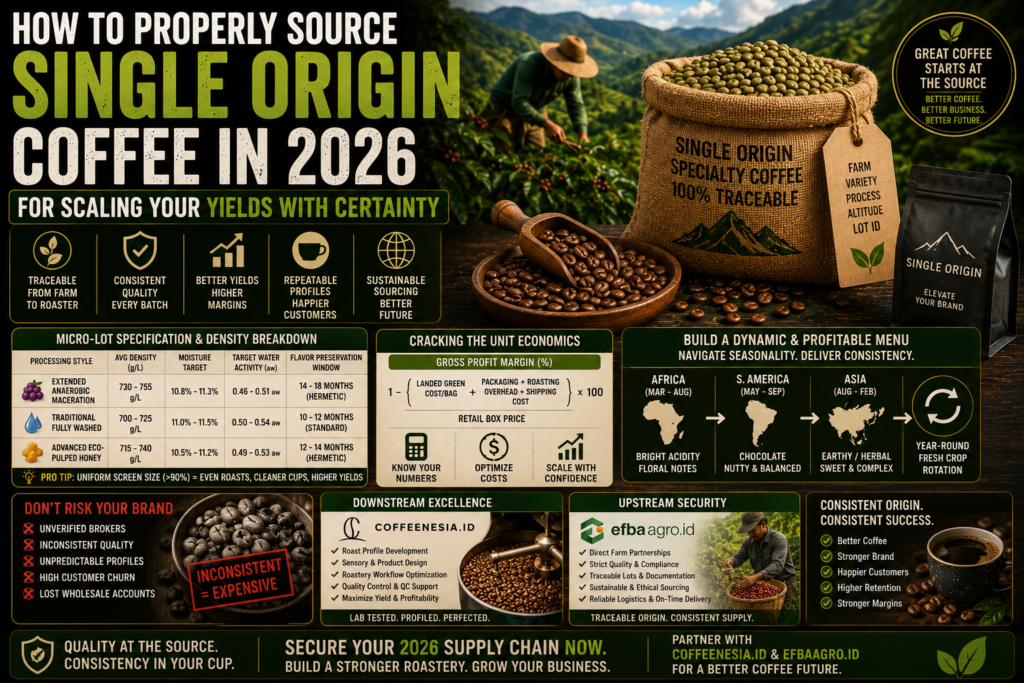
Welcome to the roasting front lines of 2026, my friends. We are currently navigating a fascinating yet brutal global landscape shaped by severe climate shifts that are actively rewriting historical harvest calendars across South America, East Africa, and Southeast Asia. For independent roasteries and e-commerce brand founders, keeping a consistent, premium lineup on the shelves has become an intense daily balancing act.
Let’s be completely honest about the hidden headaches of chasing unverified, blended “regional” lots from sketchy brokers who pass off commodity stock as premium single-farm micro-lots. When you buy those mystery bags just to patch up an inventory gap, you usually inherit an operational nightmare. You end up with an unpredictable batch filled with uneven moisture levels that completely ruins your morning, crashes your roast curves, and leads to flat, lifeless flavor profiles.
If you are running a recurring model or supplying boutique cafes, that lack of uniformity translates directly into sky-high subscriber churn and lost wholesale accounts. Securing high-uniformity, meticulously trace-mapped single origin coffee is the ultimate shortcut to keeping your sanity, honoring your craft, and keeping your customer retention metrics safely in the green. We are all in this together, and we know that building a sustainable brand requires moving away from the spot-market guessing game.
Investing in verified, transparently traded single origin coffee allows your production team to establish highly repeatable workflows. It shifts your daily routine from stressful fire fighting at the control panel to precise, data-driven optimization. Let’s break down the exact physical parameters, unit economics, and origin logistics required to master this segment in 2026.
Terroir, Density, and the Analytics of Flavor Separation
When we charge a roasting drum with high-end micro-lots, we are relying on precise physical metrics to execute our profiles successfully. We look incredibly closely at screen size distributions, bean density markers measured in grams per liter (g/L), and green moisture levels. Our team always aims to keep our green stock tightly bounded within a sweet spot of 10.5% to 11.5% moisture content.
However, the real silent killer of specialty flavor preservation is inconsistent water activity, or aw. When you source poorly handled green lots, wonky water activity causes rapid flavor fading, forcing your head roaster to constantly rewrite profiles on Cropster or Artisan just to chase a vanishing sensory target. High water activity acts as a destructive catalyst, degrading organic acids and delicate lipids within the bean structure long before the coffee even reaches your facility.
To combat this volatility, elite producers are utilizing advanced food-safe dehydration tech and hermetic seal controls immediately after processing. This engineering precision locks in a uniform density that absorbs conductive and convective heat evenly inside your drum. Let’s look at how distinct processing styles alter the underlying physical metrics of your raw materials.
Micro-Lot Specification & Density Breakdown
| Processing Style | Avg Density (g/L) | Moisture Target | Target Water Activity (aw) | Flavor Preservation Window |
| Extended Anaerobic Maceration | 730 – 755 g/L | 10.8% – 11.3% | 0.46 – 0.51 aw | 14 – 18 Months (Hermetic) |
| Traditional Fully Washed | 700 – 725 g/L | 11.0% – 11.5% | 0.50 – 0.54 aw | 10 – 12 Months (Standard) |
| Advanced Eco-Pulped Honey | 715 – 740 g/L | 10.5% – 11.2% | 0.49 – 0.53 aw | 12 – 14 Months (Hermetic) |
Pro Tip from the Cupping Lab: A uniform screen size distribution above 90% compliance means your heat penetration remains perfectly synchronized across the entire batch. If your green stock contains hidden sorting variances, your light roasts will suffer from a mix of scorched exteriors and grassy, underdeveloped cores.
Choosing uniform single origin coffee ensures your Rate of Rise (ROR) behaves predictably from the turnaround point straight through to the development phase. It gives your roasting team the freedom to highlight delicate floral notes, crisp malic acidities, and complex fruit sugars without constantly fighting sudden thermal crashes. It transforms a volatile specialty product into a highly reliable, scalable industrial ingredient.

Cracking the Unit Economics of Micro-Lots Single Origin Coffee and Subscriptions
Let’s talk pure financial logic because running a beautiful brand requires clear-headed discipline, especially with tight operating margins in today’s crowded market. Sourcing high-end micro-lots requires a higher upfront capital investment per kilo, which can easily tank your cash flow if your conversion rates lag. If your green inventory sits in the warehouse for too long due to over-ordering, your margins are eaten up by storage costs and flavor degradation.
To protect your business from sudden capital crunches, your finance team must calculate the true gross profit margin per unit across your recurring sales channels. We utilize a straightforward, clean formula to keep our subscription forecasting perfectly accurate and completely transparent. You can paste this plain-text calculation directly into your internal company tracking documents without messing up your layouts:
Gross Profit Margin (%) = [ 1 – ( (Landed Green Cost per bag + Packaging Cost + Roasting Overhead + Shipping Cost) ÷ Retail Box Price ) ] × 100
Let’s say your’re interested with Arabica Gayo Coffee and you want to secure predictable, clean lot volumes through structured origin agreements. It will allows you to optimize the landed green cost element of this equation. By establishing reliable volume projections, you completely eliminate the expensive cycle of emergency spot buying at peak market pricing. This financial predictability keeps your working capital healthy, allowing you to fund customer acquisition strategies and scale your brand with complete confidence.
Curation Strategy: Navigating Seasonality and Diversified Menus
Curating a dynamic, rotating menu is the ultimate secret to keeping your subscription base engaged and excited throughout the year. Modern consumers in 2026 want to explore diverse flavor profiles, meaning your sourcing strategy must shift seamlessly across global harvest windows without interrupting your shipping schedules. We highly recommend mapping out your menu rotation 6 to 9 months in advance to ensure continuous access to fresh-crop arrivals.
To maximize your market reach, your menu should cleanly balance wild, fruit-forward anaerobic processing styles with clean, classic washed estate profiles. This structural diversity satisfies both the adventurous connoisseur chasing complex lactic acidities and the traditional consumer who wants a comforting, sweet morning cup. Keeping a clean line of traceable offerings ensures your brand remains highly versatile, culturally relevant, and structurally protected against localized crop failures.
Refining the Profile: How Coffeenesia Perfects Your Downstream Execution

Our downstream production, blend formulation, and execution lab team at coffeenesia.id operates as your direct partner on the manufacturing floor. We help you design repeatable roast curves to handle complex profiles, optimize automated packaging workflows, and provide the technical parameters needed to turn delicate green lots into customer favorites. We specialize in helping brands navigate the daily grind of roasting thermodynamics, transforming high-yield single origin coffee into an unforgettable consumer asset.
By collaborating with our team, you gain access to experienced product developers who understand how to translate green physical data into repeatable roasting manuals. We analyze your drum dynamics, evaluate your post-roast weight loss, and help you structure highly profitable offerings that keep your subscription lines running efficiently. Let us handle the complexities of downstream product design so your team can focus entirely on expanding your online presence and driving subscriber growth.
Securing the Terroir: How Efba Agro Enforces Traceability at Origin

On the opposite side of our operational ecosystem, our agribusiness and logistics masters at efbaagro.id take complete command of your upstream supply security. They manage our extensive farm-level networks, supervise zero-emission solar drying infrastructure, and run strict compliance audits across all our origin channels. This direct control ensures that every lot complies with global frameworks, completely shielding your business from customs border delays and unexpected inventory shortfalls.
Furthermore, because our partners at efbaagro.id maintain deep, asset-backed logistics pipelines, we can easily integrate hyper-traceable direct-trade components into your commercial supply chain. From coordinating container space in congested ports to providing fully audited farm-level data, they handle the heavy operational lifting at the origin level. This powerful upstream infrastructure gives your brand an unmatched competitive advantage, delivering a premium pipeline of green coffee directly to your facility while maximizing your commercial margins.
Securing Your Roastery’s Foundations
As we look toward the future of the global specialty trade, the brands that thrive are those that prioritize raw material stability over short-term price chasing. Trying to build a reputable subscription model or wholesale program on inconsistent, unverified spot lots is a gamble that will eventually destroy your customer lifetime value. Sourcing physically stable, trace-mapped single origin coffee is the only way to protect your craft, secure your cash flow, and build a scalable business asset that honors your hard work.
We are right here with you, ready to help you streamline your sourcing pipeline and unlock maximum efficiency inside your roasting facility. Let’s move past the stress of erratic lot variations and build a beautiful, data-driven framework for your business. The future of your brand relies on the strength of your raw material foundation.
Are you ready to eliminate production guesswork and protect your long-term operating margins? Reach out to our team today for a casual, deep-dive Supply Chain Stability & Roastery Yield Audit with the experts here at Coffeenesia, and let’s secure your inventory for the year ahead.
FAQ: Practical Questions from the Roastery Floor
What is the safest way to evaluate and source the best single origin coffee allocations?
The safest way to source the best single origin coffee allocations is to partner with origin-integrated suppliers who provide comprehensive physical data sheets for every available lot. Request pre-shipment samples (PSS) that include certified metrics for moisture content, screen size distribution, density, and water activity (aw) alongside detailed harvest tracking. A transparent digital platform should allow you to evaluate these metrics and track sensory cupping scores before committing to a commercial volume.
How should roasteries handle inventory transitions when launching a seasonal single origin coffee subscription?
When launching a recurring single origin coffee subscription, you must plan your inventory transitions using a strict 30-day overlap window to prevent unexpected supply gaps. Coordinate directly with your origin exporter to ensure fresh-crop arrivals clear customs before your current-crop allocations drop below safety stock levels. Utilizing vacuum-sealed or hermetic packaging for your green inventory allows you to maintain total flavor profile consistency during these transitional rotation phases.
Why does high-altitude organic single origin coffee require a different initial heat application during the drying phase of a roast?
High-altitude organic single origin coffee typically possesses an exceptionally dense cellular structure due to slow cherry maturation rates under shaded canopies. This dense matrix requires a higher initial charge temperature and robust convective heat application to efficiently penetrate the bean core during the drying phase. Because organic lots lack chemical processing residues, their natural moisture structure releases energy uniformly, allowing you to maintain an aggressive ROR without risking surface scorching or tipping.