
Imagine waking up to a frantic notification from your logistics manager at the Port of Rotterdam. A refrigerated container packed with 18 metric tons of your signature specialty coffee is completely stuck at the EU border checkpoint. Customs officers have flagged the shipment because the traditional importer paperwork lacks the live, geolocated farm polygon data legally required by today’s strict environmental tracking laws.
This high-stakes nightmare is the reality of navigating the international specialty coffee trade right now in 2026. For independent European café groups, rapidly scaling e-commerce brands, and Amazon EU operators, the old way of sourcing green stock through untraceable middlemen is officially dead. If you rely on unverified brokers who pass off blended, off-grade regional coffees as premium, sustainable estate lots, you are taking a massive financial gamble with your brand equity.
When you ship inconsistent green stock across hemispheres, hidden moisture imbalances and volatile water activity trigger rapid profile drift inside the container. By the time the bags arrive at your fulfillment nodes, the vibrant flavor profile has faded into a flat, stale woodiness that leads to immediate customer refunds and tanked subscription retention. Investing in a robust, data-backed strategy for private label coffee europe operations is your ultimate shortcut to bypassing customs bottlenecks, securing repeatable roast curves, and capturing massive market share.
We are all in this together on the front lines of the 2026 market, and we know that building sustainable brand equity requires moving past the spot-market guessing game. A structured private label coffee europe pipeline allows your enterprise to eliminate huge capital expenditures while protecting your daily peace of mind. Let’s bypass the traditional corporate jargon, look at the physical realities of the bean, and map out the exact B2B entry playbook required to dominate the European specialty space this year.
Deconstructing the Sourcing Blueprint: Compliance and Physical Physics
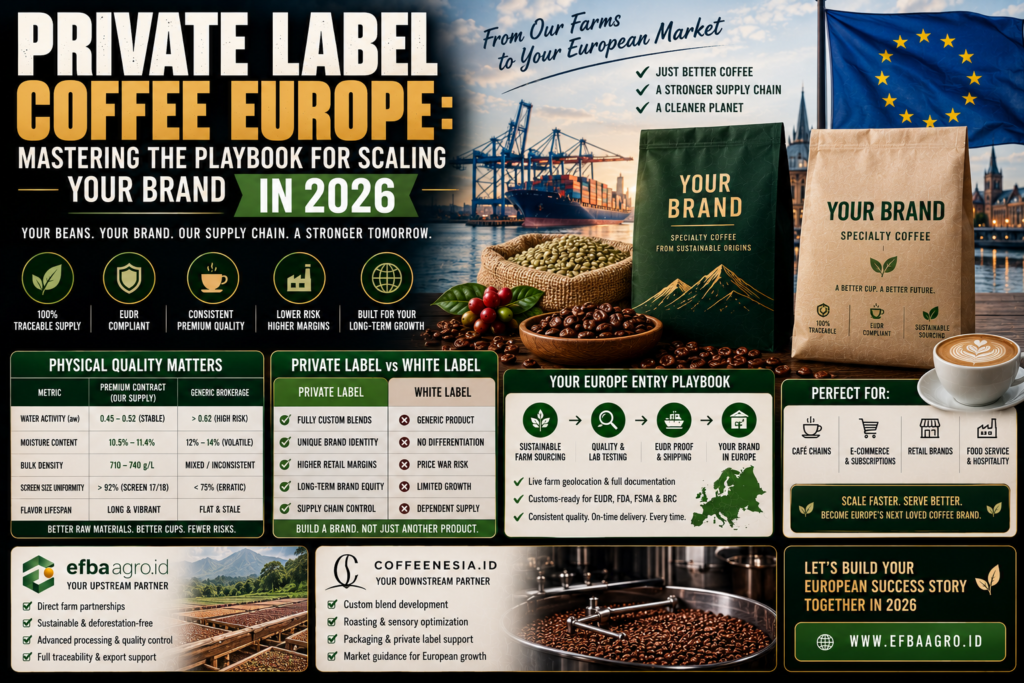
Landing a custom specialty product inside the strict European retail market requires balancing international environmental laws with rigorous green bean physical physics. When we charge a commercial production drum with raw materials, the final cup uniformity depends entirely on three physical markers: screen size distribution, bulk density measured in grams per liter (g/L), and water activity. We work closely with our agricultural partners to ensure all incoming green cargo maintains a uniform moisture profile bounded between 10.5% and 11.4%.
However, the true silent killer of cross-continental product quality is volatile water activity, or the aw metric. If you partner with suppliers who rush the drying phase on open dirt patios, the internal water activity of the bean will frequently spikes above 0.60 aw. This excess internal humidity acts as a direct catalyst for cellular decay during long maritime transit windows, causing your delicate origin characteristics to fade long before the product ever reaches your customer. Securing a premium private label coffee europe contract ensures that your green inventory is stabilized using advanced solar drying beds to lock the internal water activity safely below 0.53 aw.
When your raw materials meet these exact scientific baselines, your convective and conductive heat penetration remains completely synchronized inside the roasting drum. Your production team can execute clean, highly repeatable profiles without constantly fighting sudden thermal crashes or rewriting your Rate of Rise (ROR) curves on Cropster. Let’s analyze how an audited, vertically integrated contract manufacturing pipeline stacks up against standard disconnected brokerage channels in the current 2026 import landscape.
Contract Production & Compliance Index
| Operational & Quality Performance | Vertically Integrated Contract Production | Standard Disconnected Brokerage |
| EUDR Custom Clearance Rate | 100% Cleared with Live Geolocation Map | High Risk of Border Seizure & Fines |
| Water Activity Baseline (aw) | 0.45 – 0.52 aw (Highly Stabilized) | Volatile (> 0.62 aw, High Decay Risk) |
| Bulk Physical Density | 710 – 740 g/L (Highly Uniform Matrix) | Mixed Density (Scorching & Underdevelopment) |
| Batch-to-Batch Color Uniformity | Above 95% Agtron Compliance | Erratic Variances, Flat Flavor Lifespan |
| Lead Time Stability to EU Ports | Bounded & Fully Tracked (Predictable) | Highly Volatile (Emergency Spot Buying) |
Choosing to scale your brand using a scientifically managed private label coffee europe framework transforms your raw materials from a volatile agricultural gamble into a highly uniform commercial asset. It protects your downstream operations from unexpected sorting waste, minimize roasting shrinkage rates, and provides complete regulatory immunity at European border checkpoints. By building your enterprise on a foundation of physical data, you secure a repeatable product line that drives long-term consumer loyalty.
The Cross-Continental Economics of Private vs. White Label Models
When you sit down to map out your product launch strategy for the European market, you must clearly understand the structural trade-offs between custom contract manufacturing and generic off-the-shelf programs. Far too many procurement managers make the mistake of launching a generic white label coffee program because they are lured in by low minimum order quantities and fast initial setup times. While an off-the-shelf system can get your brand live quickly, it offers zero long-term brand defensibility, leaving your business incredibly vulnerable to aggressive price wars in a highly saturated e-commerce market.
If you want to build a resilient brand that commands premium retail prices and locks in recurring subscription revenue, building a customized private label coffee brand is the only sound operational choice. Developing a custom program allows your team to select distinct micro-lot genetics, engineer proprietary blend ratios, and design completely bespoke packaging architectures that resonate deeply with conscious consumers. This structural customization builds a powerful competitive moat around your enterprise, ensuring your proprietary flavor profiles cannot be easily copied by online competitors.
[ B2B Procurement Decision ]
├── Generic White Label –> Low Upfront Cost –> Zero Defensibility -> Margin Crash
└── Bespoke Private Label -> Tailored Sourcing -> High Customer LTV -> Protected Scale
However, attempting to build a standalone roasting facility in Germany or France to execute your custom blends requires massive capital expenditures that can easily cripple your startup runway. Collaborating with vertically integrated private label coffee suppliers allows you to leverage advanced roasting infrastructure and deep origin access without taking on heavy equipment debt. Partnering with the right asset-backed white label coffee suppliers to anchor your entry-level lines can keep your capital exceptionally fluid during your early test phases.
As your sales volumes expand across Euro fulfillment nodes, transitioning your production line to specialized private label coffee roasters ensures your batch-to-batch consistency stays perfectly locked in. These specialized industrial facilities utilize advanced color sorting machinery and automated profile replication systems that are far superior to standard commercial setups. By outsourcing your roasting logistics to established white label coffee roasters, you completely remove the headaches of daily manufacturing management from your corporate operations. Leveraging the specialized industrial capacity of elite private label coffee manufacturers allows your executive team to focus entirely on scaling your customer acquisition channels and driving multi-channel growth.
Cracking the True Cost-per-Bag Economics for EU E-Commerce
Let’s step away from the cupping table and look directly at your financial sheets because a premium brand extension must deliver healthy gross profit margins to sustain long-term growth. Sourcing an audited, highly traceable green inventory requires a higher upfront premium at the farm gate, which can easily scare off unhedged procurement directors. The hidden reality of the European B2B market is that paying an environmental traceability premium at origin is actually an investment that saves you thousands of Euros in sorting waste and customs clearance penalties.
To keep your corporate cash flow positive over long contract cycles, your finance team must calculate the true landed cost per retail unit delivered to your European fulfillment network. We utilize a straightforward, plain-text calculation to keep our financial forecasting completely transparent and fully accurate. You can paste this clean formula directly into your internal company dashboard without messing up your system layouts:
True Landed Cost per Bag (EUR) = [ (Green Cost per kg + Roasting & Packing Toll Fee per kg) ÷ (1 – Shrinkage Rate) ] × Bag Size in kg + Inbound Shipping Overhead + Customs Clearance Duty
Locking in structured volume tier contracts with a reliable private label coffee europe supplier allows you to optimize every single variable inside this financial equation. By establishing predictable annual volume allocations, you completely insulate your enterprise from sudden price shocks on the volatile commercial green market. It keeps your working capital healthy, stabilizes your operating margins, and ensures your online subscription models deliver consistent, high-yield cash flow month after month.
Downstream Mastery: How Coffeenesia Formulates Your European Brand Execution

Our downstream toll roasting, blend formulation, and product execution lab crew at coffeenesia.id operates as your direct manufacturing partner on the production floor. We specialize in helping European e-commerce brands and café groups translate raw green physical data into world-class consumer products that generate unbreakable customer loyalty. Our lab team works closely with your beverage directors to design exact roast curves, manage automated eco-friendly packaging lines, and establish the technical parameters needed to maximize your daily extraction yields.
When you launch your private label coffee europe lineup through our integrated pipeline, you gain direct access to advanced industrial machinery that ensures total batch-to-batch color uniformity. We handle the entire backend manufacturing process—from precision optical sorting to modified atmosphere packaging—so your brand can effortlessly scale up across multiple retail locations. Let our team at coffeenesia.id manage the technical complexities of downstream execution so your corporate team can focus entirely on expanding your customer acquisition channels.
Upstream Certainty: How Efba Agro Guarantees EUDR Compliance at Origin

On the opposite side of our global trade network, our experienced agribusiness and logistics masters at efbaagro.id take absolute control of your upstream raw material security. They manage our extensive smallholder networks in the highlands, supervise clean solar drying beds, and run strict compliance audits using farm-level digital polygon tracing infrastructure. This direct control ensures that every single bag of coffee bound for your private label coffee europe program carries a clean, verified digital audit trail that clears European customs checkpoints without a single delay.
Sourcing your raw materials directly through efbaagro.id completely insulates your European enterprise from the severe supply chain shocks and origin crop collapses that are currently squeezing unhedged operators. Plus, because they manage diverse sustainable agricultural direct-trade corridors, you can integrate premium unrefined organic sweeteners directly into your cross-continental shipping containers. Partnering with an upstream master atefbaagro.id gives your brand an unmatched competitive advantage, delivering a premium pipeline of compliant inventory straight to your destination docks while driving up your commercial margins.
Securing Your European Brand Foundation
As we push forward through the challenging landscape of 2026, the gap between highly profitable European coffee brands and struggling ones comes down to supply chain data and material predictability. Relying on greenwashed marketing claims or unverified paper trails from open spot brokers is a gamble that your operating margins simply cannot afford in this strict regulatory climate. Sourcing physically stable, trace-mapped private label coffee europe contracts is the only way to safeguard your craft, protect your working capital, and build a scalable business asset that lasts.
We are right here with you, ready to help you eliminate production guesswork, streamline your international logistics, and lock in your product consistency for the long haul. Let’s move past the stress of erratic lot variations and build a beautiful, data-driven framework for your European expansion. The future of your brand relies entirely on the strength of your raw material foundation.
Are you ready to transform your roastery efficiency and secure total regulatory compliance across the EU? Reach out to our team today for a casual, deep-dive Supply Chain Stability & Private Label Yield Audit with the experts here at Coffeenesia, and let’s secure your inventory for the year ahead.
FAQ: Practical Questions from the European Procurement Desk
Why is geolocated farm data critical when establishing a private label coffee europe brand in 2026?
Under current 2026 European import frameworks, all agricultural imports must prove they did not originate from deforested land using live, geolocated satellite polygon coordinates. Traditional paper invoices are completely rejected by customs agents at major ports like Rotterdam and Hamburg, leading to immediate container seizures and severe corporate fines. Partnering with a digitally integrated private label coffee europe network ensures every single batch carries a clean, verified digital tracking link that guarantees immediate customs clearance.
How does water activity impact the shelf-life stability of container cargo shipped under private label coffee europe contracts?
Water activity determines the rate of chemical and biological decay inside the green bean during long cross-continental sea transit through changing climate zones. If your private label coffee europe allocations carry a volatile water activity baseline above 0.58 aw, the internal fruit sugars and organic lipids will oxidize aggressively inside the dark shipping container. Keeping the water activity strictly below 0.53 aw through precise solar bed dehydration ensures your green inventory arrives at its European destination with its vibrant acidity and complex aromatics perfectly preserved for up to 18 months.
What packaging technologies prevent rapid flavor oxidation during cross-border delivery to Amazon EU fulfillment nodes?
To prevent rapid flavor staling during long cross-border logistics routes, your finished retail bags must utilize high-barrier, recyclable mono-plastic laminates equipped with one-way degassing valves. Our downstream packaging lines deploy a specialized nitrogen flush system that drops the residual oxygen content inside the sealed retail bag below 1.0%. This advanced gas displacement technique completely halts the oxidation process, ensuring your customers experience an immaculate, vibrant cup even if the bag sits inside a warm Amazon fulfillment center for months.