
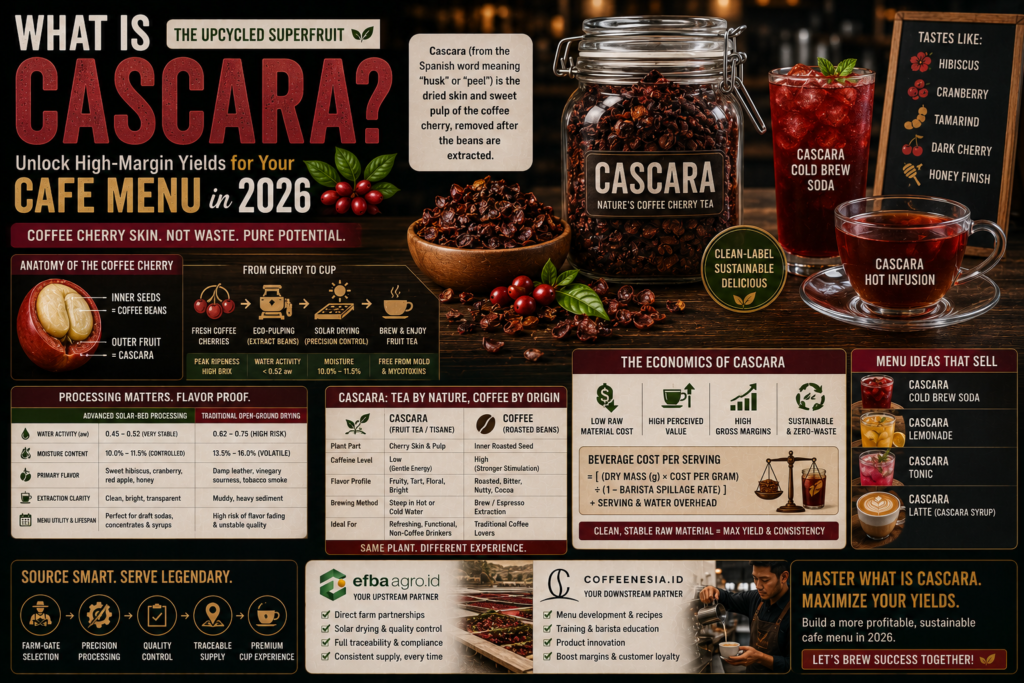
Imagine a busy Saturday morning rush inside your specialty cafe right now in 2026. A curious customer stands at the register, points directly at a beautiful glass jar of dried, mahogany-colored fruit skins on your retail shelf, and asks your team a simple question: what is cascara?
If your barista freezes up and gives a vague, uninspired answer like, “Uh, I think it’s some kind of tea made from coffee waste,” you have just missed a massive opportunity for an intentional guest connection. Even worse, you have completely left a high-margin beverage sale on the table. In today’s highly competitive food and beverage landscape, consumer education is the ultimate tool used by leading boutique brands to justify premium menu pricing and drive recurring retail interest.
When your floor staff cannot explain exactly what is cascara, it usually points to a deeper issue in your raw material sourcing line. Far too many roastery founders and procurement managers buy cheap, dust-heavy “waste hulls” from unverified spot brokers just to jump on the upcycled beverage trend quickly. These low-tier lots are frequently packed with inconsistent moisture levels and a volatile water activity baseline that triggers rapid microbial decay.
An unstable batch of fruit skins will quickly develop a sour, vinegary off-flavor that instantly ruins the guest experience, destroys your extraction efficiency, and kills your repeat sales. Truly mastering the underlying data behind what is cascara allows you to build absolute brand authority, streamline your barista training, and unlock a massive high-margin revenue stream. Let’s sit down over a solid brew, bypass the generic corporate manuals, and look directly at the processing physics, sensory attributes, and backend economics required to master this botanical asset this year.
Anatomy of the Cherry: Defining the Botanical Asset
To give your front-line baristas the confidence to educate your retail community, we need to look at the physical reality of coffee cherry anatomy. When a customer asks for a clear definition of what is cascara, the answer starts directly in the high-altitude orchard blocks during the peak harvest window. To put it simply, it is the dried skin and residual sweet pulp of the coffee cherry that is carefully preserved after the inner seeds—the coffee beans—are extracted during wet-mill processing.
If we look closely at the etymology of the word, it translates directly from the Spanish word for husk, skin, or peel. But on the modern specialty floor, we must understand that there is a massive structural difference when defining what is a cascara allocation versus traditional agricultural mulch. Low-grade hulls are violently ripped off by dry hulling machines months after harvesting, resulting in a dirty, brittle byproduct that is only fit to be used as farm fertilizer.
[Fresh Coffee Cherry]
├── Inner Seeds –> Traditional Coffee Beans
└── Outer Fruit –> Advanced Solar Dehydration –> Premium Clean Cascara
Premium specialty fruit skins are carefully removed during the eco-pulping phase while the cherry is fresh, sweet, and bursting with natural sugars. Our upstream production teams track the cherry Brix levels meticulously at the farm gate, ensuring we only process fruits that have reached peak maturity. To fully understand what is cascara from a quality control standpoint, you must understand that the wet fruit skins are immediately transferred onto raised solar drying beds.
This rapid transition prevents ambient humidity from triggering wild, uncontrolled open-air fermentation on the ground. The dehydration process is carefully managed to drop the internal moisture levels uniformly while locking the internal water activity safely below a stable 0.52 aw baseline. This precision engineering halts enzymatic breakdown, locks in the natural organic acids, and guarantees your raw materials arrive at your loading dock free of dangerous mycotoxins.
The Sensory Blueprint: Unlocking the Flavor Profile
The second most common question your team will face at the brew bar is a practical one: what does cascara taste like? Far too many consumers hear the word “coffee” and assume the infusion will carry heavy notes of dark cacao, roasted nuts, or bitter espresso oils. Your staff can easily shatter this myth by explaining that because it is a dried fruit skin, it brews into a brilliantly tart, complex botanical tisane that completely mimics the flavor attributes of premium herbal extracts.
When processed under pristine conditions, the natural malic and citric acids within the dried skin matrix deliver a beautiful sensory experience. You will experience an immediate wave of sweet hibiscus, dried cranberry, rich tamarind, and dark stone fruits like plums and black cherries, all rounded out by a lingering, honey-like finish. It provides a highly versatile flavor canvas that allows modern mixologists to design signature beverages that appeal directly to non-coffee drinkers.
However, if your supplier uses traditional, unverified open-ground patio drying, the delicate sugars within the pulp will oxidize aggressively and rot under the sun. This poor handling results in a muddy, highly unstable raw material that carries a heavy aftertaste of damp leather and vinegary sourness. Let’s look at the exact processing parameters that separate premium solar-bed processing from low-grade commodity options.
Dehydration Style & Flavor Clarity Index
| Quality Metrics | Advanced Solar-Bed Processing | Traditional Open-Ground Patio Drying |
| Water Activity (aw) | 0.45 – 0.52 aw (Highly Stable) | 0.62 – 0.75 aw (High Microbial Risk) |
| Moisture Content | 10.0% – 11.5% (Strictly Bounded) | 13.5% – 16.0% (Volatile Internal Decay) |
| Primary Flavor Notes | Sweet hibiscus, cranberry, red apple, honey | Damp leather, vinegary sourness, tobacco smoke |
| Extraction Yield Clarity | Exceptionally Clean & Transparent | Muddy, Heavy Sediment, Unpredictable |
| Menu Utility & Lifespan | Perfect for Draft Sodas & Concentrates | High Risk of Warehouse Flavor Fading |
Understanding what is cascara in terms of flavor clarity completely changes how your development team approaches recipe formulation. Sourcing raw materials that meet these pristine processing metrics means your extraction curves remain perfectly uniform from one bag to the next. Your head barista won’t have to alter steep times constantly to mask processing defects, allowing your team to serve a clean, memorable guest experience every single time.
Clearing the Confusion: Tea vs. Coffee Classifications
Because this ingredient sits at the intersection of two distinct beverage worlds, it often creates a confusing nomenclature overlap for retail consumers. To build absolute clarity at the register, your team must be trained to answer: what is cascara coffee versus traditional tea classifications? The simplest way to demystify this for your community is to explain that while the ingredient originates from the coffee plant (Coffea arabica), it is chemically and structurally prepared as a fruit tea or tisane.
It does not contain the heavy, insoluble oils or intense chlorogenic acid compounds found inside the roasted seed, meaning it will never mimic the mouthfeel of a traditional brew. Instead, it behaves exactly like a high-end loose-leaf botanical, requiring a controlled hot or cold water steeping environment to release its water-soluble fruit sugars. When your guests ask what is cascara tea, your baristas can confidently define it as a naturally sweet, antioxidant-rich fruit infusion that represents the ultimate intersection of coffee origin and tea aesthetics.
From a physical chemistry standpoint, the caffeine content is significantly lower than a standard cup of filter coffee or a shot of espresso. It delivers a smooth, gentle energy lift driven by high concentrations of natural polyphenols, making it an incredible afternoon menu recommendation for health-conscious guests. Clearly defining these technical attributes to your retail audience removes purchasing friction, builds consumer confidence, and allows your brand to command a premium menu position effortlessly.
The Economics of Botanical Extractions
Let’s step away from the barista counter and look directly at your financial statements because a sustainable menu addition must perform beautifully on paper to justify its place in your inventory. When you evaluate the unit economics of a premium upcycled beverage line, the numbers are incredibly attractive compared to running a traditional espresso program. Because the raw material is an upcycled agricultural asset, your cost per gram is remarkably low, while its unique, exotic narrative allows you to command a highly profitable retail price point.
However, if your production team is forced to sort through dust-heavy bags or fight uneven particle sizes from a low-grade spot lot, your real-world yields will crash. To maintain absolute financial control across multiple cafe locations, you must track your exact beverage cost per serving after accounting for barista spillage and waste factors. We rely on a clean, bolded plain-text formula to keep our operational forecasting perfectly accurate across our entire distribution pipeline:
Beverage Cost per Serving = [ (Dry Mass in Grams × Cost per Gram) ÷ (1 – Barista Spillage Rate) ] + Serving & Water Overhead
Sourcing technically stable raw materials ensures your extraction efficiency stays entirely predictable month after month, keeping your “Barista Spillage Rate” tightly controlled. Every single kilo of clean inventory translates directly into high-margin liquid revenue, allowing you to create profitable concentrates, signature syrups, or chilled draft sodas with total accuracy. It is the ultimate way to maximize your facility’s profit margins while providing a truly sustainable, zero-waste option that honors your brand’s environmental values.
Refining the Brew: How Coffeenesia Formulates Your Customer Education

This is precisely where our downstream production, product development, and execution lab crew at coffeenesia.id steps in to scale your brand’s operations. We don’t just ship raw ingredients to your loading dock; we act as your direct partner on the manufacturing floor to help your team master what is cascara in real-world retail applications. Our lab team works directly with your beverage directors to develop custom extraction profiles, formulate repeatable syrup blueprints, and design fast-paced barista training workflows.
By collaborating with our team at coffeenesia.id, you gain access to experienced sensory developers who know how to scale recipes from a single testing cup to high-volume commercial batches without losing flavor clarity. We provide the technical parameters, custom extraction manuals, and educational assets needed to transform raw botanical imports into consumer favorites that drive up your average ticket sizes. Let us manage the backend complexities of downstream product development so your retail team can focus entirely on delivering world-class hospitality.
Sourcing the Husk: How Efba Agro Enforces Clean Upstream Dehydration

On the opposite side of our agricultural network, our experienced agribusiness and logistics masters at efbaagro.id take complete command of your upstream supply security. They manage our extensive smallholder networks in the highlands, supervise clean solar drying infrastructure, and run strict compliance audits long before the export containers are sealed at the port. Managing the agricultural infrastructure directly at the farm gate ensures that your brand has access to an uninterrupted flow of pristine raw materials that are completely shielded from quality drops.
Plus, because our partners at efbaagro.id specialize in sustainable, direct-trade agricultural corridors, you can source premium unrefined organic sweeteners alongside your specialty botanical allocations. This fully traceable supply chain gives your company a massive competitive advantage, allowing you to prove your commitment to the circular economy while maximizing your commercial margins. Aligning your procurement line with a secure upstream master at efbaagro.id means you can stop playing guessing games with open spot-market listings and build a highly profitable, resilient beverage program.
Capitalizing on Educational Menu Design
As we move forward through 2026, the food and beverage brands that achieve long-term success are those that know how to turn verified agricultural upcycling into clean, memorable consumer experiences. Relying on unverified, dusty spot lots from unvetted brokers is a gamble that will eventually cost you your best customers and ruin your flavor consistency. Truly understanding what is cascara and partnering with an origin-integrated team allows you to build a scalable, highly profitable asset that elevates your entire brand reputation.
We are right here with you, ready to help you optimize your menu yields, streamline your barista education, and protect your long-term operating margins. Let’s move past the stress of erratic lot variations and build a beautiful, data-driven framework for your business. The future of sustainable beverage innovation relies entirely on the quality of your raw material foundation.
Are you ready to eliminate production guesswork and unlock incredible liquid margins on your beverage floor? Reach out to our team today for a casual, deep-dive Cascara Menu Integration & Sourcing Audit with the experts here at Coffeenesia, and let’s craft something legendary together.
FAQ: Barista Crash Course Masterclass
When customers ask what is cascara, what is the most effective 30-second explanation a barista can use during a busy morning rush?
The most effective way to explain what is cascara to a busy customer is to define it as a naturally sweet, antioxidant-rich fruit tea made from the upcycled skins of specialty coffee cherries. Explain that when the fresh coffee cherry is harvested, the outer fruit is carefully separated from the inner bean and dried on raised solar beds, exactly like premium loose-leaf tisanes. Emphasize that it brews into a brilliantly refreshing drink filled with notes of sweet hibiscus, dried cranberry, and honey, rather than tasting like traditional roasted coffee.
How does the caffeine content of a hot brew compare to traditional espresso-based menu options?
The caffeine content of a standard cup is remarkably gentle, yielding roughly 25% of the caffeine concentration found in a traditional cup of filter coffee or a standard espresso shot. This lower concentration makes it an exceptional menu recommendation for afternoon customers who want a complex, vibrant beverage experience without experiencing late-night jitters or a heavy energy crash. It allows your cafe to capture a massive market segment of health-conscious consumers who avoid intense stimulants late in the day.
What are the optimal water quality and temperature parameters required to maximize extraction yields without pulling out bitter tannins?
To achieve maximum extraction clarity, your baristas should use purified water with a total dissolved solids (TDS) baseline between 120 and 150 ppm, heated to an exact temperature of 93°C. Steeping the dried fruit skins at this thermal sweet spot for exactly 6 minutes allows the highly soluble stone-fruit sugars and malic acids to release uniformly into the liquid. Avoid using boiling water or extending the brew time past 7 minutes, as excessive thermal exposure will begin to pull out astringent, woody tannins that dry out the palate.