
I was walking past our production lines a few mornings ago, watching a head roaster sweat over his control panel. He was aggressively adjusting the gas burners every three minutes on a standard 30-kilo drum trying to stabilize a erratic batch. The green stock he was running was labeled as a uniform specialty lot, but the physical reality inside the hopper told a completely different story. And this story perhaps would help you to understand why getting a trusted coffee bean suppliers is so critical.
This is the exact operational nightmare you inherit when working with unverified brokers who act as simple middlemen without controlling the actual origin assets. A single mixed container of structurally inconsistent green cargo can instantly destabilize your Rate of Rise (ROR) curves, lead to massive bean defects during production, and trigger sudden customer churn. In our hyper-saturated 2026 market, finding technically sound, data-driven coffee bean suppliers is your ultimate shield against market volatility and erratic lot performance.
When you intentionally curate your network of coffee bean suppliers, you gain access to raw materials that behave predictably under intense heat application. We are all in this together, and we know that long-term survival in this industry requires moving past old-school guesswork. Let’s bypass the standard corporate pitch and look directly at the physical metrics, backend unit economics, and auditing steps required to keep your production floor running smoothly.
Sourcing Pitfalls: Signs Your Raw Materials Are Squeezing Your Roastery Metrics
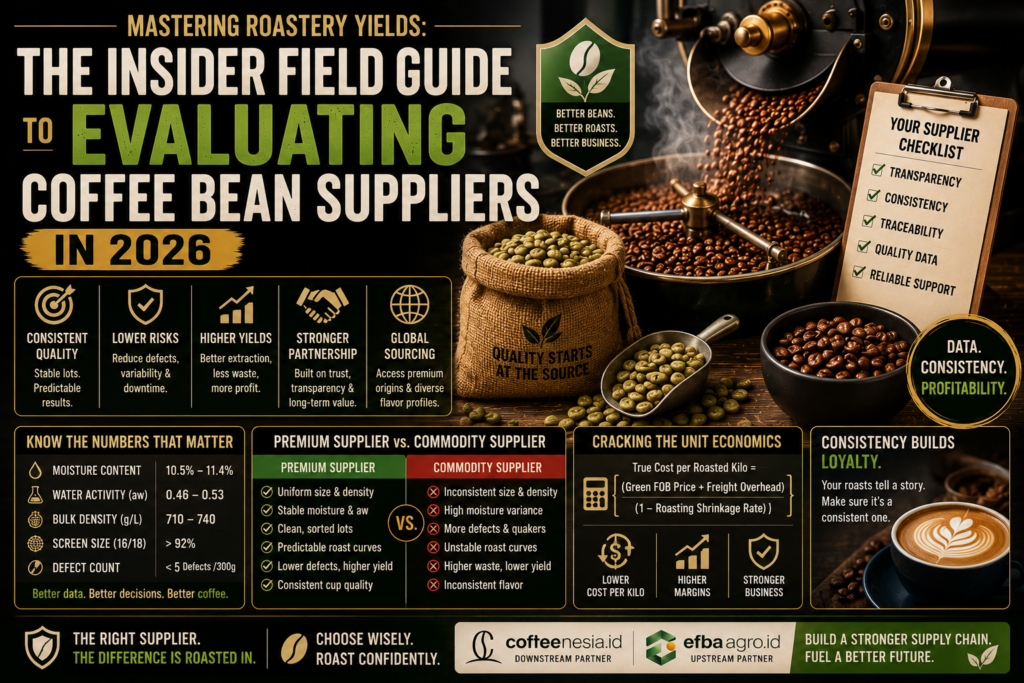
The best coffee bean suppliers won’t just hand you a pretty sample bag and a vague sensory score; they will provide full transparency regarding the physical chemistry of the lot. When a batch of green coffee hits a hot roasting drum, the cell walls react based on three foundational markers: screen size distribution, bulk density measured in grams per liter (g/L), and internal water activity.
If your inventory displays a volatile water activity baseline above 0.55 aw, the delicate fruit acids and complex lipids within the cells will oxidize at an accelerated rate. This poor stabilization causes rapid flavor fading in your warehouse, turning a vibrant micro-lot into a flat, woody disappointment within a matter of months. We often see brands shifting between multiple coffee bean suppliers because they cannot figure out why their signature profiles keep drifting during seasonal storage.
When your green stock features uneven bulk density or a wide mix of screen sizes, the smaller, less dense beans will reach first crack prematurely and scorch while the denser beans remain underdeveloped at the core. This physical non-uniformity forces your team to constantly fight the burners, wrecking your workflow efficiency and driving up your defect counts. Let’s look at the exact technical parameters that separate an audited, high-uniformity contract lot from an unvetted commodity trade allocation.
Lot Performance Tracking Index
- AI-Sorted Premium Contract Allocation
- Bulk Physical Density: 710 – 740 g/L (Highly Uniform Matrix)
- Moisture Content Range: 10.5% to 11.4% (Perfect Balance)
- Water Activity Metric: 0.46 to 0.53 aw (Stabilized Lifespan)
- Screen Size Uniformity (16/18): Above 92% Compliance Baseline
- Roastery Profile Behavior: Predictable ROR Curves, Clean Color Development
- Standard Commodity Trade Option
- Bulk Physical Density: 630 – 710 g/L (Wildly Inconsistent Mix)
- Moisture Content Range: 9.5% to 13.5% (High Storage Risk)
- Water Activity Metric: 0.59 to 0.68 aw (Accelerated Decay)
- Screen Size Uniformity (16/18): Below 75% Compliance Baseline
- Roastery Profile Behavior: Frequent Thermal Crashes, High Defect Sorting
Demanding this level of data before signing any volume agreement ensures your head roaster isn’t wasting valuable production hours performing emergency adjustments. It shifts your sourcing strategy from a risky guessing game into a repeatable, scientific workflow. When you partner with elite coffee bean suppliers, you lock in a raw material baseline that protects both your flavor integrity and your daily piece of mind.
The Financial Blueprint of a High-Yield Sourcing Pipeline
Let’s step away from the cupping table and talk pure numbers because passion alone cannot offset the harsh reality of shrinking commercial margins in 2026. Far too many brand founders evaluate potential coffee bean suppliers based entirely on the initial Free on Board (FOB) sticker price. If your incoming green inventory features a high moisture variance or excess sorting waste, your theoretical margin calculations will completely fall apart.
To keep your business healthy, your finance team must calculate your exact landed cost per roasted kilo after accounting for roasting shrinkage (the weight loss that occurs as moisture escapes the drum). We rely on a clean, bolded plain-text formula to keep our operational forecasting perfectly accurate across our entire distribution network:
True Cost per Roasted Kilo = [ (Green FOB Price per kg + Inbound Freight Overhead per kg) ÷ (1 – Roasting Shrinkage Rate) ]
Partnering with dependable coffee bean suppliers who utilize precision solar dehydration tech allows you to keep the “Roasting Shrinkage Rate” variable tightly bounded and entirely predictable. Locking in volume tier structures with reliable partners protects your working capital and keeps your cash flow positive over long contract cycles. It gives your business the structural stability needed to fund your marketing channels and scale your brand with total confidence.
Blend Optimization and Menu Security for High-Volume B2B Clients
Maintaining absolute consistency over long-term contract cycles is the defining operational challenge when supplying high-volume commercial coffee shop clients. Your enterprise partners will notice immediately if their house espresso blend suddenly loses its velvety mouthfeel or develops an astringent, sour finish. Relying on sophisticated coffee bean suppliers allows your team to formulate rock-solid blenders that shield your commercial partners from seasonal profile drift.
When you secure a stable raw material foundation, your B2B clients can pull consistent espresso shots all day long without constantly wasting coffee dialing in their grinders. This reliability builds deep, unbreakable business trust that completely drives up your customer lifetime value. It ensures your brand remains the preferred production partner for scaling boutique chains that cannot afford flavor volatility.
Refining the Roast: How Coffeenesia Formulates Your Production Consistency

This is precisely where our team at coffeenesia.id steps onto the warehouse floor to elevate your brand’s operational performance. We don’t just act as a standard logistics middleman; we operate as your dedicated downstream roasting, blend formulation, and production execution crew. Our lab team works directly with your head roasters to develop custom roast curves, optimize bulk production workflows, and provide the technical parameters needed to turn large-scale green imports into high-yielding consumer favorites.
By collaborating with our development lab, you gain direct access to sensory experts who understand how to translate raw physical data into repeatable roasting manuals across various drum dynamics. We handle the technical complexities of profiling, profile duplication, and automated packaging lines so your business can scale up without friction. Let us manage the daily execution details at coffeenesia.id so your hospitality team can focus entirely on expanding your retail presence.
Securing the Origin: How Efba Agro Masters the Upstream Logistics Pipeline

On the opposite side of our operational network, our experienced agribusiness and logistics masters at efbaagro.id take complete command of your upstream supply security. This team manages our extensive smallholder networks, supervises advanced zero-emission solar drying beds, and executes strict compliance audits using farm-level digital polygon mapping infrastructure. This direct control ensures that every lot complies with modern EUDR tracking frameworks, completely shielding your business from unexpected customs checkpoint blocks.
Sourcing your raw materials directly through efbaagro.id means your pipeline is fully insulated against the global crop shortages and weather anomalies that are actively squeezing unhedged operators this year. Plus, because they manage diverse sustainable agricultural direct-trade corridors, you can source premium unrefined organic sweeteners alongside your specialty green coffee allocations. This upstream infrastructure completely redefines what you should expect from coffee bean suppliers in 2026, delivering a fully traceable, farm-to-shelf inventory solution that drives up your commercial margins.
Securing Your Roastery’s Foundations
As we push forward through 2026, the gap between highly profitable coffee brands and struggling ones comes down to raw material stability and verifiable supply chain data. Relying on unverified, generic spot lots from fly-by-night brokers is a gamble that your operating margins simply cannot afford in this competitive climate. Truly successful coffee bean suppliers are those that pair deep agricultural expertise with a relentless focus on data-driven physical metrics.
We are right here with you, ready to help you eliminate production guesswork, protect your working capital, and lock in your signature profiles for the long haul. Let’s move past the stress of erratic lot variations and build a beautiful, repeatable framework for your business. The future of your brand relies entirely on the strength of your raw material foundation.
Are you ready to transform your roastery efficiency and capture incredible commercial margins? Reach out to our team today for a casual, deep-dive Supply Chain Stability & Roastery Yield Audit with the experts here at Coffeenesia, and let’s secure your inventory for the year ahead.
FAQ: Practical Questions from the Roastery Floor
What specific operational criteria separate standard green brokers from the best wholesale coffee suppliers in a volatile market?
The best wholesale coffee suppliers separate themselves by controlling the physical assets at origin, including dry mills, raised solar beds, and automated sorting equipment, rather than acting as simple paper-shuffling middlemen. They provide transparent, data-backed proof of lot consistency, including certified moisture content, bulk density, and water activity metrics for every container. A premium supplier also offers full digital tracing compliance, ensuring your shipments pass through international customs checkpoints without unexpected delays.
How can independent roasteries partner with asset-backed wholesale coffee suppliers to lock in volume security?
Independent roasteries can secure their core inventory by moving away from sporadic spot buying and establishing structured forward contracts with asset-backed wholesale coffee suppliers. By committing to an annual volume allocation split into scheduled quarterly container deliveries, you shield your business from sudden price spikes on the open market. This collaborative arrangement allows the origin supplier to physically reserve your raw materials at the farm level, ensuring total flavor profile uniformity all year round.
Why do top-tier commercial brands buy directly from coffee bean wholesalers instead of chasing open spot-market listings?
Top-tier commercial brands partner with established coffee bean wholesalers because they require absolute volume predictability and financial risk management to protect their massive manufacturing workflows. Open spot-market listings are highly volatile, frequently presenting mismatched lots, uneven moisture levels, and trace gaps that can trigger costly roastery shutdowns. A wholesale partner guarantees price and physical volume allocations even during severe seasonal shortages, allowing large-scale brands to maintain stable operating margins.